

























































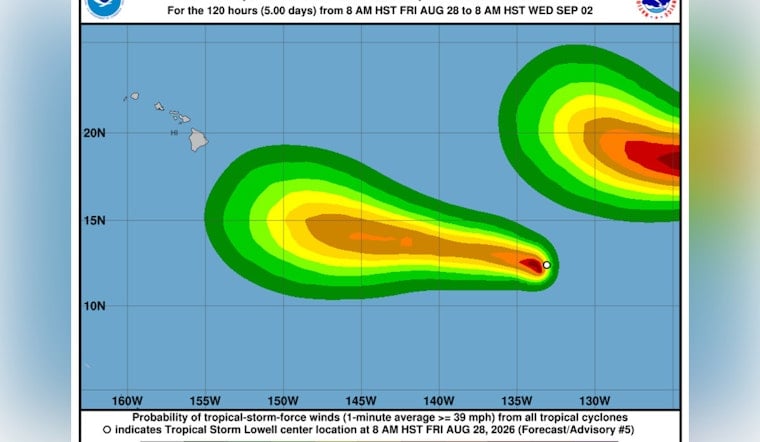
Tropical Storm Lowell formed in the East Pacific last Thursday and is forecast to strengthen into a hurricane within days, putting Hawaiʻi back on alert less than two weeks after Hurricane Lala flooded roads, knocked out power to hundreds of thousands, and isolated the rural Kaʻū District on Hawaiʻi Island. As of early Friday, Lowell had maximum sustained winds of 45 mph and was located roughly 1,560 miles east-southeast of Hilo, moving north-northwest at just 5 mph.
Forecasters expect Lowell to turn toward the west Saturday and continue on that path into next week, according to the Honolulu Star-Advertiser. The National Hurricane Center's latest advisory pegged Lowell's minimum central pressure at 1003 mb, with tropical-storm-force winds extending up to 80 miles from its center, according to the National Hurricane Center, which is headquartered in Miami. Forecasters said steady strengthening is expected over the next several days, and the storm could reach hurricane strength over the weekend before growing into a Category 2 system by next Wednesday with winds near 110 mph. By that point, Lowell is projected to sit about 600 miles southeast of Hilo, and current models suggest it could cross into the Central Pacific as a hurricane by Monday.
Some regional hurricane models suggest an even faster rate of intensification is possible, per forecasters cited by the Star-Advertiser's report. Lowell is not traveling alone: Tropical Storm Karina also formed in the East Pacific last Thursday, is expected to become a hurricane in the coming days, and could grow into a major Category 3 storm far from land by Sunday night before weakening early next week as it moves away from land near Baja California.
Kaʻū's Only Road Still Washed Out
The timing is especially fraught for Hawaiʻi Island's Kaʻū District, which Hurricane Lala left severely isolated after landslides and washouts hit Hawaiʻi Belt Road, known as Route 11 — the area's sole primary transportation corridor, according to Governor Josh Green's office. Lala passed within 30 miles of South Point as a Category 1 hurricane on August 15, ultimately traveling more than a couple thousand miles across the Pacific and persisting as a tropical cyclone for about 15 days before continuing toward the western Pacific as a post-tropical system roughly 680 miles north of Kure Atoll.
Ground saturation across the islands remains extreme. University of Hawaiʻi researchers calculated that Lala dumped approximately 1.3 trillion gallons of water statewide between August 14 and 16, with the Laupahoehoe station on Hawaiʻi Island recording 32.1 inches of rain in a single day and Kaiholena logging a peak hourly rate of 4.4 inches, per UH News. That level of saturation means even the outer bands of a system like Lowell could trigger rapid flash flooding and mudslides in geographically isolated areas, a risk that lingers as recovery continues in places Hoodline has covered a Kaʻū farm's grant win and other lingering utility failures across Honolulu.
Federal and State Relief Still Rolling Out
President Trump approved a federal disaster declaration for Hawaiʻi on August 26, intended to help the state recover from Lala's destruction, with especially targeted assistance for the Kaʻū District. The U.S. Department of Agriculture opened emergency disaster assistance to Hawaiʻi's agricultural producers on August 25, including the Livestock Indemnity Program and Emergency Assistance for Livestock, Honeybees, and Farm-Raised Fish, according to the USDA Farm Service Agency, with claims remaining open through March 2027. Those claims matter because only about 3 percent of Hawaiʻi farmers carry federal crop insurance, since underwriting rules are built around mainland commodity crops rather than small, diversified island farms, according to Honolulu Civil Beat.
Hawaiʻi's Insurance Division has also been scrambling to keep pace with claims volume. Commissioner Scott K. Saiki invoked HRS § 431:9-201(b) on August 17 to let temporary, non-resident independent adjusters work in the state without a license for up to 120 days, and on August 26 issued Memorandum 2026-7A directing insurers to evaluate storm claims based on specific causation and loss timing rather than automatically applying high hurricane deductibles tied to storm watches or warnings, per the Hawaiʻi Department of Commerce and Consumer Affairs.
Honolulu Skies Stay Clear For Now
Despite the approaching systems, Honolulu itself is not bracing for immediate impacts. The National Weather Service said the city can expect mostly sunny or partly cloudy skies through Thursday, with scattered showers over the next few days, east winds of 15 to 20 mph through Monday, and high temperatures in the mid- to upper 80s. Hawaiʻi overall is expected to see warm but pleasant tradewind weather over the coming week.
Still, the back-to-back nature of this year's storms has strained recovery efforts that were already underway after Lala knocked out power to more than 220,000 customers statewide — including 113,000 on Oʻahu alone — and forced the closure of all state and county government offices and public schools on August 17, as Hoodline previously reported in its coverage of 911 outages during Lala. NOAA's Central Pacific Hurricane Center had projected a 70 percent probability of an above-normal season with 5 to 13 tropical cyclones this year, citing moderate-to-strong El Niño conditions that raise sea surface temperatures and reduce wind shear across the basin — a forecast that is now playing out as Lowell and Karina both churn simultaneously in the East Pacific.
September 11 will mark the 34th anniversary of Hurricane Iniki, the Category 4 storm that struck Kauaʻi in 1992 and remains the benchmark for hurricane destruction in the islands, according to the National Weather Service. With Lowell's exact path beyond next week still uncertain and Kaʻū residents still dependent on a damaged Route 11 for emergency medical access, officials and forecasters alike are watching closely to see whether this hyperactive season delivers another direct hit.



