

























































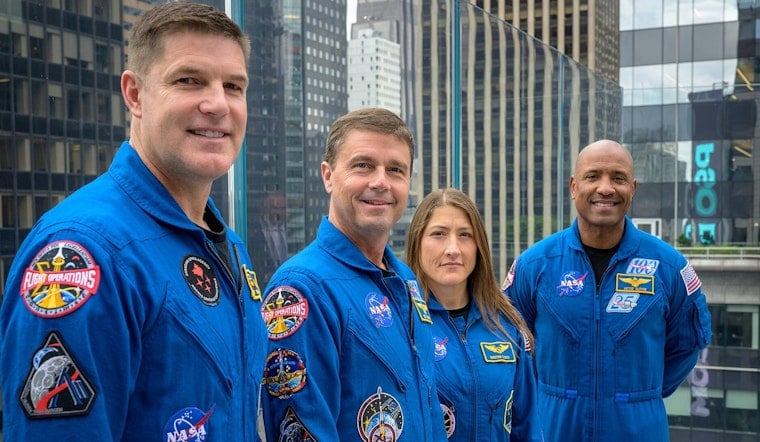
President Donald J. Trump will present the Congressional Space Medal of Honor to the four-member Artemis II crew during a ceremony at NASA's Johnson Space Center in Houston starting at 11 a.m. on Friday. The astronauts being recognized are mission commander Reid Wiseman, NASA astronaut Victor Glover, NASA astronaut Christina Koch, and Canadian Space Agency astronaut Jeremy Hansen, who together flew a 10-day test flight around the Moon that concluded in April.
The medal is one of the rarest honors in American spaceflight. Codified at 51 U.S.C. § 30901 under Public Law 91-76, it allows the president to award a medal in the name of Congress to any astronaut who distinguishes themselves through exceptionally meritorious contributions to the nation and mankind, according to the Office of the Law Revision Counsel. Before Friday's presentation, only 30 astronauts had ever received it, with 17 of those medals awarded posthumously to the crews lost in the Apollo 1, Challenger, and Columbia disasters, as reported by CBS News. The last astronauts to receive it were SpaceX Demo-2 astronauts Bob Behnken and Doug Hurley, honored in January 2023 for restoring crewed orbital launch capability to American soil, according to SpacePolicyOnline.com.
Trump will be joined at the ceremony by NASA Administrator Jared Isaacman, according to FOX 5 New York, which cited information provided by NASA. Isaacman was nominated by Trump in late 2025 and confirmed by the U.S. Senate as the agency's 15th administrator on December 17, 2025.
A Record-Setting Flight Around the Moon
Artemis II served as a test flight for NASA's Orion spacecraft, and the crew became the first humans to travel beyond the Moon in more than 50 years. The mission's astronauts traveled 695,081 miles, breaking the previous distance record set by the Apollo 13 astronauts in 1970, per the outlet's reporting.
Fox 5 New York's coverage draws on an original report from Fox 26 Houston, written by Terrian Spurs. Artemis II launched from Kennedy Space Center on April 1 and concluded on April 10 with a splashdown in the Pacific Ocean off San Diego, where the Orion capsule Integrity was recovered by the U.S. Navy amphibious transport dock USS John P. Murtha, according to FOX 35 Orlando. Hoodline previously covered the splashdown and heat shield analysis.
An International Crew, an American Medal
Hansen's presence on the crew has drawn some attention because he flew as a Canadian Space Agency mission specialist rather than a NASA astronaut. NASA's advisory for Friday's event specified awarding the medal to “each of NASA's Artemis II crew members,” a phrasing that Space.com notes has stirred public discussion over how the presentation format will handle an international coalition partner under U.S. law.
The ceremony will be available through NASA's live stream, and it will take place amid a broader visit by the president to Texas. Ahead of the official Johnson Space Center appearance, Trump is scheduled to visit Houston the evening of Thursday, August 27, to headline a private Republican National Committee fundraiser, according to the Houston Chronicle. That fundraising stop is separate from Friday's official medal presentation.
Artemis Roots and a Fiscal Crosscurrent
The Artemis program traces back to Trump's first term, when he signed Space Policy Directive 1 on December 11, 2017, directing NASA to refocus American space policy on returning humans to the Moon, according to NASA. That history makes Friday's medal ceremony something of a milestone moment for a policy the president initiated nearly a decade earlier.
The recognition also arrives amid budget debate. Administration funding requests for fiscal year 2027 included a proposed 23% overall reduction to NASA's budget and a 46% cut to space science spending, as reported by The Guardian. The tension between celebrating the Artemis II achievement and the proposed cuts to NASA science programs is unresolved as the ceremony approaches.
Johnson Space Center's role in national space policy has also been a subject of local lobbying. In April 2025, Texas lawmakers led by Senator Ted Cruz and Representative Brian Babin pushed Trump to relocate NASA Headquarters from Washington, D.C., to Johnson Space Center, citing the center's 12,000-person workforce and cost efficiencies, as Hoodline previously reported.





.jpg)