

























































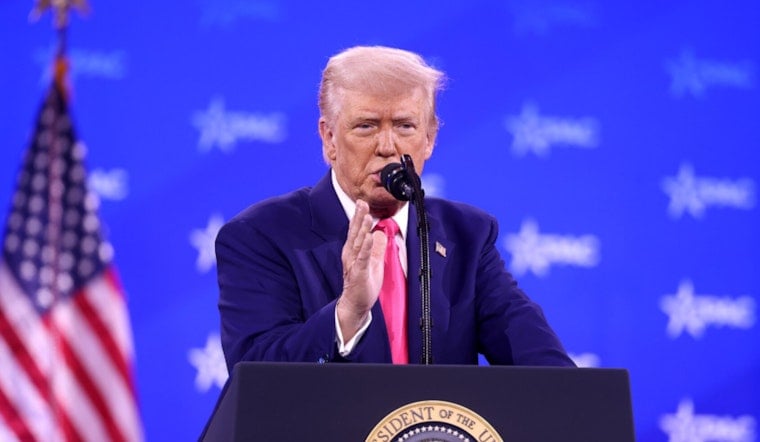
President Donald Trump announced this week that federal law enforcement has captured nine out of ten fugitives who were on the FBI's Ten Most Wanted list, calling the achievement a virtual record during a public address. The claim, made as of this week according to the president, was amplified by the FBI's Sacramento field office and comes amid a string of high-profile international arrests that have thinned out the bureau's most notorious roster in 2026.
The statement, shared by FBI Sacramento on X, credits the capture rate to broader federal law enforcement efforts. In the same address, Trump also cited an overall increase in federal criminal prosecutions alongside the fugitive captures, according to the dossier's account of the president's remarks shared via Facebook on Thursday.
A $1 Million Incentive Behind the Push
The nine-of-ten milestone follows a significant policy shift earlier this year. In March, the FBI quadrupled its standard reward for information leading to the arrest of Ten Most Wanted fugitives, raising it from $250,000 to as much as $1,000,000, according to the FBI. That increase itself built on an earlier hike, when the bureau raised its baseline reward from $100,000 to $250,000 back in May 2023.
The financial incentive has coincided with, and possibly helped drive, a run of major captures. In January, federal authorities apprehended former Canadian Olympic snowboarder Ryan James Wedding in Mexico, one of the most prominent names on the Ten Most Wanted list, where a $15 million reward had been offered for his capture, as reported by PBS News. Wedding had been accused of running a transnational drug trafficking enterprise tied to the Sinaloa Cartel and of ordering homicides against witnesses.
A Decades-Old Cold Case Closes in Honduras
Another arrest that fed into the current tally came in February, when international law enforcement captured Alexis Flores in Honduras after more than 25 years on the run. Flores had been wanted for the 2000 kidnapping and murder of 5-year-old Iriana DeJesus in Philadelphia, per CBS News. Flores had originally been added to the Ten Most Wanted list in 2007 but was removed during a routine criteria review in March 2025, before his eventual capture last February closed out one of the program's longest-running cold cases.
Not every capture takes decades. In March, Samuel Ramirez Jr. was apprehended in Culiacán, Mexico, just 1 hour and 13 minutes after being added to the Ten Most Wanted list, setting the record for the shortest duration any fugitive has spent on the roster. That stands in stark contrast to fugitives like Víctor Manuel Gerena, who remained listed for 32 years, according to background compiled by the dossier's sourcing.
How the List Actually Works
Despite its name, the Ten Most Wanted list is not a ranked countdown. The FBI does not order fugitives 1 through 10; instead, candidates are submitted by the bureau's 56 field offices based on criminal severity and whether national publicity would help lead to an arrest, according to WKMG. Final candidates are then vetted by the Criminal Investigative Division at FBI Headquarters before being added.
Fugitives can also come off the list without being caught. Beyond capture or death, the FBI removes names if charges are dropped or if an official review determines the individual no longer poses a particularly dangerous menace to society — a fate that has befallen roughly 11 to 15 people across the program's history under non-capture criteria.
A 76-Year-Old Program With a 93 Percent Track Record
The Ten Most Wanted program dates back to March 14, 1950, when FBI Director J. Edgar Hoover turned a late-1949 wire service interview about the bureau's toughest guys into a permanent public initiative, according to Encyclopaedia Britannica. The first person ever added to the list was bank robber Thomas J. Holden.
Since then, more than 538 fugitives have appeared on the list, with over 500 — roughly 93 percent — eventually apprehended or located, per FBI figures. More than 160 of those captures came as a direct result of citizen tips and public media cooperation, underscoring the role everyday viewers of wanted posters and news broadcasts have played over the decades.
That historical context matters for interpreting this week's announcement. While the current 9-of-10 capture rate is being framed as a virtual record, it largely tracks the program's long-term success rate, and the list itself is dynamic — when a fugitive is captured, FBI Headquarters and its field offices nominate a new candidate to fill the vacancy, meaning the current snapshot is not a permanent end point for the Most Wanted program.
Part of a Broader Pattern of Recent Captures
The current wave of arrests fits a pattern Hoodline has tracked over the past year and a half. In April, a Kansas City murder suspect landed on the list after vanishing, while January saw the extradition of fugitive Alejandro Rosales Castillo from Mexico to Charlotte to face murder charges. Earlier captures include Cindy Rodriguez Singh, arrested by Dallas FBI agents in August 2025, and Arnoldo Jimenez, captured in Monterrey in February 2025 after a decade-long manhunt.





.jpg)