

























































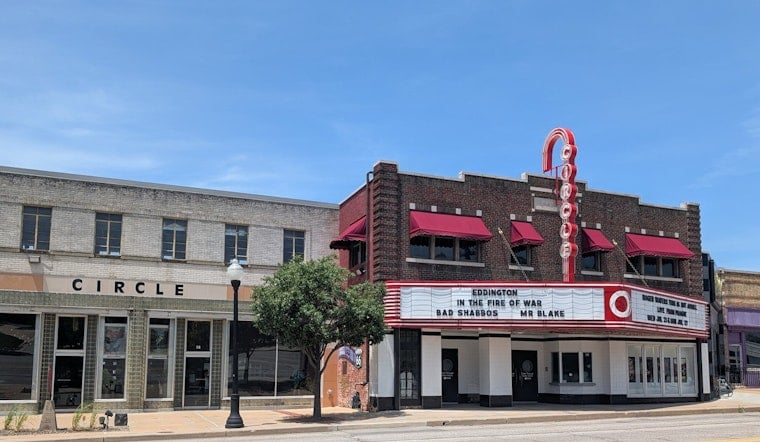
Woody Guthrie is remembered in Oklahoma as the Dust Bowl balladeer who wrote This Land Is Your Land, but a new documentary premiering in Tulsa on August 20 argues there's a whole other chapter to his story: the years he spent immersed in Jewish culture, family and song after moving to New York. Dust Bowls and Jewish Souls: Another Side of Woody Guthrie screens at 7 p.m. at Circle Cinema, preceded by a 6 p.m. reception featuring a live performance of Guthrie's music by Jesse Aycock.
The film traces Guthrie's path from Oklahoma to Los Angeles and eventually to New York City, where his life took an unexpected turn through marriage and family, according to The Journal Record. Guthrie married dancer Marjorie Greenblatt, his second wife, and through her he was drawn into the orbit of her mother, Aliza Greenblatt, an acclaimed Yiddish poet who introduced him to Jewish history, traditions and literature. The film includes archival footage, photographs, music and interviews with family, collaborators and historians, and it draws parallels between Americans fleeing the Dust Bowl and Jewish refugees seeking safety and belonging.
Guthrie and Marjorie lived at 3520 Mermaid Avenue in Brooklyn's Coney Island from 1943 to 1952, directly across from Aliza Greenblatt's home in Sea Gate, according to the Coney Island History Project. It was there that he wrote songs including Mermaid's Avenue and Hanuka Dance, penning original lyrics about Jewish life that touched on latkes, borscht and even the Holocaust. Friday evenings in that household centered on family gatherings, Yiddish poetry, music and storytelling, a rhythm that shaped much of the material the documentary now revisits.
A Chance Museum Visit Sparked the Project
Director Steven Pressman, a San Francisco-based former journalist known for the Emmy-nominated HBO documentary 50 Children: The Rescue Mission of Mr. and Mrs. Kraus and PBS's Holy Silence, said he felt obligated to tell the story of Guthrie's little-known Jewish life and music. Pressman first conceived the film four years before its 2026 release, after spotting a sheet of Guthrie's handwritten Hanukkah lyrics displayed beside his guitar at an exhibition in New York's Morgan Library and Museum, as reported by JNS. He said he had no idea Guthrie had written songs about Hanukkah until that moment, and the discovery set him on a four-year project tracing Guthrie's journey from Dust Bowl balladeer to coalition-building artist.
Folkways Records founder Moses Asch, the Jewish American son of Yiddish author Sholem Asch, first introduced Guthrie to New York's Jewish cultural milieu after the songwriter moved to the city in 1940, per the same JNS account. Decades later, Guthrie's daughter Nora Guthrie uncovered his unpublished Yiddish- and Hanukkah-themed lyrics in the Woody Guthrie Archives, work that eventually led the klezmer ensemble The Klezmatics to set the words to music on albums including Wonder Wheel and the 2006 release Woody Guthrie's Happy Joyous Hanukkah, the Coney Island History Project notes. The documentary's soundtrack blends Guthrie classics with klezmer and Yiddish folk music, reflecting that same rediscovery.
Brooklyn Childhood, Bar Mitzvah Included
Guthrie's children Arlo and Nora Guthrie recalled growing up in 1950s Brooklyn surrounded by Jewish immigrant culture, according to the article's account. One especially notable detail from that upbringing: Arlo Guthrie was tutored for his bar mitzvah by Meir Kahane, who was then serving as rabbi of the Howard Beach Jewish Center in Queens, JNS reports. Aliza Greenblatt herself had immigrated to the United States from Bessarabia in 1900, and her daughter Marjorie danced with the Martha Graham Dance Company in the 1930s before marrying Guthrie in 1945, according to JTA.
The film has already found an audience beyond Oklahoma. It made its world premiere on June 4, 2026, at the Toronto Jewish Film Festival, and in August it won the Audience Award for Best Documentary Feature at the 46th San Francisco Jewish Film Festival, which ran from July 16 to August 2, according to the Jewish Film Institute. The Tulsa stop is part of a broader festival run, brought locally through a collaboration between the Woody Guthrie Center, the Sherwin Miller Museum of Jewish Art, the Oklahoma Jewish Film Festival and Circle Cinema.
What to Expect at Circle Cinema
Pressman will attend the Tulsa premiere for a post-film discussion moderated by Cady Shaw, senior director of the Woody Guthrie Center. The evening opens with the 6 p.m. reception and Aycock's performance before the 7 p.m. screening at Circle Cinema, the Kendall Whittier district theater that Hoodline named a cultural landmark in Tulsa's 918 Day Passport challenge last year as the city's oldest operating movie theater and a nonprofit art house.
For Tulsa audiences already familiar with Guthrie through the Woody Guthrie Center and his induction into the Oklahoma Music Hall of Fame, the documentary offers a fuller picture of the man behind the guitar. It reframes a songwriter most closely tied to the Dust Bowl and to This Land Is Your Land as someone whose personal life and artistic development were shaped just as profoundly by Jewish culture, family and faith during his years on Mermaid Avenue.



