

























































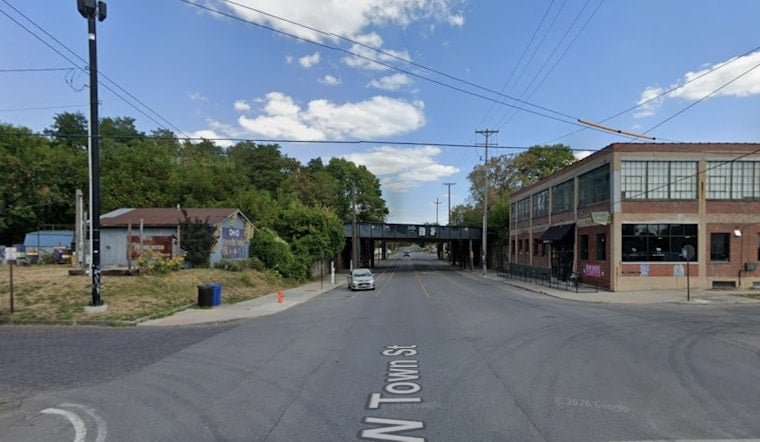
A two-car crash on the 400 block of West Town Street flipped one vehicle onto its roof Saturday morning near downtown Columbus, sending one person to the hospital in stable condition. The crash was reported around 11:39 a.m. in the East Franklinton area, just west of the Scioto River.
According to WSYX, first responders rushed the injured person to a local hospital after the two-vehicle collision left one car upside down. The outlet reported the person was in stable condition following the crash, though further details on the circumstances of the wreck were not immediately available.
A Corridor in the Middle of Rapid Change
West Town Street runs through East Franklinton, a historic district undergoing significant commercial and residential redevelopment as it sits amid ongoing infill growth just west of downtown Columbus, according to the City of Columbus Department of Public Service. The area functions as an urban arterial corridor, meaning it carries a steady mix of local and through traffic even as new development reshapes the neighborhood around it.
Rollovers involving two vehicles are less common than single-car, run-off-road wrecks, but they aren't mysterious in terms of physics. National Highway Traffic Safety Administration crash mechanics research has found that 51% of multi-vehicle rollover crashes happen when a collision with another vehicle acts as the tripping force that flips a car onto its roof or side, even at relatively modest urban speeds.
What Happens Next With the Investigation
Severe crashes resulting in overturned vehicles typically trigger a more formal review process. Hoodline has previously reported that the Columbus Division of Police relies on its specialized Accident Investigation Unit to conduct scene mapping, vehicle damage analysis, and traffic reconstruction for collisions involving serious injury or rollovers.
Ohio law also sets a firm paper trail in motion. Under Ohio Revised Code § 5502.11, investigating agencies must submit an official OH-1 written accident report to the Ohio Department of Public Safety within five days when a crash involves personal injury or property damage exceeding $1,000. That report typically becomes the foundational record used in insurance claims and any legal proceedings that follow, and it should detail factors like speed and right-of-way once filed.
Part of a Broader Pattern on Columbus Streets
Saturday's wreck is the latest in a string of severe crashes Hoodline has covered around Columbus in recent days. Just a two-car crash at the downtown gateway left four people hurt, one critically, and another rollover crash near John Glenn Airport trapped two occupants who needed extrication before being hospitalized. In December 2025, a collision on Columbus's West Side near Franklinton killed a civilian and injured a police officer.
Franklin County leads all Ohio counties in total urban traffic collisions, recording more than 30,000 crashes annually across its municipal roads and highways, per Ohio State Highway Patrol crash database records cited by O'Connor Acciani & Levy. Statewide, the Ohio State Highway Patrol has identified failure to yield the right of way, unsafe speed, driving left of center, and following too closely as the top contributing factors in multi-vehicle crashes.
City's Vision Zero Push Continues Amid Persistent Crash Volume
Columbus has been working to bring down severe crash outcomes through its Vision Zero initiative, which aims to eliminate all traffic fatalities and serious injuries citywide by 2035 by targeting a High Injury Network responsible for more than half of all severe crashes on just 7% of city streets, according to the City of Columbus. The city puts more than $5.3 million annually toward those engineering and enforcement investments.
The effort appears to be having some impact. Columbus recorded 48 traffic fatalities in 2025, down from 52 in 2024 and 73 in 2023, according to WOSU. Statewide, preliminary data released by the Ohio Governor's Office showed overall traffic fatalities dropped roughly 3% in 2025 compared to 2024, marking a fourth consecutive year of decline, though severe injury crashes like Saturday's continue to occur even as the fatality trend improves.





