

























































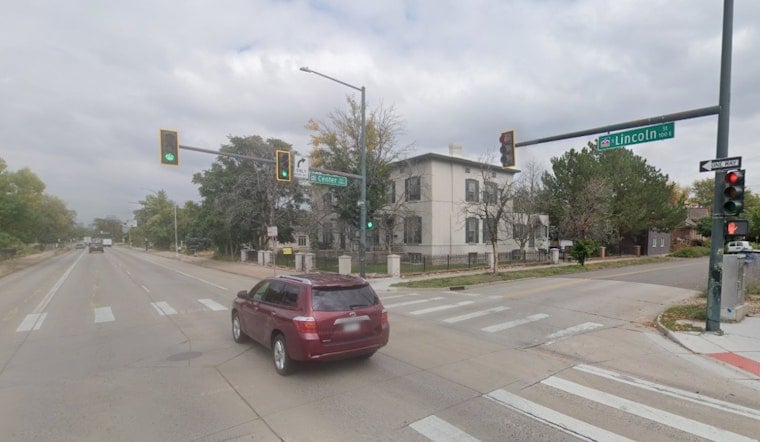
A two-vehicle crash on South Lincoln Street sent one person to the hospital with serious injuries early Friday, prompting road closures and a traffic diversion through Denver's Baker/Speer neighborhood. Denver police say the crash happened in the area of South Lincoln Street and East Center Avenue, and drivers were urged to expect delays and seek alternate routes.
According to a Crash Alert posted by the Denver Police Dept., officers are investigating a crash involving two motorists that resulted in serious bodily injury, with one person transported to a local hospital. The department noted that it does not issue a public alert for every crash — only when at least one person involved suffers serious injuries, or the collision forces a road closure. Anyone with information can reach Denver police at 720-913-2000, though the department is not staffed around the clock to respond to that line.
The crash site sits on a stretch of roadway with a troubled safety record. South Lincoln Street operates as a multi-lane, one-way northbound arterial through central Denver, forming a high-volume traffic couplet with southbound South Broadway, according to the City and County of Denver. The corridor is also part of the city's High Injury Network, the roughly 5% of Denver streets that account for more than half of all traffic fatalities and serious injuries citywide.
A Corridor Already Under Scrutiny
This is not the first serious crash to draw attention to the Lincoln Street corridor this month. Hoodline previously reported on a crash further north on the corridor that sent one person to the hospital, and the city has pointed to that same stretch when justifying safety upgrades. Targeted measures already in place along Lincoln Street, including photo speed enforcement and signal adjustments at 6th Avenue, cut overall crash rates at that intersection by 52%, the city says. That intersection sits north of Friday's crash site at East Center Avenue.
The Denver Department of Transportation and Infrastructure has scheduled corridor safety projects along Lincoln Street for this year, including curb extensions and protected bike lanes, citing the corridor's history of serious and fatal vehicle collisions as justification. Those projects are separate from the enforcement measures already credited with reducing crashes near 6th Avenue.
A Rising Toll on Denver Streets
Friday's crash adds to a grim tally for Denver roadways. The city recorded 93 traffic fatalities in 2025, its highest single-year death toll since at least 2013, according to Axios. As of August 20, the city's Vision Zero tracking dashboard had logged 43 traffic fatalities for 2026 so far, per city data. Statewide, Colorado traffic deaths reached 701 in 2025, a 2% increase over the prior year, with Denver County ranking among the top three counties statewide for both speed-related and impairment-related fatal crashes, according to the Colorado Department of Transportation.
What Happens Next in the Investigation
It remains unknown whether speed, right-of-way violations, or driver impairment played a role in Friday's crash — those specifics are expected to emerge only once Denver police complete a full investigation. Under Colorado law, drivers involved in any collision resulting in injury are required to immediately notify law enforcement and remain at or return to the scene, with violations treated as a Class 2 misdemeanor traffic offense.
If investigators ultimately determine that recklessness caused the serious injuries, the driver could face a vehicular assault charge, a Class 5 felony carrying one to three years in prison under Colorado Revised Statutes § 18-3-205. If impairment is found to be a factor, the charge escalates to a Class 4 felony carrying two to six years. Denver Police Department records guidelines state that official investigation reports for crashes involving serious bodily injury take five to seven days to complete once the investigation closes and must be ordered through the department's Civil Liability Section rather than pulled from self-reported online crash logs. Denver police say the public can track broader traffic crash data through the city's Open Data Catalog in the meantime.





