

























































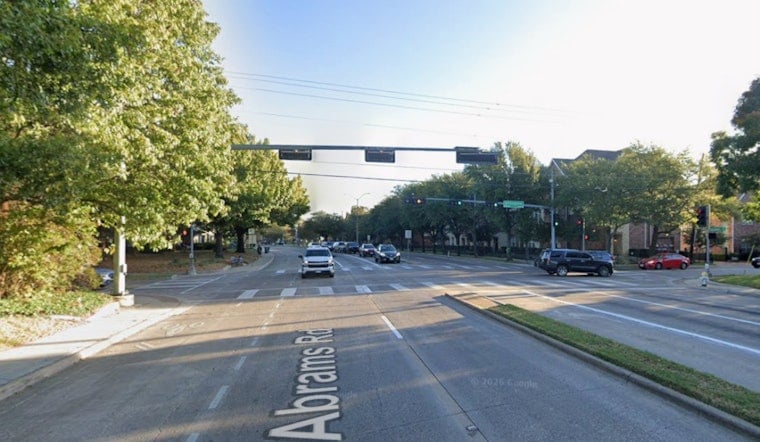
Two Dallas ISD students were injured last night when a driver struck them on Abrams Road and fled the scene without stopping to help. The crash left East Dallas residents renewing their calls for safer streets along a corridor that has become one of the city's most dangerous for pedestrians.
The hit-and-run was first reported by WFAA, which detailed how the two Dallas ISD students were hit while on Abrams Road before the driver took off. The outlet noted that the incident has once again galvanized East Dallas neighbors who say they've grown weary of watching cars speed through their neighborhood streets.
A Corridor With a Documented History of Danger
The stretch of Abrams Road where the students were hurt sits within a section of roadway that has drawn sustained scrutiny from city engineers and neighbors alike. An engineering study presented in June revealed that a single mile-long stretch of Abrams Road saw 149 vehicle crashes between 2021 and 2025, with drivers routinely blowing through curves at speeds in the 40s in zones posted for 30 to 35 miles per hour, according to the Lakewood/East Dallas Advocate. That kind of speeding, paired with the road's curves, has made it a persistent hot spot for the very kind of collision that just left two students hurt.
During a town hall in June on the Abrams Road Corridor Study, residents described physically stepping into traffic to shield children crossing the street, and they cited near-miss collisions involving school crossing guards, the same outlet reported. Those accounts echo years of complaints from neighbors who have said the corridor simply isn't safe for kids walking to and from school.
City and Federal Officials Have Already Moved on Fixes
City officials weren't unaware of the risk before this latest crash. The Dallas City Council authorized a $991,727 engineering contract with HDR Engineering, Inc. in January to conduct a Traffic Safety Study and design new traffic signals for the Abrams Road corridor as part of the city's Vision Zero initiative, according to the City of Dallas. That study is meant to evaluate signals and other safety measures aimed at curbing crashes along the road.
Separately, U.S. Representative Julie Johnson submitted a $4.8 million federal funding request in April for the City of Dallas to build comprehensive safety upgrades along 3.3 miles of Abrams Road between Richmond Avenue and Northwest Highway. Those proposed improvements, per Johnson's office, include signal modernization, ADA-compliant sidewalks, upgraded pedestrian crossings, and median enhancements. The push for funding followed more than 1,500 local residents signing a petition demanding heavier traffic enforcement after a December 2024 crash near an active school zone at Abrams Road and Royal Lane killed two men, according to the Lake Highlands Advocate.
Abrams Road's Repeated Toll on Vulnerable Road Users
Tuesday's crash is far from the first time a driver has fled after hitting someone on Abrams Road. In May, Dallas Police arrested a 37-year-old suspect following a hit-and-run in the 7400 block of Abrams Road that injured multiple victims and resulted in the death of an unborn child, as Hoodline previously reported. And in September 2024, a pedestrian using a wheelchair was struck and killed in a hit-and-run in the 5900 block of Abrams Road near Northwest Highway, prompting police to ask the public for help tracking down a fleeing white SUV, according to KTVU.
Under Texas Transportation Code § 550.021, failing to stop and render aid after a crash that causes personal injury is a felony punishable by up to five years in state prison, with penalties escalating to a third-degree felony carrying two to ten years if the crash causes serious bodily injury, per the Murphy & McKinney Law Firm. Despite those steep penalties, identifying drivers who flee remains a persistent challenge for investigators unless tips or surveillance footage surface, as has been the case in several recent Dallas-area hit-and-runs.
A Citywide Trend That Hasn't Reached Every Street
The Abrams Road pattern unfolds even as Dallas has made broader progress on traffic safety. Citywide traffic fatalities dropped by nearly half in 2025, falling to 107 fatal crashes compared to 208 the year before, while serious injuries dropped from 935 to 595, a decline largely attributed to targeted safety modifications on high-injury corridors under Vision Zero, according to the Dallas Observer. Still, arterial streets like Abrams Road remain dangerous for people on foot even as the citywide numbers improve.
That pattern isn't unique to Abrams Road. A 2026 regional traffic safety analysis found that roughly 60 percent of severe traffic crashes in the Dallas metroplex occur on just 7 percent of regional roads designated as the High Injury Network, according to Hamilton Wingo. Rapid population growth across North Texas has outpaced traffic-calming infrastructure on key arterial corridors, the analysis found, leaving stretches like Abrams Road disproportionately dangerous for the students, crossing guards, and neighbors who use them every day.





