

























































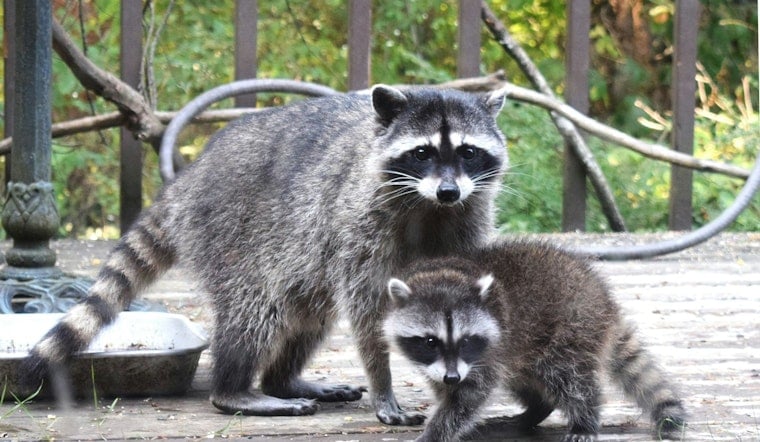
Two dead raccoons found on Long Island streets this week have tested positive for rabies, becoming the 38th and 39th confirmed terrestrial rabies cases in Suffolk County since February 7, 2025. One raccoon was found dead on a street in Bay Shore, while the other turned up on a street in Islip, before members of the Islip Animal Shelter picked up the animals and sent them to the health department for testing. Officials were notified of the positive results on Wednesday.
According to News 12 Long Island, the Suffolk County Department of Health Services does not believe there was any human exposure connected to either raccoon. Health officials are nonetheless urging residents not to touch, handle, or move wild animals, especially those behaving strangely, since rabies is a deadly disease that attacks the central nervous system and is commonly found in wild animals. Diagnostic testing for the Islip raccoons ran through the Wadsworth Center, the New York State Department of Health's public health laboratory in Albany, which processes wildlife samples submitted by local shelters, according to Patch.
A 16-Year Streak Broken, Then Shattered
The scale of what's unfolding in Suffolk County becomes clearer with a little history. Newsday notes that before February 7, 2025, the county had not recorded a single confirmed case of terrestrial rabies in land mammals since 2009 — a 16-year run that ended when the disease re-emerged after spreading eastward from neighboring Nassau County. Since that first case, the outbreak has expanded across western Suffolk towns including Amityville, Deer Park, Lindenhurst, Wyandanch, Islip, Babylon, Huntington, and Smithtown, racking up 39 confirmed cases in under 18 months.
The situation isn't unique to Suffolk. In Nassau County, public health officials declared rabies an “imminent public health threat” last year after recording 25 rabid animals within a 12-month span, per the same Newsday reporting. That surge in 2024 preceded the disease crossing the county line into western Suffolk in early 2025, setting the stage for the pattern now playing out street by street in towns like Islip and Bay Shore.
Raccoons vs. Bats: A Key Distinction
It's worth separating this outbreak from a different, older problem. Bat rabies has long been endemic to the region, with roughly 3% to 6% of bats submitted to state labs from Suffolk testing positive in a typical year, according to the Babylon Herald. Between 2016 and 2025, county officials logged nearly 30 rabid bat cases as routine background activity. Terrestrial raccoon rabies is different: it travels along the ground, moving raccoon to raccoon and yard to yard, which puts household pets and anyone spending time outdoors at far greater risk than the airborne-adjacent bat cases ever did.
That ground-level spread is exactly what worries officials about incidents like the one in Manorville two months ago, when a resident needed post-exposure rabies treatment after being scratched by an infected raccoon on their own property. Newsday reported that health officials suspected the incident was caused by someone illegally transporting a rabid animal from western Long Island — a violation of state health directives that risks pushing the outbreak line farther east into parts of Suffolk that have so far stayed clear.
What The County Is Doing About It
The Suffolk County Department of Health Services has partnered with the U.S. Department of Agriculture to distribute oral rabies vaccine bait pouches across western Suffolk towns, including Islip, Babylon, Huntington, and Smithtown, according to a report from News 12. The bait packets are placed in wooded and suburban areas in hopes of immunizing wild raccoon populations before the disease can spread further. The county and the Town of Islip have also periodically hosted free rabies vaccination clinics for resident dogs, cats, and ferrets at the Town of Islip Animal Shelter in Central Islip, easing the financial burden on pet owners during an active outbreak.
Those clinics matter because state law leaves little room for exceptions. Under New York State Public Health Law § 2141, all dogs, cats, and domesticated ferrets must receive an initial rabies vaccination by four months of age and a second shot within a year, according to FindLaw. Owners who don't comply can face fines of up to $200. With terrestrial rabies now confirmed in dozens of animals across the western half of the county, keeping pets current on their shots is one of the few barriers standing between the outbreak and household exposure.
How To Report A Sighting
Health officials are asking anyone who spots a raccoon or other wild animal acting strangely to call the Suffolk County Police Department's non-emergency line at 631-852-COPS or the New York State Department of Environmental Conservation at 631-444-0250. Anyone who is bitten or has direct contact with a wild animal should call Suffolk County health officials right away at 631-854-0333 for evaluation, since post-exposure treatment is critical — rabies is considered nearly always fatal once symptoms appear. With two more confirmed cases just added to the county's tally, officials are repeating the same message they've given all year: don't touch, don't handle, and don't move wildlife, no matter how harmless it looks.





