

























































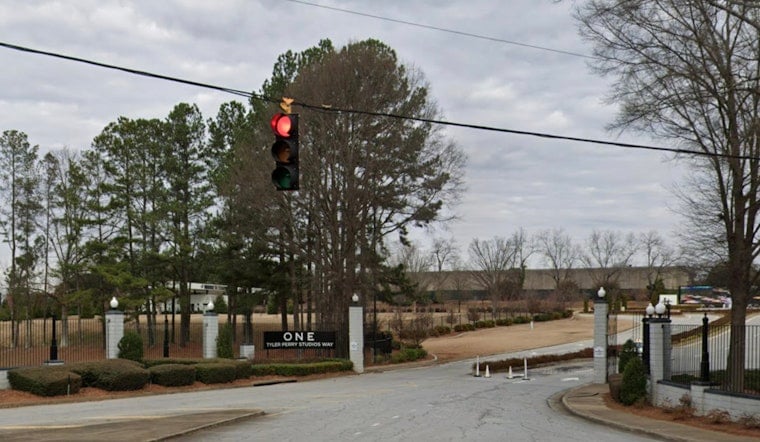
Tyler Perry Studios has launched a new specialty division called Maxscene, aimed at developing and producing projects from independent filmmakers and helping them find theatrical distribution and audiences. The division is already working with several unnamed filmmakers, and its first slate includes a coming-of-age story, a romantic comedy, and a thriller, with titles and casts to be announced in the coming months.
The news was first reported by AJC.com, which detailed how the studio, long focused for two decades on bringing Tyler Perry's own written and directed projects to life, is now extending its resources to outside creators. Maxscene is based at the studio's Atlanta campus and is led by Antoinetta Stallings, who serves as the studio's Head of Development and Acquisitions, managing content sourcing, script development, and executive production pipelines, according to the report.
Perry named the division after his late mother, Willie Maxine Perry, who died in 2009 at age 64. She worked as a preschool teacher in New Orleans and has long been cited by Perry as the inspiration for his career and for the Madea character, according to Essence.
Building on a Year of Filmmaker Development Programs
Maxscene follows a string of initiatives the studio has rolled out to cultivate filmmakers outside Perry's own catalog. The report notes the studio's Dream Collective 100 program included 10 aspiring filmmakers and provided support sessions and workshops as part of its latest filmmaking initiative. That effort built on the original Dream Collective, launched in March 2025, which awarded $30,000 short-film production grants to five emerging filmmakers and brought on former Academy of Motion Picture Arts and Sciences CEO Dawn Hudson and producer Nekisa Cooper as advisors, per Tyler Perry Entertainment.
Maxscene will provide support depending on each filmmaker's specific project needs and could acquire production projects outright, offering what the studio describes as a pathway for first-time filmmakers to bring their work through production and toward distribution. That focus on securing theatrical releases addresses a persistent bottleneck in the industry, where underrepresented filmmakers frequently struggle to land big-screen opportunities as major studios increasingly push indie work straight to streaming, as Complex reports.
A Studio Reshaping Its Own Footprint
Maxscene arrives at a moment when Tyler Perry Studios is rethinking how it uses its 330-acre Fort McPherson campus, the former U.S. Army base Perry bought for $30 million in 2015 before opening the $250 million studio there in October 2019 — a milestone that made him the first African American to outright own a major film studio, according to WSB-TV. The lot has already hosted outside ventures, including Studio of the Americas, the nation's first Native American-owned film and television studio, which joined the campus in a partnership announced last year alongside the Georgia Film Academy for Indigenous student internships.
Perry also indefinitely paused an $800 million, 12-soundstage expansion of the lot in February 2024 after viewing demonstrations of OpenAI's text-to-video generator Sora, citing concerns about AI's potential to displace film industry jobs, according to The Guardian. Filings later revealed plans for a $200 million-plus, 38-acre Tyler Perry Entertainment District adjacent to the campus, encompassing 1.3 million square feet of retail, offices, and public theaters, per the Development of Regional Impact filings reported by AJC.com. This summer, the studio also partnered with Synapse Virtual Production to build an LED-volume virtual production soundstage on the lot, a high-tech bet on Atlanta's future that is expected to open by the end of the year.
Georgia's Film Incentives Loom Large
Maxscene's projects will develop within an ecosystem heavily shaped by Georgia's film tax credit, which offers a 20% base credit plus an optional 10% promotional uplift. The credit generated more than $2 billion in direct production spending in fiscal year 2025 and supported over 34,000 state jobs, according to the Georgia Department of Audits and Accounts. State lawmakers have debated capping or tightening eligibility for the credit to boost local job returns, a factor that could shape how far Maxscene's ambitions can stretch as it works to place independent films in theaters.





