

























































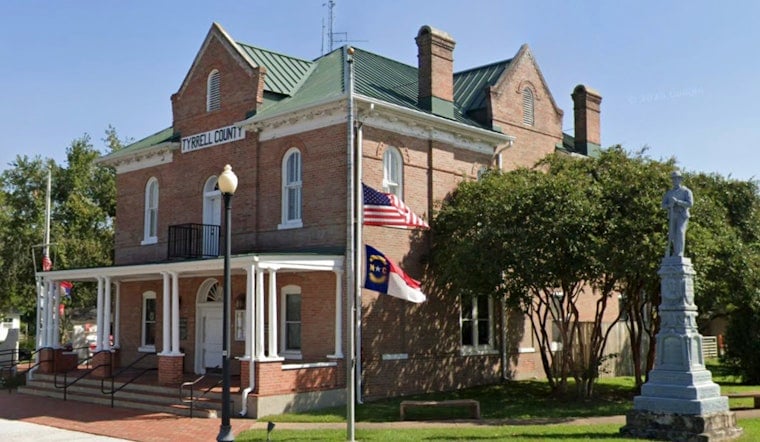
A metal plate now covers the words “In appreciation of our faithful slaves” on the Confederate monument outside the Tyrrell County courthouse, the final resolution to a federal lawsuit brought by four Black residents who spent years fighting to erase the 124-year-old inscription. The statue itself, a 23-foot memorial topped with a sculpted portrait of Robert E. Lee, still stands atop its 12-foot base in Columbia, North Carolina — but as of July 17, the phrase that inflamed the county for years is hidden from view.
The change came after Tyrrell County commissioners voted in May 2026 to cover the raised lettering rather than continue defending the language in court, according to the Raleigh News & Observer. Commissioner Rob Thompson cast the only vote in favor of removing the phrase outright, arguing that doing so would end the lawsuit and stop the county's mounting legal bill, and telling colleagues that “no child should have to be told what a faithful slave is,” per the News & Observer. His fellow commissioners rejected full removal but ultimately agreed to cover the text with a plate instead.
All parties filed a joint stipulation of dismissal with prejudice in August 2026, permanently closing the case with each side covering its own legal costs, according to Carolina Journal. A dismissal with prejudice means the plaintiffs cannot refile the same claims in the future, closing the legal chapter even as the underlying monument remains in place.
A Lawsuit Built Around One Phrase
The federal case, brought by Joyce Sykes Fitch, Mark Mixon, Sherryreed Robinson and Adriana Blakeman under the banner Concerned Citizens of Tyrrell County, deliberately targeted only the “faithful slaves” wording rather than demanding the entire monument's removal, the Albemarle Observer reported. That narrow framing was a legal workaround: North Carolina's 2015 monument law, enacted as Session Law 2015-170, blocks local governments from permanently removing or altering publicly owned objects of remembrance without approval from the North Carolina Historical Commission. State appellate courts in Alamance County in 2024 and Gaston County in 2026 both ruled that county commissions lack authority under that law to relocate courthouse Confederate monuments, according to Legal Newsline, closing off the state-court path and pushing the Tyrrell County plaintiffs toward a federal equal protection strategy instead.
That strategy worked, at least in part. U.S. District Judge James Dever III ruled in 2025 that the plaintiffs plausibly alleged the 1902 inscription reflected discriminatory intent and had a disparate impact on Black residents, allowing the equal protection claim to proceed under the federal Arlington Heights standard, per the Albemarle Observer. Dever rejected the county's request to dismiss the case in March 2025. Rivka Maizlish, a senior research analyst at the Southern Poverty Law Center, said the equal protection strategy was the first such case she had seen advance this far in court.
Sherryreed Robinson, one of the named plaintiffs, said the monument has no place on the courthouse grounds at all and plans to continue pushing for the entire statue's removal from the site. Robinson and her sister began campaigning to take down the memorial in 2020, after George Floyd's murder by Minneapolis police, per the News & Observer's reporting. Emancipate NC attorneys Jaelyn Miller and Ian Mance helped residents file the federal lawsuit, an effort similar to the group's other North Carolina civil rights work, including a Durham lawsuit against Meta the firm also backed.
Threats and a History Tied to Slavery
Organizing against the inscription reportedly came with a cost. Adriana Blakeman said a truck bearing the Tyrrell County emblem threatened her and ran her off the road, according to the lawsuit, and lawsuit organizers more broadly described threats and unequal treatment during the campaign. Concerned Citizens of Tyrrell County had organized petitions, marches, and highway billboards opposing the inscription before the case reached federal court.
The monument's history runs deeper than the text itself. The site where it stands once held a post used to restrain enslaved people while they were whipped, according to the lawsuit. About 3,000 people attended the monument's 1902 dedication in the town square, and its base bears the names of Confederate residents living at the time it was erected — rectangular stone panels on all four sides detail county Civil War military units and casualties, placing the “faithful slaves” language directly alongside those soldier listings, per the Albemarle Observer. The monument was one of many built across the South during a construction wave that ran from 1890 to 1920.
Tyrrell County attorneys had argued throughout the litigation that commissioners were simply complying with the 2015 state monument law, and in January 2026 they sought a protective order to block plaintiffs from deposing current and former commissioners under oath, claiming the monument decisions were shielded by legislative privilege, according to Carolina Journal. Not everyone on the board wanted to act while the case was still pending — Commissioner Jordan Davis opposed taking action on the inscription while the lawsuit remained unresolved, the Albemarle Observer reported in May 2026.
A Small County With a Large National Footprint
Tyrrell County is one of North Carolina's oldest and least populated counties, located about 150 miles east of the Triangle along the Albemarle Sound and Alligator River. U.S. Census Bureau data from 2024 puts the county's population at roughly 3,423 residents, the smallest of any county in the state, with non-Hispanic Black residents making up about 33% of the population and a median household income of $41,685.
The dispute fits into a much larger national pattern. The Southern Poverty Law Center's fourth edition of its “Whose Heritage?” report, published in April 2025, documented 2,086 Confederate symbols still standing in public spaces nationwide, including 683 dedicated monuments — the organization tracks about 2,000 such monuments across the country overall. Research cited in the News & Observer's reporting found that Black southerners felt less welcome and safe at courthouses displaying Confederate monuments and were more skeptical the justice system would treat Black people fairly, while researchers Emily Wager and Lucy Britt, who conducted surveys of North Carolinians in 2022 and southerners in 2024, found no overall effect on white residents and reported similar but smaller effects among Latino residents.
Other North Carolina communities have taken different paths through the same legal thicket. The North Carolina Court of Appeals affirmed in August 2023 that the Town of Louisburg lawfully relocated a 106-year-old Confederate monument from a main street to a cemetery in 2020, ruling that individual citizens lacked standing to challenge the move under the same 2015 statute, according to Carolina Journal. In neighboring Chowan County, residents have pursued a separate legal fight over secretive Confederate monument relocation plans in Edenton. For now, the Tyrrell County monument itself remains standing at the courthouse, its soldiers and casualties still listed on stone, with only the plate over one phrase marking the outcome of six years of organizing and two years of federal litigation.




