

























































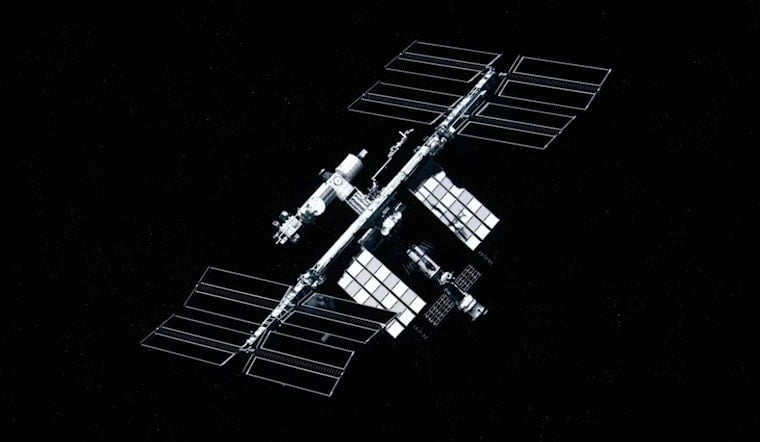
NASA astronaut Deniz Burnham, a UC San Diego graduate, is set to launch to the International Space Station next March aboard a Russian Soyuz spacecraft for her first spaceflight — a mission that will keep her in orbit for roughly seven months as a flight engineer conducting research some 250 miles above Earth.
NASA officially announced the assignment on July 30, confirming that Burnham will fly aboard the Roscosmos Soyuz MS-30 spacecraft, launching from the Baikonur Cosmodrome in Kazakhstan, according to NASA. She will serve as an Expedition 76 flight engineer alongside Russian cosmonauts Dmitri Petelin and Konstantin Borisov, rounding out the three-person crew that will ride the Soyuz MS-30 capsule together. As the San Diego Union-Tribune reports, Burnham is now 40 years old and joined NASA's active astronaut corps in 2024.
Burnham didn't come to this moment cold. Per Interfax, she spent June and July training in Kazakhstan as part of the official backup crew for the Soyuz MS-29 mission, which launched July 14 — meaning she ran through the same simulations as the prime crew before stepping into her own flight assignment.
From Alaskan Oil Rigs to Orbit
Before NASA, Burnham spent more than a decade in the energy industry managing oil drilling projects in Prudhoe Bay, Alaska, as well as in Canada and Texas. She also holds the rank of Lieutenant as an Engineering Duty Officer in the U.S. Navy Reserve, according to UC San Diego Today. That background in heavy engineering and remote field operations is the kind of technical résumé NASA looks for in candidates suited to long-duration orbital work.
Burnham was born at Incirlik Air Base in Adana, Turkey, in October 1985 and grew up in a military family before graduating from Vanden High School in Fairfield, California. The San Diego Union-Tribune reports she earned a bachelor's degree in chemical engineering at UC San Diego in 2007, and NASA notes she later went on to earn a master's degree in mechanical engineering from USC in 2017. She was selected in December 2021 as one of just 10 American astronaut candidates chosen from more than 12,000 applicants for NASA Astronaut Group 23, officially receiving her astronaut wings after completing basic training in March 2024.
UC San Diego's Growing Astronaut Legacy
Burnham will become the fourth UC San Diego graduate to travel to space, per UC San Diego. She joins Jessica Meir, Kate Rubins and Megan McArthur — a group that, according to UC San Diego Today, makes the university one of the country's leading pipelines for female astronauts, with all four UCSD graduates who have reached space being women. Rubins became the first human to sequence DNA in orbit in 2016, and Meir took part in the first all-female spacewalk in 2019, milestones detailed by the University of California.
The region's ties to human spaceflight run deeper still. Sally Ride, the first American woman to go into space, joined UC San Diego's physics faculty in 1989 and spent nearly 20 years there before her non-profit, Sally Ride Science, was formally incorporated into UC San Diego Extension in 2015, according to KPBS. Other San Diego universities have their own astronaut alumni: Matthew Dominick and Jonathan “Jonny” Kim both graduated from the University of San Diego, with Dominick completing an eight-month stay aboard the ISS in 2024, while Ellen Ochoa graduated from San Diego State University, per the Union-Tribune.
A Seat-Sharing Deal Amid Geopolitical Strain
Burnham's ride on a Russian spacecraft is made possible by a NASA-Roscosmos seat-barter agreement extended through 2030, which trades seats on American SpaceX Dragon and Russian Soyuz vehicles without any exchange of funds, according to SpacePolicyOnline.com. The arrangement is designed to guarantee that at least one NASA astronaut and one Roscosmos cosmonaut remain aboard the station at all times, even if either country's launch vehicle faces delays. It's a practical hedge that has kept mixed-nation crews flying together despite broader tensions between Washington and Moscow.
When Burnham reaches the International Space Station next March, she'll be joining a research outpost orbiting roughly 250 miles above Earth, according to the Union-Tribune. Her seven-month rotation will add her name to a short but growing list of UC San Diego graduates who have left the classroom for orbit — following a path first cleared by Sally Ride nearly four decades ago.





