

























































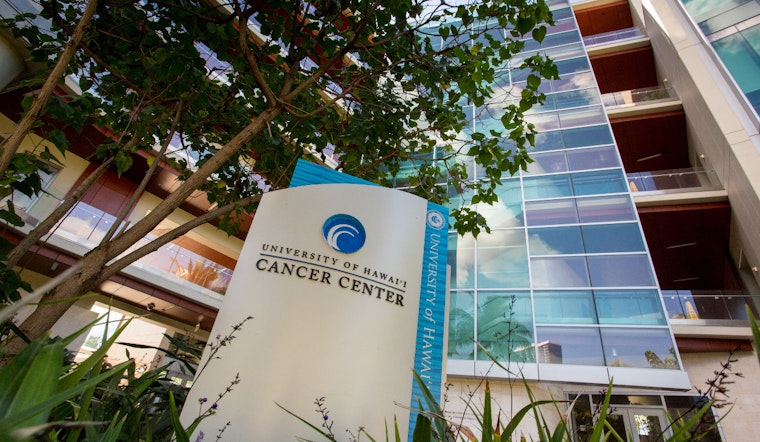
A laboratory tucked inside the University of Hawaiʻi Cancer Center's Kakaʻako campus just earned a designation held by only eight facilities on the planet. The Body Composition Shared Resource Laboratory received formal recognition Wednesday as an International Atomic Energy Agency Collaborating Centre, a status that ties the Honolulu lab into a global network using nuclear and radiological science to fight disease — with the Pacific's obesity and cancer risks squarely in its sights.
The plaque ceremony took place at the UH Cancer Center at 701 Ilalo St. in Honolulu, according to the University of Hawaiʻi System. IAEA nutrition specialist Alexia Alford presented the plaque and formally recognized the center as an IAEA Collaborating Centre for Nutrition, while Leila Kazemi, an IAEA program manager, joined the proceedings. The designation makes the lab the only IAEA Collaborating Centre in human health worldwide dedicated specifically to nutrition, and one of just eight such centers globally, per the university's announcement.
The lab is led by John Shepherd, UH Cancer Center's chief scientific officer, whose team will now work to standardize nuclear and radiological body composition assessment techniques and deliver specialized clinical and technical training to IAEA member states. Shepherd said the designation will put body composition methods directly into the hands of health workers across the Pacific, and will support research so that body composition data can inform nutrition policies and clinical guidelines worldwide. Lynne Wilkens, another UH Cancer Center leader quoted in the announcement, said the designation gives the laboratory expertise to benefit both the Pacific and the world.
A Regional Answer to a Documented Crisis
The designation lands amid some of the starkest public health statistics in the world. World Health Organization estimates cited by the University of Hawaiʻi show that Pacific Island nations account for nine of the ten most obese populations on Earth, with non-communicable diseases linked to obesity contributing to 75% of deaths across the region. A November 2025 UNICEF analysis reported by Pacific Island Times found that a quarter of children ages 5 to 14 across the Pacific are overweight, with Niue and the Cook Islands recording the highest youth obesity rates in the world, at nearly 40% among 5- to 19-year-olds. Obesity itself is associated with roughly 20% of all cancers, according to the university's announcement, which frames body composition as a critical risk factor for cancer and other diseases.
That regional weight of evidence is why the joint work plan between UH and the IAEA runs through 2030, with the lab set to conduct collaborative research projects and host technical workshops for delegates from across the Pacific. Delegates already attending an IAEA regional training course at the Kakaʻako lab this week — running from Monday through Friday — come from Fiji, Papua New Guinea, Tonga, Samoa, Palau, Vanuatu, the Marshall Islands, and the Cook Islands. They're getting hands-on sessions with DXA, BodPod, bioelectrical impedance, and 3D optical scanning systems, along with training in stable isotope methods including deuterium dilution dose preparation, saliva sampling, and sample analysis by Fourier transform infrared spectroscopy.
Not the First Nutrition Center, But a Different Toolkit
UH's lab isn't the first IAEA Collaborating Centre focused on nutrition. St. John's Research Institute in Bangalore, India, was designated in 2010 as the agency's first such center, using stable isotope techniques to evaluate body composition, infant nutrition, and metabolic health, according to the International Atomic Energy Agency. The IAEA maintains Collaborating Centres across specialized scientific fields worldwide, including 15 active centers dedicated to nuclear security alone as of January 2026, the agency has reported — underscoring how selective the human health designation is by comparison. The IAEA describes itself as the world's central intergovernmental forum for scientific and technical cooperation in the nuclear field, promoting the safe, secure, and peaceful uses of nuclear science and technology.
Shepherd's team brings an unusual résumé to the role. In October 2022, he was awarded $3.1 million from the National Institute of Child Health and Human Development for the “Shape Up! Keiki” study, which uses 3D optical body scanning to evaluate childhood obesity and associated health risks in Hawaiʻi and the Pacific, as reported by Big Island Now. His team also holds a NASA Translational Research Institute for Space Health grant for the “Astro-3DO” project, which applies the same 3D optical scanning technology to monitor astronauts' muscle mass and frailty risks during long-duration spaceflight, showing the lab's reach extends well beyond the islands it primarily serves.
The People Behind the Instruments
Several staff members carry specific responsibilities inside the lab's daily operations. Jonathan Bennett, a researcher who chairs the body composition section of the International Society for Clinical Densitometry, established the laboratory's stable isotope methods and quality control protocols. En Yong Liu, an exercise physiologist who manages the lab, oversees its instruments and reference standards, while Valerie Saiki works as a DXA technologist and clinical study coordinator. Chad B. Walton said the designation places Shepherd's lab within a small international network and reaffirms the quality of UH Cancer Center research more broadly.
Part of a Broader Kakaʻako Expansion
The IAEA news follows a stretch of momentum for the UH Cancer Center's Kakaʻako campus. Seven weeks ago, on July 6, the center opened the Hoʻōla Early Phase Clinical Research Center, creating Hawaiʻi's first facility giving local residents direct access to early-phase clinical trials without traveling to the mainland, according to the university. That expansion followed a UH Cancer Center study, reported by Hoodline, which found Hawaiʻi residents spent more than $230 million traveling to the mainland for cancer care between 2021 and 2023 — a cost the center's local infrastructure push is meant to chip away at.
The UH Cancer Center's footprint is already substantial. It's the only National Cancer Institute-designated cancer center in Hawaiʻi and the Pacific, one of just 74 such centers nationwide, and ranks in the top 4% of all cancer centers in the United States, per the university's announcement. Its catchment area spans roughly 7 million square miles and includes more than 2 million people, the largest catchment area of any NCI-designated center in the country. In August 2019, the National Cancer Institute awarded the center an $8 million, six-year grant as one of only 14 designated Minority/Underserved Community Sites, aimed at boosting clinical trial participation among Native Hawaiians, Pacific Islanders, and rural residents across Hawaiʻi and Guam.
The center, established as an independent research institute in 1981, opened its six-story Kakaʻako complex in 2013, funded in part by a 2006 state tobacco tax increase, according to Island Scene. Today it directly employs more than 300 faculty and staff with an additional 200 affiliate members, operates as part of the University of Hawaiʻi at Mānoa, and contributes more than $57 million annually to Hawaiʻi's economy. It's also the anchor of the Hawaiʻi Cancer Consortium, which includes The Queen's Health Systems, Hawaiʻi Pacific Health, Kuakini Medical Center, Adventist Health Castle, Hilo Benioff Medical Center, HMSA, and JABSOM. This week's IAEA training course, which wraps up Friday, is the latest example of that consortium's Kakaʻako home doubling as a training ground for the wider Pacific.




