

























































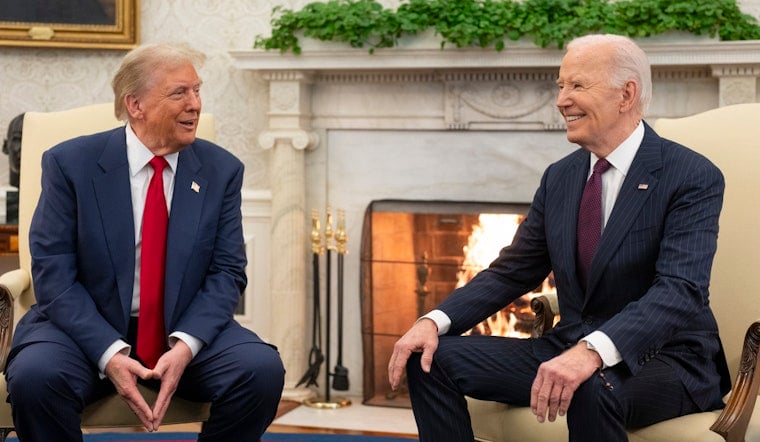
Utah Governor Spencer Cox says he once told President Joe Biden, in the presidential limousine on a Salt Lake City street, that Biden should consider pardoning Donald Trump. Biden, according to Cox, took the idea seriously enough to discuss it at length with First Lady Jill Biden that same week — but never went through with it.
The account comes from an excerpt of Cox's upcoming book that was published by NJ.com, drawing on reporting first done by journalist McKay Coppins for The Atlantic, which obtained the excerpt ahead of the book's publication, according to NOTUS. Cox writes that he told Biden, “Mr. President, I know this might sound crazy,” before making his case that a pardon could help de-escalate the country's partisan retribution cycle. At the time, Trump was the Republican front-runner for the White House and was facing criminal charges in New York, Florida, Georgia and Washington, D.C., stemming from 2023.
Biden did not pardon Trump. But per Cox's account, Biden told him he had actually been considering the idea for a while and said he and Jill Biden had a long conversation about it that same week. Cox writes that things did not turn out as he hoped in either this effort or a parallel one aimed at Trump himself, and that he ultimately concluded he failed.
A Second Track Aimed at Trump
Cox's book, titled Off Ramp: How to Be a Peacemaker in an Age of Contempt, is set for release next month and carries a foreword from social psychologist Jonathan Haidt, according to Books-A-Million. The governor, who says he had no personal loyalty to Trump and had never voted for him, describes attempting a similar approach with Republicans after the July 2024 assassination attempt on Trump in Butler, Pennsylvania. He wrote a letter urging Trump to choose unity over retaliation, hoping Trump would respond to the moment by unifying the country rather than escalating tensions, according to Mediaite. Cox went on to publicly endorse Trump's campaign, which won back the White House in 2024.
By Cox's own account, that effort with Trump never materialized into anything either. Trump, now president, has at times referred to Biden as “Sleepy Joe” and “enemy of the state,” a level of rhetoric that sits at odds with the unifying message Cox says he urged both men to embrace.
Why Cox Keeps Pushing an Anti-Polarization Message
The pardon pitch fits a pattern for Cox, who has spent years positioning himself as a voice against political polarization. He launched the nationwide Disagree Better campaign in July 2023 during his one-year term as chair of the National Governors Association, partnering with Colorado Governor Jared Polis to bring red- and blue-state governors together, per the National Governors Association. Decision science research presented at Harvard Kennedy School around the same time found that productive political disagreement requires counteracting the instinct partisans have to shut down or cancel those who disagree with them, according to Harvard Kennedy School's own account of the collaboration.
That framework has taken on heavier weight in Utah since Charlie Kirk, the founder of Turning Point USA, was assassinated while speaking at an event at Utah Valley University in September 2025. Cox's book arrives next month, timed close to the one-year anniversary of that shooting, a proximity noted by KSL TV. Utah Valley University has announced it will cancel classes and close operations on September 10 so students and faculty can take part in community service marking the anniversary, partnering with United Way, according to East Idaho News.
The Limits of a Presidential Pardon
Even if Biden had gone through with a pardon, it would not have wiped away all of Trump's legal exposure. Article II, Section 2 of the Constitution limits a president's pardon power to “Offences against the United States” — meaning it applies only to federal crimes and could not have touched Trump's state-level indictments in New York or Georgia, according to Congress.gov's constitutional annotations. The only prior instance of a sitting president fully pardoning a former president came on September 8, 1974, when Gerald Ford signed Proclamation 4311 pardoning Richard Nixon for federal offenses tied to Watergate, citing national healing as his motive, per the Gerald R. Ford Presidential Museum.
Cox's revelations land against a backdrop of rising political violence nationally, including the June 2025 killing of a Minnesota state legislator and an April 2025 arson attack on the Pennsylvania governor's residence, according to public safety reporting cited by NPR. Cox's broader message — that politicians and the public alike need to find off-ramps from escalating hostility — has also shaped his work at home, including a Hoodline report on a family toolkit built around it.



.jpg)