

























































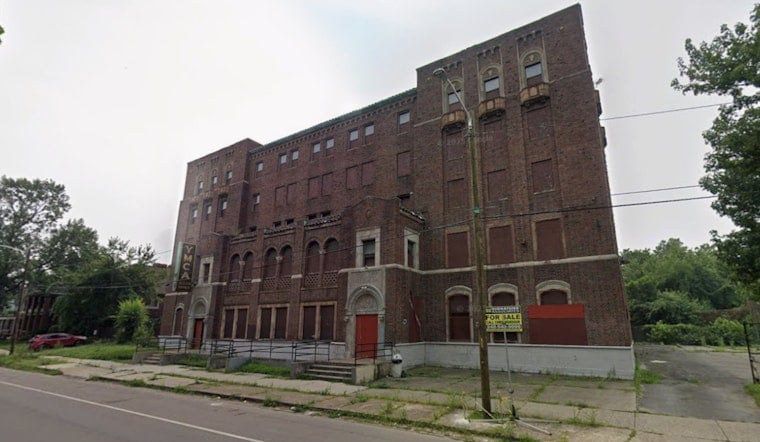
A five-story red brick building near Clark Park in Southwest Detroit has sat empty since 2000, its dormitory rooms, basketball courts and swimming pool untouched for a quarter century. Now the former Western Branch YMCA has new owners with plans to turn the 90,000-square-foot structure into apartments, offices and community space.
Inkwell Partners, a Detroit-based development firm, purchased the building for $1.1 million, according to developers cited by the Detroit Free Press. Ryan Zampardo, a principal at the firm, told the paper that the dozens of small dormitory-style rooms scattered throughout the building could be combined into roughly 30 to 50 modern apartments on the upper floors, with office space potentially joining them. He said Inkwell hopes to place community-oriented fitness and child care facilities on the lower floors, in keeping with the building's original mission as a neighborhood Y.
Devon Caldwell, another principal at Inkwell Partners, said the project will move slower than the firm's average redevelopment, and the Free Press reports there is no stated timeline yet for construction. The redevelopment is expected to take a few years just for pre-construction planning, since the project will require historic rehabilitation specialists to navigate the building's late-1920s bones — including separate entrances that were originally built for men and boys.
A Ford-Funded Landmark Frozen in Time
The Western Branch YMCA officially opened on April 15, 1928, constructed with a $750,000 gift from Edsel and Eleanor Clay Ford and designed by Detroit architectural firm Malcomson & Higginbotham, according to Historic Detroit. At the time, Southwest Detroit was a dense industrial and residential enclave home to roughly 178,000 residents, a population far larger than the neighborhood carries today, per the same account. The building's layout shifted over the decades — during the late 1980s it operated with a split use, housing a community child care center alongside a halfway house for non-violent offenders that the Michigan Department of Corrections leased until 1999.
The YMCA of Metropolitan Detroit sold the building in 2000, and land records show Dennis Kefallinos bought it that same year for $500,000, per the Free Press. Before that sale closed, the YMCA association had considered a different buyer: the Detroit Rescue Mission wanted the site as a rehabilitation center for substance abusers and a shelter for homeless people in early 2000, but the association abandoned that proposed sale after neighborhood pushback, according to the newspaper's reporting. Crain's Detroit first reported the eventual sale of the building.
A Seller With a Long History of Vacant Detroit Property
Kefallinos held onto the property for a quarter century while it remained unoccupied, and the building itself became something of an outlier among his holdings for simply remaining standing. A media investigation published in October 2024 found that Kefallinos held 292 Detroit properties in public records at the time, but only about 6% were occupied, while roughly half were vacant lots, as reported by BridgeDetroit. In February 2025, the City of Detroit settled 13 lawsuits against Kefallinos covering 108 properties, a deal that required him to spend $850,000 on demolition and place five other properties into court-appointed receivership.
Before Inkwell's purchase, commercial real estate listings had the vacant YMCA building on the market for $1.995 million, nearly double what the firm ultimately paid, according to listing data compiled by Realmo.
Inkwell's Track Record With Vacant Historic Buildings
Zampardo said Inkwell Partners knows the building well, given the firm's work in the neighboring Hubbard Farms and Southwest Detroit areas. Inkwell has undertaken about 20 development and redevelopment projects in Detroit since 2017, with historic rehabs of residential buildings forming a core part of its portfolio.
Most recently, in July 2025, Inkwell Partners and its development partners completed a $15 million restoration of two long-vacant historic apartment buildings, Kingsley Arms and Lee Arden, delivering 87 affordable housing units in Detroit's Piety Hill neighborhood, according to LISC Fund Management. That Piety Hill project was financed in part by $9.6 million in low-cost loans from the Detroit Housing for the Future Fund, a public-private financing pool the City of Detroit and LISC Detroit established in 2020. Whether Inkwell will tap that same fund or another subsidy tool for the YMCA project remains an open question, as does how much community feedback in Southwest Detroit will shape the final plans for the lower-floor fitness and child care space.
Part of a Broader Detroit Housing Push
The YMCA redevelopment would slot into a citywide affordable-housing push that has been building for years. In April 2024, the City of Detroit announced it had surpassed $1 billion in public and private investments into affordable multifamily housing over a five-year period across 46 city neighborhoods. Nearby, infrastructure has also been catching up to the neighborhood's ambitions: a $6 million streetscape overhaul along the West Vernor Highway corridor near Clark Park added new sidewalks, historic lighting and planter beds, according to Model D Media.
For now, the former Western Branch YMCA stands as it has for years — vacant, but no longer forgotten. With Inkwell Partners now holding the deed and a rough vision for apartments, offices and community space, the building's next chapter will depend on financing decisions, historic preservation requirements, and the years of pre-construction work developers say still lie ahead.



