

























































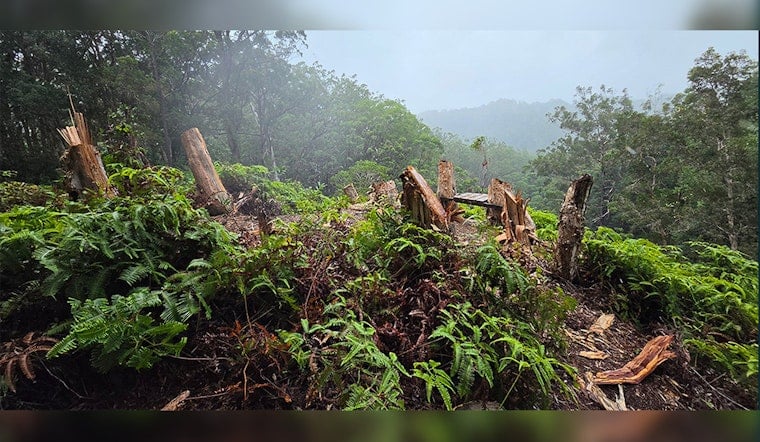
State forestry staff hiking through the ʻEwa Forest Reserve above Wahiawā discovered a jarring scene last month: nine to ten paperbark eucalyptus trees severed near ground level, their splintered trunks left behind, with a homemade bench installed nearby overlooking the cut area. The Hawaii Department of Land and Natural Resources says the damage was documented in photographs taken on July 28 and released the images publicly this week, appealing to the public for help identifying who was responsible.
According to officials with the DLNR Division of Forestry and Wildlife, the unauthorized clearing appears to have been done to create a scenic viewpoint. As reported by Maui Now, DOFAW staff reported that vandals chopped down multiple trees in the reserve and left at least 10 felled paperbark eucalyptus behind. Ryan Peralta, a forestry program manager with DOFAW's Oʻahu branch, said the tree removal is illegal and disrespectful to the ʻāina.
A Non-Native Tree, But Still Protected Ground
Paperbark eucalyptus trees were brought to Hawaiʻi in the early 1900s for watershed reforestation and to control erosion, and while the species is now considered naturalized and non-native, that doesn't make cutting it down legal. Under Hawaiʻi Administrative Rules Chapter 13-104, removing, injuring, or killing plant life in public forest reserves is prohibited outright, per the same rules DLNR cited in its announcement. Any fines collected from violations are designated for deposit into the state's Forest Stewardship Fund.
Forest reserves like ʻEwa exist to do more than grow trees. They provide habitat for native species, support recreational access for hikers and hunters, and help supply fresh water to the island. The stakes in this particular reserve are especially high: the ʻEwa Forest Reserve sits atop critical portions of Oʻahu's Waiawa Watershed, which recharges the Pearl Harbor Aquifer, the primary drinking water source supplying more than 364 million gallons daily across the island, according to DLNR's forestry division.
Millions of Acres, Limited Boots on the Ground
Catching whoever built that illegal viewpoint won't be easy. The Division of Conservation and Resources Enforcement, known as DOCARE, operates with roughly 130 state conservation officers responsible for monitoring 3.2 million acres of state land, 3 million acres of ocean waters, and 750 miles of coastline statewide, as detailed in a report from Maui Now. That kind of staffing ratio means officers can't patrol every remote trail, which is why DLNR leans heavily on tips from the public through its DLNRTip app.
The state has been trying to close that gap. DLNR commissioned 24 new conservation officers in December 2024 and launched a statewide recruitment campaign in January to fill 53 entry-level enforcement positions, though high physical and testing standards tend to stretch out the hiring pipeline for these roles.
Part of a Broader Pattern on Oʻahu
This isn't the first time state forestry infrastructure on Oʻahu has been targeted. In January 2021, vandals broke into DOFAW's Waimano greenhouse and destroyed rare, near-extinct native Hawaiian plants that botanists had spent years propagating for outplanting in forest reserves. The ʻEwa Forest Reserve itself has grown in recent years, having undergone a major expansion in late 2018 when the state acquired the 2,900-acre Helemano Wilderness Area above Wahiawā using federal, state, and private funds to improve trail and hunting access.
The reserve sits within the broader Koʻolau Mountain Range, which spans 110,000 acres and yields an estimated 133 billion gallons of fresh water annually while sheltering native species such as the ʻelepaio bird and endangered tree snails, according to the Natural Resources Conservation Service. Reaching remote trailheads like the Poamoho Trail above Wahiawā also depends on cooperative agreements between DLNR's Na Ala Hele program and private landowners, including Dole Food Company, for public vehicular access.
How to Report Suspicious Activity
DLNR is urging anyone with information about the tree cutting or the bench installation to come forward. Forest users can report violations through the DLNRTip app, or by calling the Division of Conservation and Resources Enforcement directly at 808-643-DLNR (3567). Officials say the illegal clearing has left behind an eyesore that disrupts the surrounding forest ecosystem, on top of the legal exposure anyone involved could face under state conservation rules.





