

























































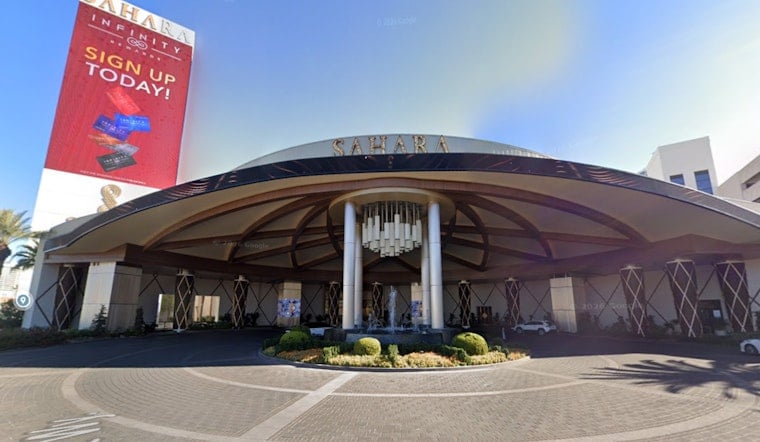
Sahara Las Vegas has opened a new Vegas Loop station at its Paradise Road entrance on the east side of the property, giving guests underground Tesla access to the Las Vegas Convention Center, Strip resorts, and Harry Reid International Airport. The station sits next to the resort's digital marquee and runs daily from 7 a.m. to 9 p.m., with extended hours during convention events.
The opening, reported by FOX5 Las Vegas, means Sahara now operates as a dual transit hub — home to both the tunnel station and the northernmost terminal of the 3.9-mile Las Vegas Monorail, according to InfoComm. The monorail's elevated line runs seven stations along the east side of the Strip from MGM Grand up to Sahara, placing two competing transit technologies at the same doorstep. Guests can buy Vegas Loop tickets either online in advance or by scanning a QR code at the station upon arrival, per the same FOX5 report. The Boring Company, which owns and operates the Vegas Loop, sets all routes, stations, fares, airport availability, and operating hours, and notes that specifics can shift by day, destination, and the convention or event schedule.
A Fast-Growing Tunnel Map
Sahara becomes the network's 11th active station, joining stops at convention center halls, Resorts World, Westgate, and Fontainebleau, according to The Boring Company. The system has now carried more than 4 million cumulative passengers since it began in 2021 as a 0.8-mile shuttle serving only the convention center. Local approvals from Clark County and the City of Las Vegas now authorize a far larger buildout — up to 68 miles of tunnel and 104 stations — after commissioners expanded an initial 51-station approval in 2023 and again in 2025.
The Boring Company projects that a fully built network could eventually move up to 90,000 passengers per hour, with underground trips taking between 2 and 8 minutes. The system relies on human-driven Tesla Model Y and Model X vehicles moving through single-bore tunnels at speeds up to 35 mph, according to Fontainebleau Las Vegas. Public fares typically range from $4.25 for a single ride up to $12 for longer routes, though travel within the convention center campus stays free for badge holders.
Resort Corridor Momentum Continues
Sahara's station follows closely on the heels of Fontainebleau Las Vegas, which opened its own Vegas Loop stop in January, giving guests direct routes to the convention center, Westgate, and Encore, as Hoodline previously reported in a Strip tunnel milestone story. Resort owners generally fund the construction of individual stations while The Boring Company finances the tunnel boring itself, a pattern reflected across the corridor's recent expansion. During the CONEXPO-CON/AGG trade show in March, the network hit a peak event milestone, moving roughly 82,000 passengers over five days at the convention center, which drew more than 140,000 attendees.
Airport connectivity remains a work in progress. The Boring Company launched a $12 mixed-mode shuttle to Harry Reid International Airport in December 2025 after securing Nevada Transportation Authority approval for a temporary service that combines underground tunnel with up to four miles of surface street travel. Fully subterranean airport tunnels are not expected until later this year or 2027.
Growth Alongside Scrutiny
The expansion has not come without friction. In late 2025 and early 2026, Nevada OSHA issued workplace safety citations tied to employee chemical burns, and the Las Vegas Valley Water District levied a $500,000 fine over unauthorized wastewater discharge — issues Hoodline detailed in its report on the company's burns and dumping scandals. Company leadership has publicly committed to addressing the workplace hazards.
The tunnel network's footprint keeps stretching beyond the resort corridor as well. In June, the Nevada System of Higher Education Board of Regents approved plans for a Vegas Loop station on a 1.3-acre UNLV campus parcel, intended to connect students and faculty to the Strip and convention center — a plan Hoodline covered when regents first weighed the deal. Whether ridership can keep pace with the ambitions of a 104-station network built on individual electric cars, rather than high-capacity trains, remains an open question critics continue to raise as the tunnels multiply.





