

























































A wooden double-decker bus built in 1918 will sit parked beside a 2001 commuter coach that survived the collapse of the World Trade Center when the New York Transit Museum's 29th Annual Bus Festival returns to Brooklyn Bridge Park next month. The free, rain-or-shine event runs from 10 a.m. to 3:30 p.m. on September 19 at Emily Warren Roebling Plaza, bringing buses spanning more than a century of New York transportation history to the waterfront beneath the Brooklyn Bridge.
MTA New York City Transit is co-hosting the festival alongside the museum, according to Brooklyn Paper. Museum staffer Regina Shepherd said the festival brings the museum's large buses into the spotlight and welcomes the public aboard, per the outlet's report. The event has historically drawn roughly 10,000 visitors to Brooklyn Bridge Park each year to view historic and modern MTA buses, according to a New York Transit Museum event deck.
Visitors can board and explore the vintage buses, meet members of New York City's transit workforce, and use the museum's mobile app for interactive activities at the festival grounds. Kids and adults can also compete in trivia, and attendees who complete a scavenger hunt by finding and photographing the historic buses will receive a transit-themed temporary tattoo. Those who RSVP through the museum's website can win a dual/household membership, which includes one year of free museum admission plus discounts on vintage train rides.
A Wooden Double-Decker and Its Sister Bus
The oldest restored bus in the museum's collection, Bus 303, was built in 1918 for the Fifth Avenue Coach Company and operated on Manhattan routes as a wooden, open-air double-decker. It underwent a restoration completed this year and will appear alongside Betsy, the museum's 1931 double-decker. Fifth Avenue Coach Company was among the private operators running early surface routes before the city consolidated bus service, part of a history stretching back to when municipal bus service in New York officially began in 1919, according to the Metropolitan Transportation Authority. Motor buses gradually replaced the city's streetcar and trolley networks through the 1930s and 1940s, per the same account.
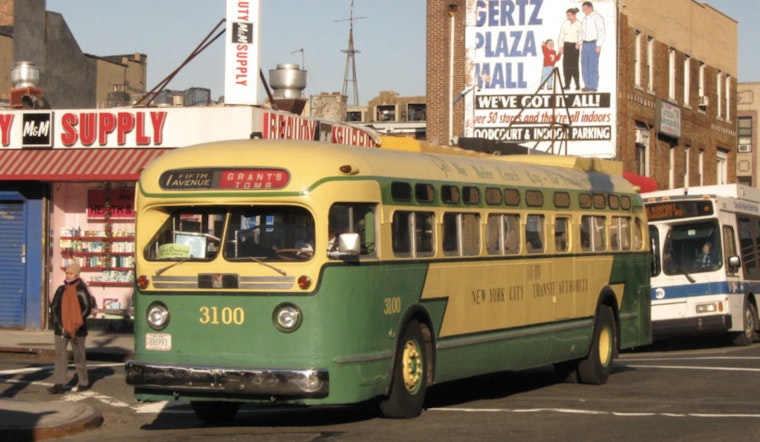
Also on display will be Bus 3100, an experimental vehicle built in 1956 by the Fifth Avenue Coach Company that became the first air-conditioned transit bus in the United States. It also introduced fluorescent lighting, wraparound seating, and a rear exit door operated by pushing it open. Full fleet-wide air conditioning orders didn't follow for another decade, not arriving in large quantities until 1966, according to the New York Transit Museum.
Fishbowl Buses and a Four-Decade Workhorse
Two General Motors New Look buses, nicknamed the Fishbowl for their large, six-piece rounded windshield, will also be part of the lineup. Bus 100 was built in 1959 by General Motors and was among the first group of 190 New Look buses to bring the design to New York City. Bus 5227, built in 1971 and rebuilt by Blitz Corporation in the 1980s along with a fleet of similar GM New Look buses, retains its early-1990s appearance with a blue-and-white color scheme. It holds a notable distinction: it was the final NYC Transit bus without a wheelchair lift to continue carrying passengers, a milestone tied to the broader push toward accessibility that began in 1981 when New York City Transit introduced wheelchair-accessible buses following lawsuits from disability advocacy groups, according to Able News. That effort eventually made the agency the first major transit operator in the world with a 100% wheelchair-accessible fixed-route bus fleet, the outlet reports.
Rounding out the historic fleet is Bus 3865, a 1993 Rapid Transit Series bus, commonly known as RTS. It served under Jamaica Buses and the Queens Surface Corporation in Queens before coming under the MTA Bus Company. RTS buses first entered service citywide in 1979 and remained in operation until 2019, a four-decade run before the model line's retirement from active revenue service.
A Rolling 9/11 Memorial as Anniversary Nears
The festival's most emotionally weighted vehicle is Bus 2185, a 45-foot 2001 MCI commuter coach nicknamed Pamela that sustained extensive damage at the World Trade Center on September 11, 2001. It was rebuilt at NYC Transit's East New York Central Maintenance Facility and returned to service in 2005. The bus now carries a memorial livery featuring American flags and a “9/11/2001: Never Forget” graphic, and its display comes as New York City approaches the 25th anniversary of the attacks. The restoration took three years to complete, according to the New York Transit Museum, which has described the coach as a rolling memorial and a symbol of transit worker resilience.
The buses on display join a modern fleet that has grown enormously since these vehicles were in service. The MTA now operates the largest municipal bus fleet in the United States, with more than 5,800 active buses carrying roughly 1.3 million riders on an average weekday across all five boroughs, according to the MTA Regional Bus Operations overview.
Shopping and Milestones Beyond the Buses
The Transit Museum Store will set up a temporary festival shop selling vintage models and toys, along with apparel, books, posters, and other transportation-themed items. The museum has cautioned that vehicles and equipment on display may change ahead of the event.
This year's festival also lands during the New York Transit Museum's 50th anniversary. The museum opened in 1976 inside the decommissioned 1936 Court Street subway station in Downtown Brooklyn as a temporary exhibit marking the U.S. Bicentennial, and it remains the largest museum dedicated to urban public transit in North America. The festival grounds themselves carry their own milestone: Emily Warren Roebling Plaza, beneath the Brooklyn Bridge, officially opened in December 2021, completing the 85-acre Brooklyn Bridge Park master plan and honoring the engineer who led the bridge's completion in 1883. Hoodline previously reported on the museum's vintage subway rides program, and more recently covered a unionization push among the museum's front-line staff.





