

























































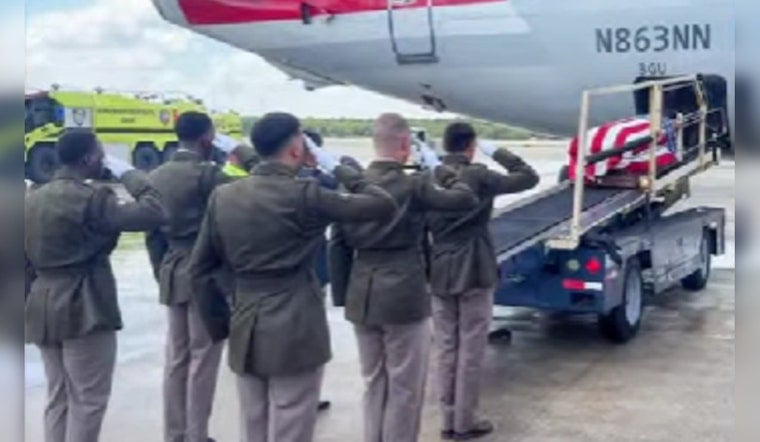
A soldier from Vinton, Louisiana, who died in a Japanese prisoner-of-war camp in 1942 has finally made it home, more than eight decades after he went missing during World War II. Technician Fifth Grade Gurnie Joseph “Tutie” Richard was escorted into the state by Louisiana State Police, who joined fellow law enforcement agencies and military personnel for the final leg of his journey.
According to Louisiana State Police, Richard's remains were positively identified more than eight decades after his death, and troopers accompanied him home to Vinton as part of a broader honor escort. That identification came after the Defense POW/MIA Accounting Agency officially accounted for Richard on August 26, 2025, following the exhumation of commingled unknown remains from Common Grave 706 at the Cabanatuan POW Camp Cemetery. Scientists from DPAA and the Armed Forces Medical Examiner System used dental and anthropological analysis, along with mitochondrial DNA and Y-chromosome Short Tandem Repeat DNA matching from Richard's surviving family, to confirm his identity, the agency reported.
From Vinton Football Star to Army Air Corps
Before the war, Richard grew up in Vinton, where he was a standout athlete on the 1935-1936 Vinton High School state championship football team alongside his brother Bernie, according to the Dignity Memorial obituary. He enlisted in the U.S. Army Air Corps in 1940 and served as a Technician Fifth Grade with the 17th Bombardment Squadron, 27th Bombardment Group, deploying to the Philippines in late 1941, just before the Japanese invasion, per the same source.
After Allied defenders on the Bataan Peninsula surrendered on April 9, 1942, Richard survived the roughly 65-mile Bataan Death March, only to die of nutritional deprivation on November 26, 1942, at Cabanatuan POW Camp #1, according to the Louisiana Department of Veterans Affairs. Cabanatuan was the largest U.S. prisoner facility in the Philippines, where more than 2,500 American POWs perished from starvation, disease, and mistreatment, DPAA notes.
A Decade-Long Effort to Name the Missing
Richard's identification is part of DPAA's Cabanatuan Project, launched in 2014 to identify more than 2,700 U.S. and Filipino service members buried in the camp's mass graves. As of February 2025, the project had identified more than 90 individuals, while over 900 remained unaccounted for, the agency's data shows.
Following his accounting, the American Battle Monuments Commission affixed a bronze rosemary wreath rosette next to Richard's name on the Walls of the Missing at the Manila American Cemetery in the Philippines in late 2025, marking that he had finally been identified and brought home.
State Honors and a Homecoming in Southwest Louisiana
Louisiana Governor Jeff Landry issued Executive Order JML 26-080 directing U.S. and state flags to fly at half-staff across Louisiana on Thursday, while Louisiana State Police and Patriot Guard Riders escorted Richard's remains from Houston's George Bush Intercontinental Airport into the state, according to the Office of Governor Jeff Landry.
Final memorial services for Richard are scheduled for Saturday at Hixson-Sulphur Memorial Funeral Home in Sulphur, Louisiana, with burial to follow at Big Woods Cemetery in Edgerly, per the American Press. Richard's parents and siblings did not live to see his return, but nieces and other extended family members are expected to welcome him home, closing out a search that spanned 84 years and three generations of his family.





