

























































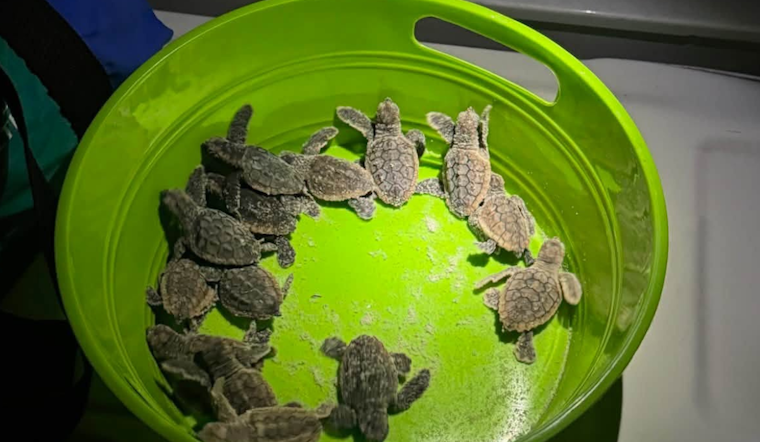
Seventy-five baby sea turtles wandering the wrong way toward Atlantic Avenue got a second chance this week after Volusia County deputies and county workers stepped in to gather them up and send them safely out to sea. The hatchlings had been trying to climb a beach approach instead of heading toward the ocean, a disorientation that wildlife officials say is becoming an increasingly common hazard during one of the busiest nesting seasons the county has ever recorded.
According to FOX 35 Orlando, Volusia County deputies collected roughly 75 young sea turtles after being contacted by the county, which helped gather the confused hatchlings before they could wander into roads or parking lots. The rescue was reported per a Volusia County Sheriff's Office Facebook post, and all of the rescued baby turtles were ultimately released into the ocean. The incident unfolded as New Smyrna Beach, one of the county's densest nesting hotspots, has accounted for nearly 700 of the roughly 1,654 total nests logged so far this season on Volusia County's Sea Turtle Nest Dashboard, according to ClickOrlando.
Why Hatchlings Crawl the Wrong Way
Sea turtle hatchlings rely on moonlight reflecting off the ocean to orient themselves toward the water once they emerge from their nests. Artificial lights, including porch lamps, streetlights, and beach fires, can confuse that navigation instinct, causing hatchlings to crawl inland toward roads, streets, and parking lots instead. The station's report notes that officials point to this kind of light confusion as the likely cause behind hatchlings turning toward Atlantic Avenue rather than the surf.
The odds are already stacked against these tiny travelers. Young sea turtles reach adulthood at a rate of just one in 1,000, and female sea turtles that survive to breeding age nest only every two to three years, laying 80 to 120 eggs in each nest. Florida beaches typically host between 40,000 and 84,000 sea turtle nests in a given year, and the state is home to five sea turtle species: the hawksbill, Kemp's ridley, loggerhead, leatherback, and green turtle.
A Record-Breaking Season in Volusia County
The rescue landed in the middle of a historic nesting season. On July 22, Volusia County set an all-time annual record when surveyors documented the season's 1,517th nest in Daytona Beach Shores, breaking the previous countywide record of 1,516 nests set in 2023, per Observer Local News. The county has also documented multiple nests this year from the Kemp's ridley sea turtle, recognized as the world's rarest and most endangered sea turtle species. Nesting season runs annually from May 1 through October 31.
Biologists with Volusia County's Habitat Conservation Plan attribute the record count to conservation protections put in place 20 to 30 years ago, since sea turtles typically need two to three decades to mature and return to their natal beaches to nest. The current surge reflects the long-term payoff of conservation efforts that trace back to the 1970s and 1990s, including Volusia's pioneering federal Habitat Conservation Plan, which the county established after a 1995 federal lawsuit over beach driving. That plan gave Volusia an Incidental Take Permit requiring pre-dawn nest inspections before vehicles can enter drivable sections of beach, a structure that still shapes how the county manages one of the few Florida coastlines that allows public beach driving.
Lighting Rules Carry Real Financial Teeth
The disorientation of dozens of hatchlings crawling toward Atlantic Avenue points to an ongoing tension between coastal development and wildlife preservation. Volusia County's Sea Turtle Lighting Ordinance requires all window and door glass within line of sight of the beach to carry a visible light transmittance tint rating of 45% or less, preventing interior lighting from spilling onto the sand, according to Volusia County Government. Property owners who violate the ordinance face fines from the county's Code Enforcement Board of up to $1,000 per day for a first violation, up to $5,000 per day for repeat violations, or a single fine as high as $15,000.
State law adds another layer of exposure. Under Florida Statute 379.2431, the Marine Turtle Protection Act, taking, disturbing, or possessing sea turtles, hatchlings, or their eggs is a third-degree felony carrying state criminal penalties and mandatory administrative fines, per the Florida Senate. It remains an open question whether beachfront properties near this week's rescue site complied with the county's lighting and tinting rules, and whether any code enforcement notices or fines followed the incident.
What To Do If You Find a Wandering Hatchling
Anyone who spots a disoriented or stranded hatchling in Volusia County is asked to contact Beach Safety at 386-239-6414 during daylight hours, the Sheriff's Office at 386-248-1777 at night or on weekends, or the FWC hotline at 1-888-404-3922, per WKMG. Callers are advised to move hatchlings to dark areas rather than carrying them into the ocean themselves. Beachgoers are also urged to keep a gentle, safe distance from nests, fill in sand holes, remove trash, sandcastles, and beach chairs before leaving the beach, and follow FWC turtle-friendly lighting guidelines.
For hatchlings that need more intensive help, Volusia County's Marine Science Center in Ponce Inlet has been rehabilitating weakened sea turtles since it opened in June 2002, caring for more than 22,000 hatchlings and washbacks in the years since, according to the Marine Science Center. The facility operates seven turtle hospital pools that are visible to the public, giving Volusia residents a firsthand look at the same conservation infrastructure that helped 75 lost hatchlings find their way back to the Atlantic this week.


