

























































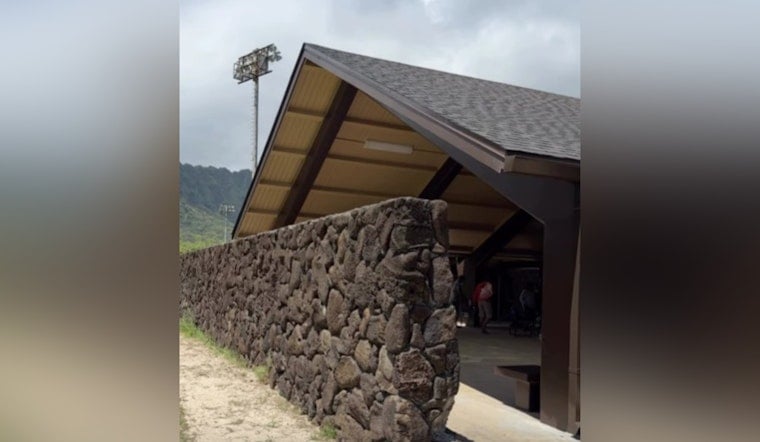
The Pahinui Pavilion at Waimānalo Beach Park has reopened for community use, giving Windward Oʻahu families, campers, and musicians a rebuilt gathering space named for one of Hawaiʻi's most celebrated slack key guitarists. The structure now includes built-in concrete benches for seating, and it sits on the Makapuʻu side of the 37.56-acre park, one of the island's largest rural beach parks with 10 designated public campsites.
Reconstruction of the pavilion began in October 2025, according to the city, and a majority of the structure has now been completed, as reported by Hawaii News Now. The project was funded through a $1,485,000 construction contract awarded to T. Iida Contracting, Ltd., along with a $330,137 design contract awarded to Jeffrey Nishi Architects, according to Hawaii Ahe. The city says the rebuild was designed to match the size and character of the original pavilion while giving it a fighting chance against the elements.
Built to Survive the Salt Air
The original pavilion dated back to 1959 and was later dedicated to Gabby “Pops” Pahinui, a resident of the nearby Hawaiian homestead, according to the City and County of Honolulu. That structure was demolished in 2019 due to structural issues, per Hawaii News Now, after decades of serving as a cultural nexus for the Waimānalo community, the city says.
To avoid a repeat of that deterioration, the rebuilt pavilion incorporates precast concrete structural supports, concrete block walls, an asphalt shingle roof, and stainless steel gutters, materials chosen specifically to withstand coastal salt air, per the same account from Hawaii Ahe. Some finishing touches remain: the city says additional electric work and grass maintenance are still outstanding, with the project expected to be fully finished by the end of 2026.
Carrying Forward a Musical Tradition
Kehaulani Puu, deputy director of the Department of Parks and Recreation, said the reopening carries the special place forward for hanauna, or generations, to gather, celebrate, learn, play and create memories, according to Hawaii News Now. The old pavilion hosted the annual Gabby Pahinui Waimānalo Kanikapila, a tradition rooted in Pahinui's own weekend-long jam sessions at his Waimānalo home, which regularly drew over a hundred musicians and community members to share food and play music, according to Gabby Pahinui's official biography.
Pahinui, who died in 1980, was widely regarded as a renowned musician and ambassador of Hawaiian culture. His influence extended well beyond Waimānalo: the annual Hawaiian Slack Key Guitar Festival was founded in 1982 as a tribute concert in his honor, helping spark wider interest in kī hōʻalu music across Hawaiʻi and internationally, as Hoodline previously reported.
More Park Upgrades Still to Come
The pavilion's reopening is just the first completed milestone in a broader, multi-year overhaul of Waimānalo Beach Park. In early 2024, the city estimated total costs for comprehensive park improvements at $4.25 million, including $1.2 million for the pavilion itself, $2.5 million for replacing two aging comfort stations, and $550,000 for repairing the park's recreation building, according to the city's own figures.
That recreation building previously suffered significant structural damage from a fire and is scheduled for renovation in early 2027, per officials. Renovation of the two comfort stations is also expected to begin in early 2027, following a January 2025 public meeting at the Waimānalo Public & School Library, where the city and consultant Architects Pacific, Inc. gathered community input on toilet layouts, sinks, and changing areas. Because the park sits directly along the shoreline, all three projects required Special Management Area approval under coastal protection land-use regulations, as detailed by the Honolulu City Council. Officials have said further renovation details will be announced at a later date.
For now, the pavilion offers a partially enclosed space for everyday and special community events, restoring a gathering spot that once anchored decades of Windward Oʻahu life. Hoodline first covered the pavilion's reconstruction kickoff back when contracts were first awarded, and the completed structure now stands as a tangible link between that groundwork and the community traditions it was built to sustain.



