

























































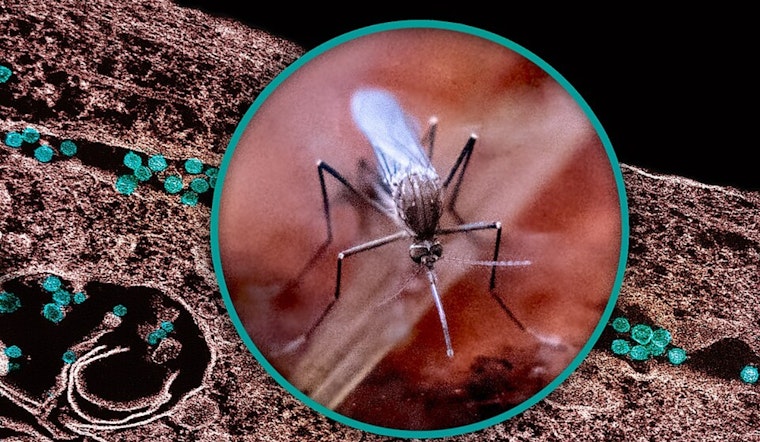
Wayne County has recorded its first human case of West Nile virus in 2026, health officials announced yesterday, confirming that a resident of Out-Wayne County — the suburban communities outside Detroit's city limits — has tested positive for the mosquito-borne illness.
According to CBS News Detroit, Wayne County health officials reported the case yesterday, marking the county's first known human infection of the year. Because the patient lives in Out-Wayne County, the case falls under Wayne County Public Health rather than the Detroit Health Department, which runs a separate municipal health system, per FOX 2 Detroit.
The human case comes about a month after Wayne County's vector surveillance program first flagged trouble. As Hoodline reported on the county's first positive trap, officials recorded Wayne County's first West Nile-positive mosquito pool of the 2026 season on July 23 during routine trapping — an early warning sign that virus activity was already circulating among local mosquito populations weeks before the first human infection was identified.
A Statewide Pattern Emerges
Wayne County's case is not an isolated event. Michigan's first human West Nile case of 2026 turned up on August 13 in a Kent County resident, identified through routine screening of a blood donation, according to the Kent County Health Department. Blood donation facilities routinely screen for mosquito-borne pathogens before products enter the supply, a detail the department noted in explaining how the case was caught.
By early August, at least 44 mosquito samples across Michigan had already tested positive for mosquito-borne illnesses, with infected pools turning up in Wayne, Washtenaw, Macomb, St. Clair, Bay, Kent, Midland, and Ottawa counties, per ClickOnDetroit. The spread illustrates how widespread vector contamination had become across both southeastern and western Michigan heading into late summer.
A Second, Rarer Virus Also Surfaces
Michigan's mosquito-borne illness concerns aren't limited to West Nile. The Michigan Department of Health and Human Services confirmed a human case of Eastern Equine Encephalitis in Roscommon County on August 19 — the state's first human EEE case since 2021. EEE is far less common than West Nile virus but carries a case fatality rate of roughly 30%, according to the state health department.
State law adds weight to how these cases get tracked. Under Section R 325.172 of the Michigan Administrative Code, physicians and clinical laboratories are legally required to report all suspected or confirmed arboviral infections — including West Nile virus and viral encephalitis — to local and state health authorities, per the State of Michigan. That reporting requirement is what allows epidemiologists to monitor outbreak trends and direct mosquito control efforts in real time.
What the Risk Actually Looks Like
Most people infected with West Nile virus never know it. About 80% of those infected show no symptoms at all, roughly 20% develop mild fever and flu-like illness, and fewer than 1% — about 1 in 150 — go on to develop severe neuroinvasive disease such as encephalitis or meningitis, according to Oakland County. Symptoms, when they appear, typically show up two to 14 days after a bite from an infected mosquito.
Wayne County has seen how severe those rare cases can be. During the 2025 mosquito season, the county reported three human West Nile cases, including one death in an older adult, while Michigan recorded 17 human cases statewide, according to the Wayne County Health Division. Severe illness and death occur predominantly among older adults and people with weakened immune systems.
Why Late August Matters
Timing is part of what has health officials on alert. West Nile virus transmission in Michigan typically peaks between late August and early September, and the risk of human infection persists until the first hard frost kills off adult mosquito populations, FOX 2 Detroit reports. That seasonal window helps explain why local health departments are pushing precautions now rather than waiting.
The pattern extends beyond Michigan's borders. Nationwide, CDC surveillance data as of August 18 recorded 222 human cases of West Nile virus across 32 states, reflecting what CBS News described as an earlier-than-typical start to the 2026 transmission season nationally. Wayne County's newly confirmed case adds to that broader national tally as the peak weeks for mosquito-borne illness continue to unfold.





