

























































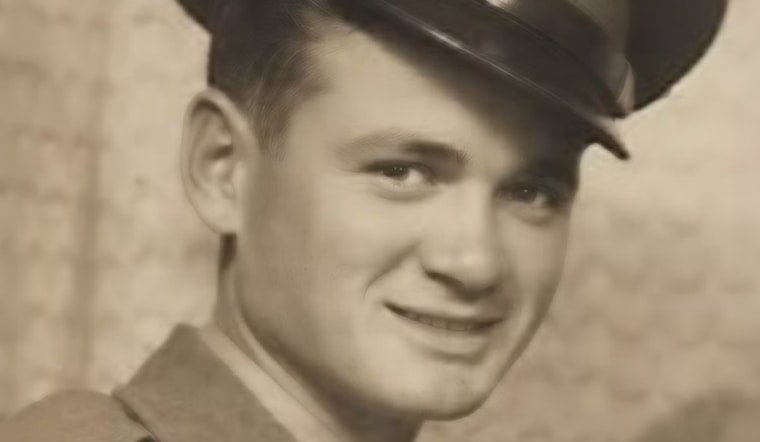
Seventy-five years after he vanished in the frozen hills near North Korea's Chosin Reservoir, U.S. Army Sgt. Willis McNiel is coming home to Weatherford, Texas. McNiel was just 20 years old when he went missing during a major battle near the Jangjin, or Chosin, Reservoir on December 2, 1950, and the Army issued a presumptive finding of death for him in December 1953. Now, following a forensic identification announced this year, his remains will be interred in the town where he grew up.
McNiel was born July 19, 1930, in Chico, Texas, and was raised in Weatherford after losing his father at age 9 and his mother at age 11, according to Military.com. He served in Company D, 1st Battalion, 32nd Infantry Regiment, 7th Infantry Division, a unit that fought as part of Regimental Combat Team 31 — commonly known as Task Force Faith — on the eastern side of the reservoir. According to the Warfare History Network, an estimated 90% to 95% of that task force's personnel were killed, wounded, or captured as they fought to hold off surrounding Chinese forces and cover the withdrawal of allied troops in late November and early December 1950.
A 75-Year Wait Ends With DNA and Dental Records
The Defense POW/MIA Accounting Agency accounted for McNiel on December 3, 2025, though the agency's public announcement did not come until February 23 — the agency typically holds complete case details until casualty officers finish formal briefings with surviving family. Per the seed report, McNiel's remains were exhumed using DNA matching technology and ultimately matched against his dental records and X-rays. The Army's Human Resources Command maintains a Past Conflict Repatriations Branch specifically tasked with identifying, locating, and contacting subsequent-generation family members of soldiers missing or killed in action, since none of McNiel's own parents or siblings lived to see him accounted for.
That generational search reflects a broader forensic challenge described in the dossier: DPAA anthropologists often compare chest radiograph clavicle structures from 1940s and 1950s tuberculosis screening X-rays against recovered skeletal remains, a technique available for roughly 72% of missing service members with surviving enlistment records, according to research cited by Texas A&M's history department. For remains too degraded or commingled for that method, the Armed Forces Medical Examiner System turns to specialized mitochondrial DNA capture techniques, processing more than 100 samples a month with a success rate exceeding 65% as of 2024.
Family Reacts to Confirmation
According to Military.com, Connie McNiel Bunn, 73, said that her father always spoke of McNiel by his nickname. “My daddy always talked about Bud — that's what he called him,” Bunn said. Bunn said her father mentioned McNiel often, and she said she is happy McNiel will finally be put to rest in his hometown. Lauren McNiel Swaim reportedly said of the identification, “It is 100% him.”
McNiel is survived by four nieces and nephews, along with other relatives and friends, per the same report. His obituary describes him as having given “the ultimate sacrifice in service to his country.” He was also preceded in death by all five of his brothers and sisters — Coy, Pat, and Norbert McNiel, and Callie Martin and Faye Crain Parish — according to his obituary published by Galbreaith Pickard Funeral Chapel, which is coordinating his services and interment.
Memorial and Burial Details
McNiel's name is inscribed on the Korean War Veterans Memorial Wall in Washington, which was updated in 2022, and he is memorialized on the Courts of the Missing at the National Memorial Cemetery of the Pacific in Honolulu. Under American Battle Monuments Commission protocol, an unaccounted-for service member's identification is marked by placing a bronze rosette beside their name on that memorial wall to signify recovery. Many Korean War remains identified by DPAA in recent years, the agency notes, originated from Operation Glory in 1954, when North Korea unilaterally turned over roughly 4,000 sets of human remains to the United States following the 1953 armistice.
Funeral services are scheduled for 10 a.m. on Monday, Aug. 31, at Galbreaith Pickard Funeral Chapel in Weatherford, following a public visitation beginning at 9 a.m. The Aug. 31 ceremony will include the national anthem sung by Piper Still, described as Bunn's 16-year-old granddaughter, and a eulogy delivered by Garren Still. McNiel will then be interred at East Greenwood Cemetery in Weatherford — a historic Parker County burial ground that is also the resting place of Broadway legend Mary Martin, according to the Texas State Historical Association.
One Name Among Thousands Still Missing
McNiel's case remains one of relatively few resolutions within a vast national accounting effort. The Korean War Veterans Association has reported 36,574 in-theater deaths during the war, and 54,246 deaths including those outside the theater. DPAA statistical updates from 2025 show that nearly 7,500 American service members remain unaccounted for from the Korean War, with agency officials estimating that approximately 5,300 of those missing remain located within North Korea itself.
McNiel's identification adds to a small but growing list of Korean War accountings that have brought overdue closure to families decades later, a pattern Hoodline has reported before. For McNiel's Weatherford relatives, the wait is finally over, and he will receive a proper military send-off roughly 75 years after he went missing in the mountains above the Chosin Reservoir.





