

























































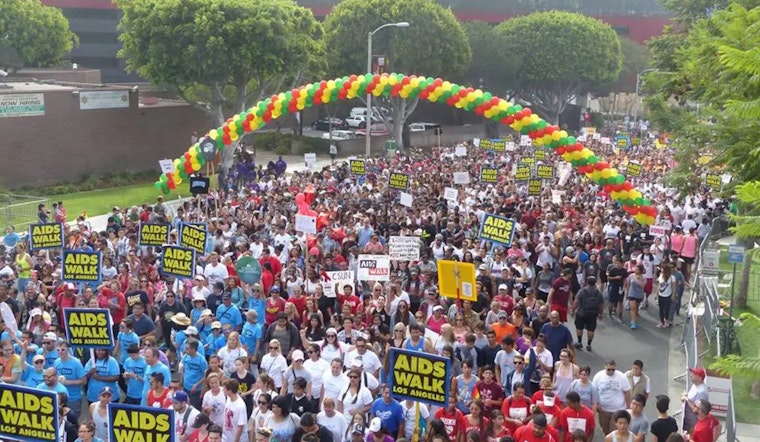
Registration is now open for the 42nd annual AIDS Walk Los Angeles, set for Sunday, October 18, when thousands are expected to gather at West Hollywood Park for a two-mile walk through the neighborhood's Rainbow District. Park doors open at 9 a.m., an opening ceremony begins at 10:30 a.m. with live music, remarks from activists and booths staffed by community organizations, and the walk itself steps off at 11 a.m.
The event is presented by APLA Health, and this year's theme, “Defend Care, Demand Action,” reflects a tense moment for the organization. As reported by MyNewsLA.com, organizers say modern tools including pre-exposure prophylaxis (PrEP), post-exposure prophylaxis (PEP) and long-acting injectable medications have dramatically improved HIV prevention, and that modern treatment can reduce the amount of virus in the blood to undetectable levels. Yet those medical gains are colliding with budget pressures that organizers say threaten to unwind decades of progress.
“The biggest risk to decades of progress is the assumption that the work is finished,” APLA Health CEO Craig E. Thompson said, per the same MyNewsLA.com report. Thompson added that HIV remains a crisis for people who are low-income, uninsured, or pushed to the margins, and said staying healthy should not depend on income or zip code. “The medicine works, but access depends on who can get it,” he said, noting that access to prevention and treatment remains an ongoing concern for the organization.
A Fundraising Goal Nearly Double Last Year's Haul
Organizers have set a fundraising target of $1,025,000 for the October walk, according to AIDS Walk Los Angeles, with more than $280,000 already raised by late August. That goal comes after the 2025 walk raised $1.05 million for APLA Health and local partner HIV organizations, according to APLA Health. Since AIDS Walk Los Angeles began in July 1985, it has raised nearly $100 million toward HIV/AIDS prevention, medical care and support services across Southern California, per APLA Health.
That first walk in 1985 was organized as an emergency grassroots response, with activists demanding government action during the epidemic's earliest, most desperate years. The inaugural event set out to raise $100,000 and ended up bringing in $673,000, according to APLA Health's account of the walk's history. Registration for this year's event is open now at aidswalkla.org, with proceeds going toward HIV-related health care and support services.
From a Closet Hotline to a Countywide Health System
APLA Health, formerly known as AIDS Project Los Angeles, was founded in October 1982 by four activists — Nancy Cole Sawaya, Matt Redman, Ervin Munro and Max Drew — who ran a single-phone hotline out of a closet at the Los Angeles Gay and Lesbian Community Services Center. More than four decades later, the organization operates eight federally qualified health centers across Los Angeles County and serves more than 23,000 people annually, according to APLA Health's own accounting of its reach.
Among its longest-running programs is the Vance North Necessities of Life Program, which began in 1986 as a $35-a-week food voucher initiative and has grown into the nation's largest network of food pantries for people living with HIV/AIDS. But in late 2025, APLA Health reported a $900,000 reduction to its food pantry program tied to federal funding cuts, forcing the agency to reduce client capacity and cut PrEP navigator positions, according to the Beverly Press. The organization also maintains 24 dental chairs across four Los Angeles County locations, a specialized service dating to 1985 that was created to serve HIV-positive patients who were turned away from private dental practices due to stigma.
Local Numbers Show Progress, but Not an End to the Epidemic
Los Angeles County is home to roughly 59,400 people living with HIV, the second-largest such population of any county in the country, and records about 1,400 new HIV transmissions each year, according to the Los Angeles County Department of Public Health. There is encouraging movement in the data: reported HIV diagnoses fell 9% year over year, dropping from 1,565 cases between July 2023 and June 2024 to 1,428 cases between July 2024 and June 2025, per the county health department's tracking.
That downward trend is part of why organizers argue continued access to prevention tools like PrEP and PEP remains essential rather than optional. It's also the tension underlying this year's walk theme — medical science has largely solved the clinical side of HIV prevention and treatment, but socio-economic barriers, food insecurity and shrinking federal support are now the front line of the fight in Los Angeles County.





