

























































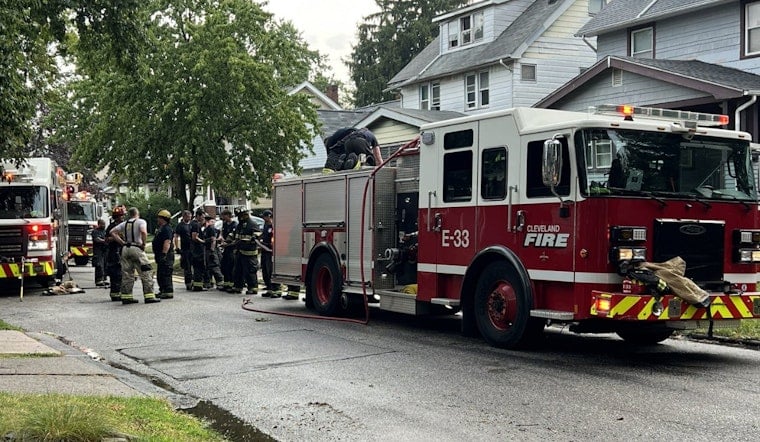
An adult woman living on West 139th Street south of Lorain Avenue had to self-evacuate through a second-floor window Friday morning as a well-involved house fire tore through her home, and five family pets did not make it out. Two dogs and three cats died in the blaze, while the resident was rushed to the hospital and is now listed in stable condition.
The Cleveland Division of Fire responded to the fire in Battalion 3's coverage area, according to a post from ClevelandFire, the official X account of the city's fire division. Cleveland EMS unit M38 transported the woman to MetroHealth, and fire officials said the blaze has since been determined to be unintentional. The department also estimated the property loss at $150,000.
Standard Route to Ohio's Only Verified Burn Center
Sending the injured resident to MetroHealth reflects routine protocol for Cleveland fire and smoke-inhalation emergencies. MetroHealth operates Ohio's only burn center verified for both adult and pediatric care by the American Burn Association and American College of Surgeons, treating more than 1,700 burn injuries annually, according to MetroHealth. Its main campus on MetroHealth Drive serves as Cleveland's primary Level I adult trauma and burn center, which explains why emergency crews across the city routinely funnel serious fire injuries there.
The exact ignition source for the West 139th Street fire has not been made public, and it remains unclear whether working smoke alarms were installed inside the home. The Cleveland Division of Fire's Fire Investigation Unit, which employs dual-certified firefighter-police officers, typically evaluates electrical systems, heating appliances and burn patterns to determine a blaze's origin and calculate losses, per a report from Signal Cleveland.
Older Homes, Faster Fires
Homes along that stretch of West 139th Street, south of Lorain in the West Park area, are largely multi-story single-family houses built in the 1910s and 1920s, according to property records reviewed by Realtor.com. Older wood-frame construction like this can let fire spread quickly through uninsulated wall cavities, a dynamic that may help explain why the resident had so little time before she had to jump from an upstairs window to escape. Research from the Home Fire Sprinkler Coalition and the National Fire Protection Association shows modern furnishings and building materials burn far faster than older materials, sometimes leaving occupants as little as two minutes to get out once a home fire ignites.
The loss of the two dogs and three cats fits into a grim national pattern. National fire safety organizations estimate more than 40,000 pets die in U.S. residential fires every year, primarily from smoke inhalation, according to the National Volunteer Fire Council. Cleveland's own fire toll has been climbing: the city recorded 16 fatal residential fires in 2025, its highest annual death count since 2006, prompting fire officials to renew public warnings about smoke alarms, as reported by WKYC.
Free Smoke Detectors Available Citywide
The Cleveland Division of Fire partners with the American Red Cross on Operation Save-A-Life, a program that provides and installs free smoke detectors and batteries for low-income and elderly residents across the city. Municipal fire officials estimate that nearly a third of smoke alarms in Cleveland homes are non-functional because of worn or missing batteries, according to the City of Cleveland.
Regionally, the American Red Cross of Northern Ohio responded to nearly 1,050 home fires between June 30, 2024, and July 1, 2025, assisting more than 4,600 residents while documenting 36 civilian fire deaths. The organization's Disaster Action Teams average roughly three residential fire responses a day across Northern Ohio and typically coordinate directly with fire departments at the scene to provide emergency lodging, financial assistance, food and mental health support to families who are displaced.
Federal data underscores why Ohio house fires carry heightened risk. The U.S. Fire Administration reports Ohio sees 34.4 injuries and 8.4 deaths per 1,000 residential structure fires, both above national averages, with residential fires accounting for roughly 85 percent of civilian fire deaths nationwide. ClevelandFire, which is not staffed around the clock on social media, reminded followers to dial 9-1-1 for emergencies rather than relying on the department's X account for real-time response.
This is at least the fifth West Side or citywide residential fire Hoodline has covered involving hospital transport since January, following blazes in Clark-Fulton, Glenville-area streets and other Cleveland neighborhoods that similarly displaced residents and, in some cases, injured pets.





