

























































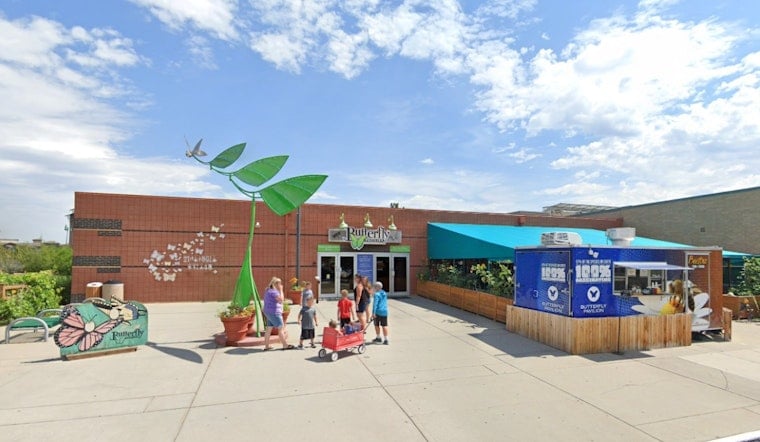
Butterfly Pavilion in Westminster is closing part of its aquatics gallery this month to prepare for a resident it has never housed before: a giant Pacific octopus, expected to arrive in early September. The move will make the nonprofit invertebrate zoo just the second place in Colorado, after Denver's Downtown Aquarium, where visitors can see one of the world's largest octopus species up close.
The octopus is the centerpiece of a $250,000 overhaul of the facility's Water's Edge exhibit, according to Westword. The project triples the venue's saltwater capacity to more than 3,000 gallons and adds 325 square feet to the exhibit, growing it to 1,100 square feet with eight new exhibits and 12 total habitats. Construction runs from August 17 through September 14, timed, per the outlet, because crowds typically decline as schools resume and before field trips and fall attendance pick back up.
The octopus itself will live in a 1,200-gallon tank fed by a life-support system with 300 gallons of additional capacity. Its sex is currently unknown, and staff has not settled on a name. Butterfly Pavilion's Brianna Firestone said the pavilion wants to meet the octopus before naming it, and the organization plans to select three possible names and let the public vote on the final choice, the report notes.
An Eight-Armed Toddler With Three Hearts
Giant Pacific octopuses are the largest octopus species on Earth, with three hearts, blue copper-based blood, and nine brains, and they typically weigh 50 to 100 pounds with arm spans of 12 to 14 feet, according to the Seattle Aquarium. Despite that size and intelligence, the species lives just three to five years, dying after a single terminal reproductive period known as senescence, per OctoNation. Female octopuses lay tens of thousands of eggs and brood them continuously without eating until death, the same account notes.
That short lifespan means keepers can't simply set an octopus loose and walk away. Sara Stevens described giant Pacific octopuses as giant eight-armed toddlers, per the Westword report, and staff use adapted dog toys and puzzle feeders for enrichment. The animals can also be trained to voluntarily enter a basket for weighing and health checks, the outlet reports, a technique that helps keepers monitor their condition without added stress.
Filling A Gap Left By A Shelved Broomfield Move
The octopus expansion follows a bigger decision the nonprofit made last year. In February 2025, Butterfly Pavilion officially canceled plans for an 80,000-square-foot relocation to the Baseline development in Broomfield, citing changing economic conditions, as reported by KUNC. The Broomfield project had been in development since 2018 before the nonprofit opted to remain in Westminster while it explores future expansion options.
Even without the new campus, Butterfly Pavilion still manages the world's first certified Pollinator District in Broomfield's Baseline community, a pilot program established in 2019 that integrates native plant habitats into the suburban development. Rather than build new, the organization redirected resources into reworking its existing galleries — reorganizing tanks and back-of-house areas and adding archways and custom enclosures to the redesigned Water's Edge exhibit, which has been in development for about a year.
Jellies, Isopods And A Living Tidepool
The octopus won't be the only new face in the gallery. Water's Edge will introduce 100 to 150 new animals representing roughly five to 10 species the pavilion has never housed before, including moon jellies, Pacific sea nettles, fish-eating anemones, a Debelius reef lobster, and giant isopods. Deep-sea isopods are arriving from Japan, while some jellyfish will come from Omaha's Henry Doorly Zoo and Aquarium, Denver's Downtown Aquarium, and other Association of Zoos and Aquariums institutions.
A new living tide pool holds 400 gallons and is designed to support about 10 to 15 species, including ochre sea stars, with shallower areas built for children and guests with mobility limitations. Sara Stevens said the new touch tank enables accessible animal engagement while allowing animals to remain uncontacted, and a full acrylic viewing panel lets visitors watch without disturbing residents. An illuminated reef feature will also let guests create glowing coral reef patterns, and Stevens said the expansion will give the ocean biome more attention while showcasing ocean invertebrate diversity.
Why An Invertebrate Zoo Matters
Butterfly Pavilion, which opened July 15, 1995, bills itself as the world's first standalone, Association of Zoos and Aquariums-accredited nonprofit invertebrate zoo. The Westminster facility draws nearly 400,000 visitors annually and has been named one of the top five tourist attractions in the Denver metro area by the Denver Business Journal, with annual gate admissions exceeding $2 million. Part of that funding comes from Colorado's Scientific and Cultural Facilities District, a voter-approved seven-county tax district established in 1988 that distributes more than $80 million annually to regional arts and science organizations, per the Scientific and Cultural Facilities District.
Invertebrates make up roughly 97 percent of all animal species on Earth, but conservation researchers warn many face severe population declines from habitat destruction, climate change and pesticides, according to KUNC's reporting. Sara Stevens put it plainly, calling invertebrates the forgotten heroes in every ecosystem — a framing that underlies why Butterfly Pavilion keeps expanding a gallery most zoos treat as an afterthought. The Water's Edge exhibit, and its still-unnamed octopus, is set to reopen to the public on September 14.





