

























































Two tall, blue powder-coated steel trees now stand at Miracle Park in Rock Hill, their yellow polycarbonate leaves swaying in the breeze and quietly doing double duty as a donor wall. The sculpture, called Sponsor Trees, was designed and built entirely by Winthrop University fine arts students who spent two semesters figuring out how to turn a thank-you list into a piece of public art.
The project debuted at the park in June 2026, according to Fort Mill Sun, which reported that the two-sculpture installation was designed by Winthrop students specifically to thank Miracle Park's donors. Winthrop University, located just a few miles from the park, describes the finished piece as two free-standing steel trees equipped with leaves that sway in the wind while displaying donors' names, functioning simultaneously as public art and a dynamic recognition display, per Winthrop University.
Fine arts professor Shaun Cassidy spearheaded the effort, and the Fort Mill Sun reports he described the central challenge as creating an interesting three-dimensional object that could also function as donor recognition. Cassidy initiated discussions with Miracle Park representatives in mid-2025, with student fabrication beginning in January 2026 ahead of the June installation, Winthrop University's release notes. That timeline means the sculpture moved from concept to finished public art over the course of two full academic semesters, a span the Fort Mill Sun's reporting also confirms.
A Student Fix For A Growing Donor List
One of the trickiest problems facing the student team was practical rather than artistic: as Miracle Park's donor base kept growing, the sculpture needed room to keep adding names. Fine arts student Forest Rain used digital design and fabrication technology to create the swaying polycarbonate leaves, resolving that structural challenge as contributions increased, according to Winthrop University. The Fort Mill Sun's reporting lists Rain among a larger group of participating fine arts students that included Ken Stiles, Jesse Gross, Zoe Gumangan, Gracelynn Mixon, Samuel Pach, Oliver Bartow, and Maria Emery.
The full arc of the work went well beyond welding steel, according to the Fort Mill Sun's account of the sculpture's development, which included brainstorming, budgeting, and meetings with clients among the required steps. That client-facing process gave students a taste of real-world design constraints rarely found in a studio classroom, where the deliverable has to satisfy both artistic vision and an outside institution's practical needs.
A Veteran Of Rock Hill Public Art Projects
Cassidy is no newcomer to putting Winthrop students' work into Rock Hill's public spaces. The British-born professor has taught sculpture at Winthrop University for more than 20 years, training in England and Canada before joining the school, and has previously led student projects across the city including the Wheels in Motion roundabout sculpture and a BMX-inspired artwork, according to Winthrop University's faculty profile.
Inside A Globally Certified Accessible Park
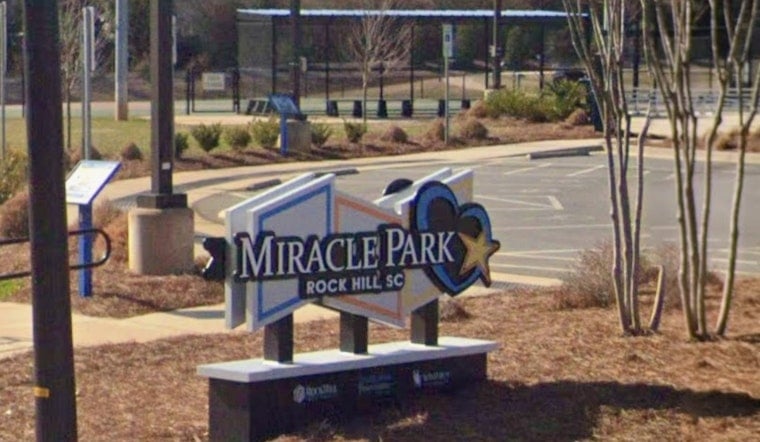
Sponsor Trees now lives inside a facility with an outsized reputation for inclusive design. Located at 1005 Eden Terrace, the 15-acre Miracle Park operates as a public-private partnership between the City of Rock Hill and the York County Disabilities Foundation, with the city handling maintenance while the foundation leads fundraising, per WRHI. In December 2021, the park became the first in the world to achieve a Global Universal Design Gold Certification from the Global Universal Design Commission, a distinction reported by Progressive Companies that recognizes spaces exceeding ADA standards to eliminate physical and social barriers.
The park has kept expanding well beyond its original footprint. Regional healthcare provider Novant Health announced a $150,000 partnership with Miracle Park in January 2026 to support inclusive outdoor space developments and community wellness initiatives across South Carolina and the Charlotte region, WRHI reported. Earlier in 2026, the park added a new 2,600-square-foot Education Building with indoor program space and a covered patio for community programs and adaptive recreational equipment storage, according to the City of Rock Hill.
Building Toward A Market Run By People With Disabilities
Miracle Park's ambitions extend past sports fields and playgrounds. The city's parks department notes that the park's planned 8,200-square-foot retail facility, the Miracle Market & Cafe, will be managed by MaxAbilities with a mission to train and employ people with physical and intellectual disabilities — a notable goal given that national employment rates for adults with intellectual disabilities remain around 34 percent, according to the same city account.
That mission has drawn corporate philanthropy from beyond the healthcare sector. Paper products manufacturer Domtar contributed a $20,000 grant in April 2025 toward the park's multi-phase expansion, adding to more than $4 million in total community fundraising, according to Domtar. The park's initial development phase cost approximately $8 million, per the same account.
The Sponsor Trees debut arrives as Winthrop University continues weaving its students into Rock Hill's civic fabric, from Cassidy's earlier roundabout sculptures to the university's role as a regional talent pipeline highlighted in Hoodline's coverage of Octapharma's $1.5B move to the city. For now, the swaying yellow leaves at Miracle Park stand as a smaller but no less deliberate example of that town-and-gown connection, built one donor name at a time.



