

























































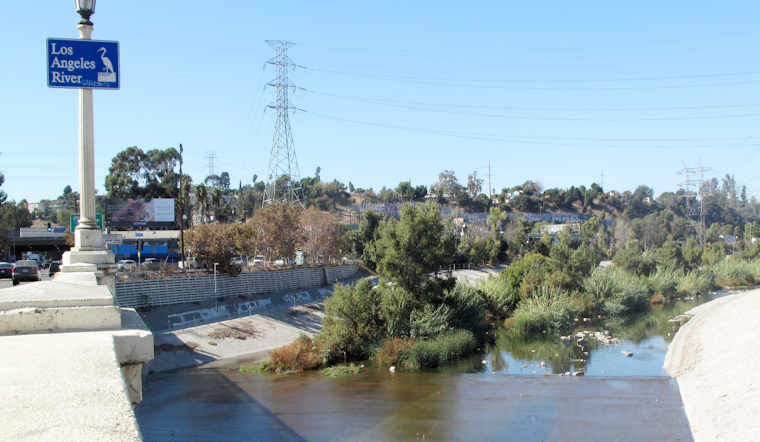
A woman was caught on camera casually floating through the Los Angeles River earlier this week with no raft, no tube, and nothing but the current carrying her along. Bystanders watching from a bridge or riverbank filmed her drifting through the fast-moving water, some reacting with disbelief as she bobbed through a channel that had swollen from record-high rain and snow runoff just days earlier.
According to the New York Post, the woman later said she was simply floating and being carried by the current, and the video quickly went viral after it was reposted on YouTube Shorts and Facebook. Onlookers in the footage can be heard exclaiming that there is no way this woman is in the water right now, capturing just how startling the sight was even to people used to seeing the concrete channel dry.
The river had grown from a small stream into what the Post's report described as a raging, brown-watered torrent after record-high rains and snow, conditions that turned an ordinary drainage channel into a genuine hazard. Some social media users likened the scene to real life Grand Theft Auto, a comparison that tracks with the game franchise's well-known replica of Los Angeles' concrete river channel, though the comparison undercuts just how dangerous the real thing can be.
Why the Channel Turns Lethal So Fast
The Los Angeles River is not a leisurely waterway even when it looks calm. During heavy rainstorms, water flow in the concrete-lined channel can reach speeds of up to 45 miles per hour as it drops roughly 800 feet in elevation across its 51-mile run from Canoga Park to Long Beach, according to a 1995 Los Angeles Times report. That steep grade, about 16 feet per mile compared with roughly four inches per mile on the Mississippi River, is what turns storm runoff into a violent, fast-moving hazard rather than a gentle current.
The channel exists in its current concrete form because of catastrophe. The U.S. Army Corps of Engineers built the 51-mile flood-control system after the Los Angeles flood of March 1938, which killed between 113 and 115 people and destroyed more than 5,000 buildings, per SFGATE's historical account. The 20-year channelization project was designed for one purpose: moving storm water out of urbanized neighborhoods as fast as possible, not hosting recreation.
That single-purpose design is exactly what makes self-rescue nearly impossible once someone is swept into moving water. High-velocity currents combined with slick concrete walls leave people with almost nothing to grab onto, which is why the Los Angeles Fire Department maintains specialized Swift Water Rescue Teams equipped with helicopter hoist systems and ground-tethered inflatable boats staged at points along the river.
A Pattern of Rescues Along the Channel
This is not an isolated scare. Hoodline previously reported that crews pulled a woman from the river in Boyle Heights after a 40-foot bridge fall, and in December 2025, LAFD Air Operations conducted a helicopter hoist rescue near Lankershim Boulevard in Arleta after a woman was swept downstream by rapid stormwater in the Tujunga Wash, a tributary that feeds into the main channel. A similar swift-water air rescue took place near Laurel Canyon Boulevard back in March 2024, underscoring how often storm-driven currents in and around the river turn deadly serious.
Swimming anywhere in the Los Angeles River is banned year-round under rules enforced by the Mountains Recreation and Conservation Authority and the City of Los Angeles, which permit only non-motorized boating, walking, and fishing, and only within designated recreation zones in the Sepulveda Basin and Elysian Valley during the Memorial Day through September 30 season, and only under ranger supervision. Floating through the current without a vessel, as the woman in the video did, falls outside those rules entirely.
Pollution Adds a Health Risk Beyond the Current
Even setting aside the risk of drowning, the water itself poses a health hazard. The Post's report noted the river contains high levels of bacteria, trash, and chemical pollutants, a concern echoed by LA Sanitation and Environment, which conducts twice-weekly E. coli testing during the summer recreation season and imposes mandatory 72-hour closures after rainstorms wash contaminated urban runoff into the channel. Because more than 60 percent of Los Angeles is paved, that runoff drains straight into the river rather than filtering through soil first.
Beyond the immediate danger, parts of the river have also served as a hidden refuge for homeless people, adding another layer of complexity to a channel that is simultaneously a flood-control necessity, a fragile ecosystem, and, increasingly, a magnet for viral moments. The Environmental Protection Agency's 2010 declaration of the river as a traditional navigable water opened the door to today's limited recreation zones, and Los Angeles County's 2021 River Master Plan is meant to balance habitat restoration and public access across roughly 2,300 acres bordering the corridor, but none of that changes the reality that unauthorized entry during high flow remains a life-threatening gamble.
The river's odd pull on the public imagination has only grown. Hoodline has covered a sober pop-up dance party that drew 1,500 RSVPs inside the dry riverbed, LAPD towing 72 cars from an unauthorized photo shoot in the channel, and even a DIY fingerboard park built onto the flood barriers in Atwater Village, all signs that Angelenos increasingly treat the concrete channel as a backdrop rather than the active flood infrastructure it remains. Officials continue to stress that whatever the current looks like on camera, entering it without authorization carries risks that go far beyond a viral clip.




