

























































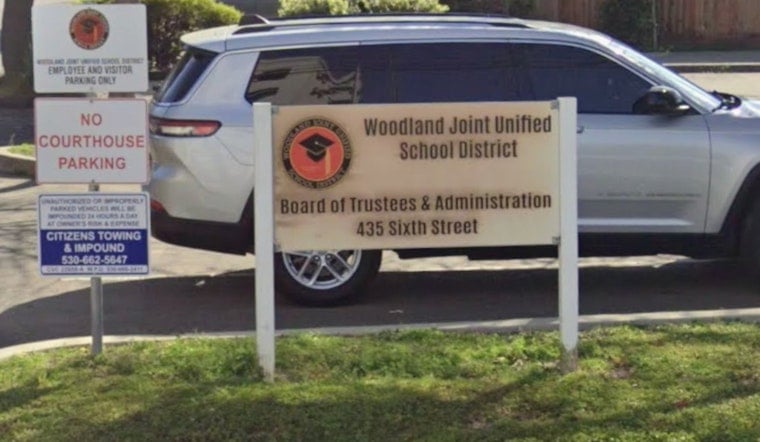
Woodland Joint Unified School District is preparing to redraw attendance boundaries for every one of its schools for the first time in 25 years, as new housing construction has packed some campuses well beyond their designed capacity while others sit less than half full. Tafoya Elementary is currently operating at 152 percent capacity, while Woodland High School has just 55 percent enrollment capacity — a gap district leaders say has become impossible to ignore.
The imbalance stems from concentrated residential construction in southeastern Woodland's Spring Lake development area, which has driven sharp student population growth near Tafoya and Spring Lake elementary campuses while leaving older neighborhood schools under-capacity, according to the Woodland Joint Unified School District. Beamer Elementary, Sci-Tech Elementary, and Plainfield Elementary are all less than half-full, while on the secondary side, Pioneer High School is more than 90 percent full even as Woodland High sits at roughly half capacity, as reported by CBS Sacramento. Rob Murray told the station that “there are fewer kids than there were 10 or 20 years ago,” a comment that captures the district's core challenge even as new homes keep going up around it.
Six Map Options, Four Community Meetings
The district released maps outlining potential boundary changes on August 14, presenting three separate options for elementary schools serving grades TK through 6 and three more for secondary schools serving grades 7 through 12. Those maps were finalized following preliminary trustee feedback at an August 6 board meeting, according to the district's announcement. WJUSD is the largest school district in Yolo County — larger than the Davis and West Sacramento school districts — which means the redrawing effort touches a wide swath of the city.
To gather input before trustees vote, the district scheduled four in-person community workshops at Woodland High, Lee Middle, Douglass Middle, and Pioneer High, including a Tuesday night session at Lee Middle School, per CBS Sacramento's report. An online feedback survey is also open through September 4. The Woodland school board is expected to make its final decision on September 10, and if approved, the new boundaries will take effect starting with the 2027–28 school year, giving families roughly a year to prepare.
Current Sixth-Graders Likely First Affected
Murray said current sixth-grade students would be the first ones potentially affected by a new middle school and high school assignment, since boundary changes are expected to primarily impact new students and elementary students once they graduate rather than uprooting kids already settled into a school. For some families, that timing lands close to home. Woodland parent Aime Wallace has twin boys in 4th grade whom she had expected would attend Pioneer High School, but the coming changes mean that could shift.
“I would be happy either way,” Wallace said of the possibility her sons end up at Pioneer or Woodland High instead, according to CBS Sacramento's report. She added that she trusts the school district to make the right decision, even as the changes mean some students will attend campuses different from those they had expected. Boundary shifts like these are inherently disruptive for families who have already mapped out which school colors their kids will wear, but Wallace's response suggests at least some residents are willing to give the district's process room to work.
A Citywide Puzzle: More Residents, Fewer Students
Woodland's situation reflects a broader demographic puzzle playing out across the city. The city's total population grew to approximately 62,800 residents by 2026, up roughly 3 percent from 60,993 in 2020, according to U.S. Census Bureau estimates. Yet WJUSD's total enrollment has moved in the opposite direction, falling to 9,299 students for the 2025–26 school year from 9,517 in 2022–23, per California Department of Education data. State records also show roughly 18 percent of WJUSD students are English Language Learners and nearly 59 percent are designated as socioeconomically disadvantaged, demographic factors that carry weight as officials consider where to draw new lines.
Woodland isn't alone in confronting this dynamic. In neighboring Davis, the Davis Joint Unified School District board voted in June to pause its own boundary realignment and campus closure process after losing more than 1,200 resident students over the preceding decade, deferring any action until at least Spring 2027. It's a reminder that shrinking enrollment paired with shifting neighborhoods is a broader Yolo County trend, not one unique to Woodland.
Facility Investments Continue Alongside Boundary Talks
The boundary discussion comes as the district continues to invest in its physical campuses. Voters approved Measure Y, a $44.2 million facility bond, in November 2020 with the required 55 percent supermajority, and that funding recently completed security, fencing, and pick-up area improvements at campuses including Lee Middle and Zamora Elementary this month. Separately, in November 2024 the district placed Measure P on the ballot, seeking $160 million in general obligation bonds to replace deteriorating portable classrooms and build modern STEAM facilities districtwide, according to Ballotpedia.
Whether the redrawn maps can meaningfully relieve overcrowding at Tafoya without triggering significant pushback from families shifted out of high-demand schools like Pioneer remains an open question the board will have to weigh before its September 10 vote. For now, the district is asking residents to weigh in on the six proposed maps while there's still time to shape the outcome.




