

























































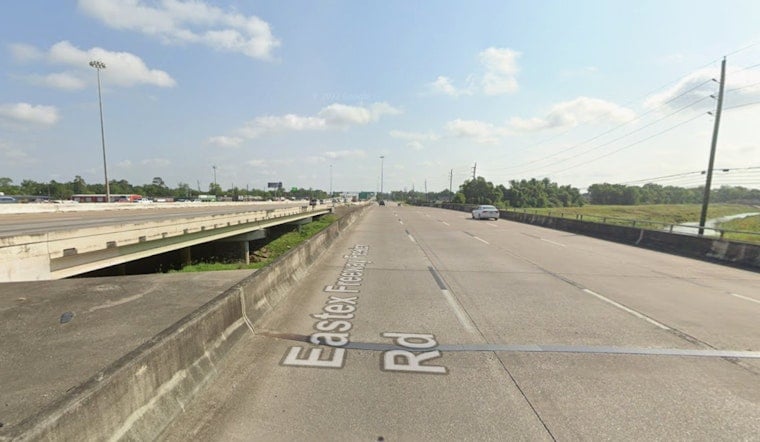
A wrong-way driver caused a head-on crash that killed one person and closed the Eastex Freeway near East Mount Houston Road early Saturday morning in northeast Harris County. Two vehicles were involved, each with a single driver, and the second driver was transported to a hospital with a condition that remains unknown.
Harris County Sheriff's Office deputies responded to a call for service at 13849 Eastex Freeway in reference to a wrong-way driver, according to a statement from Harris County Sheriff Ed Gonzalez. Upon arrival, units found the two vehicles had already crashed head-on, resulting in one fatality. The sheriff's office says it is now conducting an intoxication investigation into the wrong-way driver.
Gonzalez's statement noted that the northbound and outbound lanes of the Eastex Freeway were closed following the crash, with traffic being diverted off the ramp toward East Mount Houston Road. Media partners were directed to a staging area at a Chevron gas station adjacent to the scene as the investigation unfolded.
A Familiar and Deadly Pattern on Harris County Freeways
The stretch of US-59/IH-69 near East Mount Houston Road sits in a heavily traveled northeast Harris County corridor patrolled by both the sheriff's office and TxDOT, according to the San Antonio Express-News. It is not the first fatal wrong-way crash along this same freeway — in April 2024, a 24-year-old female wrong-way driver struck an oncoming vehicle near Rankin Road, killing both drivers and shutting down northbound lanes for hours, as reported by Click2Houston.
Wrong-way crashes remain a persistent danger across the county. A KHOU 11 analysis of Texas Department of Transportation data found that 111 people were killed in 2,891 wrong-way crashes in Harris County over a ten-year period, making it one of the state's worst hotspots for these collisions. Statewide, Texas leads the nation in fatal wrong-way driving, recording 1,199 fatal incidents between 2019 and 2023 — 6.4% of all fatal crashes in the state, double the national average, per the same KHOU analysis.
Why Deputies Are Investigating Intoxication
Studies from the Texas Department of Transportation and traffic safety researchers show that between 50% and 75% of wrong-way freeway collisions involve drivers impaired by alcohol or drugs, with the overwhelming majority occurring overnight or in the early-morning hours — a pattern that helps explain why deputies opened an intoxication investigation into Saturday's crash. Data from the AAA Foundation for Traffic Safety also shows that in fatal wrong-way collisions on divided highways, more than half of those killed are the wrong-way drivers themselves, while occupants of oncoming vehicles account for roughly 41% of deaths.
The physics behind these crashes make them uniquely lethal. Wrong-way collisions account for only about 3% of highway crashes on divided freeways, but according to National Transportation Safety Board data cited by transportation researchers and reported by ITS International, they produce fatality rates 12 to 27 times higher than other accident types because of the extreme combined impact speeds involved.
What Could Come Next for the Surviving Driver
If investigators determine the surviving driver was impaired, that person could face Intoxication Manslaughter charges under Texas Penal Code Section 49.08. The offense is a second-degree felony carrying 2 to 20 years in prison and a fine of up to $10,000 per victim if an intoxicated driver is found to have caused a fatal crash.
Several key details remain unresolved, including the exact point where the wrong-way driver entered the Eastex Freeway, toxicology results, the identity of the driver who died, and an updated medical condition for the hospitalized driver. Harris County recorded 579 total traffic fatalities in 2024, more than any other county in Texas, underscoring how frequently roadways like this one turn deadly.
TxDOT has rolled out wrong-way countermeasures on some Texas highways — including lowered reflective wrong-way signs, LED flashing alerts, radar detection units, and AI-enabled thermal sensors — that the agency says helped more than 90% of wrong-way drivers self-correct before entering highway main lanes during 2024 testing. Whether any such technology was present along this stretch of the Eastex Freeway has not been detailed in official statements.




