

























































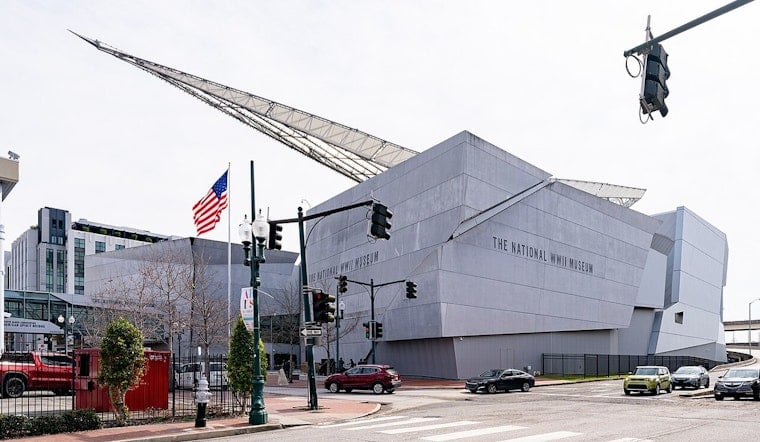
A World War II-era jeep with a disabled axle now sits inside the National WWII Museum in New Orleans, part of a sprawling new exhibit built around the ink-and-paper work of Bill Mauldin, the Army cartoonist whose grimy, weary infantrymen Willie and Joe became the visual shorthand for the American GI experience. The exhibit, titled Drawn to Combat: Bill Mauldin and the Art of War, is on view through April 18, 2027, and pairs Mauldin's original drawings with real wartime artifacts, including the Purple Heart he earned after taking shrapnel from a German mortar.
According to NOLA.com, the exhibit originated at the Pritzker Military Museum & Library in Kenosha, Wisconsin, before the New Orleans museum expanded its presentation into the Alario Special Exhibition Hall. The show combines real photos, artifacts and ink-on-paper illustrations, and includes a tableau built around the disabled jeep alongside Mauldin's Purple Heart. It also traces Mauldin's earliest artwork, drawn during his New Mexico childhood in the Depression, and follows him through his start cartooning for his high school newspaper in Phoenix.
Mauldin joined the Arizona National Guard in 1939, and when Franklin Roosevelt federalized the 45th Infantry Division, Mauldin's unit was swept into the coming war. He created cartoons for the 45th Division News before his work reached a far wider audience, and he spent most of World War II fighting in Italy, drawing on that firsthand experience of foxholes and front-line conditions that the museum has recreated for visitors. The National WWII Museum notes that curators built physical 3D environments — foxholes, makeshift command posts, bombed-out buildings — using its own artifact collection to complement the traveling show, translating Mauldin's two-dimensional sketches into walk-through spaces.
The Cartoons That Made Willie and Joe Household Names
Willie and Joe became the voice of the American GI during World War II, according to NOLA.com's report, and the two characters conveyed the exhaustion, cynicism and humanity of the ordinary soldier rather than the polished heroism found in official war messaging. That authenticity did not sit well with everyone in uniform. In March 1945, Lt. Gen. George S. Patton summoned then-23-year-old Mauldin to his Luxembourg headquarters to scold him over Willie and Joe's unkempt appearance, viewing the disheveled cartoon soldiers as a threat to discipline, according to the Pritzker Military Museum & Library.
General Dwight D. Eisenhower ultimately ordered senior officers not to interfere with the cartoonist's work in Stars and Stripes, a decision that protected Mauldin's editorial independence at a moment when GI morale hung in the balance. Mauldin won his first Pulitzer Prize for Editorial Cartooning in 1945 at age 23, making him one of the youngest recipients in the prize's history, according to Britannica. His winning cartoon mocked a cheery news headline while showing ragged GIs slogging through the rain, a tone that ran through his bestselling wartime memoir, Up Front, which was later adapted into a movie.
From the Front Lines to Politics and a Second Pulitzer
Mauldin's public life did not end with the war. He ran for Congress in 1956 as the Democratic candidate for New York's 28th Congressional District, though he lost in the predominantly conservative rural district; he later described himself as an old Truman Democrat whose platform was considered far left there, according to the St. Louis Public Library. He went on to work as a political cartoonist for newspapers in St. Louis and Chicago, and in 1959, while at the St. Louis Post-Dispatch, he won a second Pulitzer Prize for a cartoon depicting Soviet writer Boris Pasternak in a Siberian gulag asking a fellow prisoner what crime he'd committed to win the Nobel Prize — a jab at the Soviet government's forcing Pasternak to decline the 1958 Nobel Prize for Literature he'd won for Doctor Zhivago, per Encyclopedia.com.
Per the NOLA.com report, Mauldin also created a cartoon depicting the Lincoln Memorial statue grieving over President John F. Kennedy's assassination in 1963, one of several political cartoons that cemented his standing well beyond the war years. The New Orleans exhibit concludes with letters from U.S. presidents, senators and service members, underscoring how far his influence reached across American public life.
A Curator's View and a Cultural Ripple Effect
Museum curator Chase Tomlin said the museum emphasized Mauldin's World War II years in shaping the exhibit, according to NOLA.com's reporting. A July 16 panel presentation opened Drawn to Combat, featuring Tomlin alongside Mauldin's son Nat Mauldin and biographer Todd DePastino; a recording of that panel is archived at nationalww2museum.org for anyone who missed the launch.
Mauldin's reach extended into pop culture long after the war ended. Peanuts creator Charles M. Schulz, himself a World War II veteran, paid tribute to Mauldin every Veterans Day from 1969 to 1998 by depicting Snoopy walking over to Bill Mauldin's house to quaff a few root beers, according to Coffee or Die. The U.S. Postal Service dedicated a 44-cent commemorative stamp featuring Mauldin alongside Willie and Joe on March 31, 2010, at a ceremony in Santa Fe, New Mexico, according to the U.S. Postal Service.
Mauldin died on January 22, 2003, at age 81 and was buried with full military honors at Arlington National Cemetery, holding both a Purple Heart and a Legion of Merit from his wartime service, according to Warfare History Network. Shortly before his death, fellow World War II veteran Jay Gruenfeld organized a national letter campaign that sent more than 10,000 gratitude cards and letters to Mauldin at his California nursing home, a wave of tributes from veterans who credited his cartoons with keeping their spirits alive during combat.
Museum Month Events Surround the Exhibit's Run
The New Orleans exhibit's run coincides with a slate of local museum events tied to the city's Museum Month, as detailed in the NOLA.com article by writer Dave Walker, who covers behind-the-scenes regional museum activity. Gallier House will host an after-hours event with guided tours and libations from 7 to 8:30 p.m. on Wednesday, and members of other participating museums receive a five-dollar admission discount that evening.
Additional Museum Month programming is set for August 26, including a Hermann-Grima House after-hours event from 6 to 7:30 p.m., a Quarter Kaleidoscope storytelling event themed Summertime in New Orleans at the Historic BK House & Gardens at 6 p.m., and a screening of Grit & Grace: How Jewish Women Built a Better Texas at the Museum of the Southern Jewish Experience at 6 p.m., followed by a talk from Barbara Rosenthal. None of the satellite events are part of the Mauldin exhibit itself, but they reflect the broader museum-going moment the New Orleans show has landed in.





.jpg)