

























































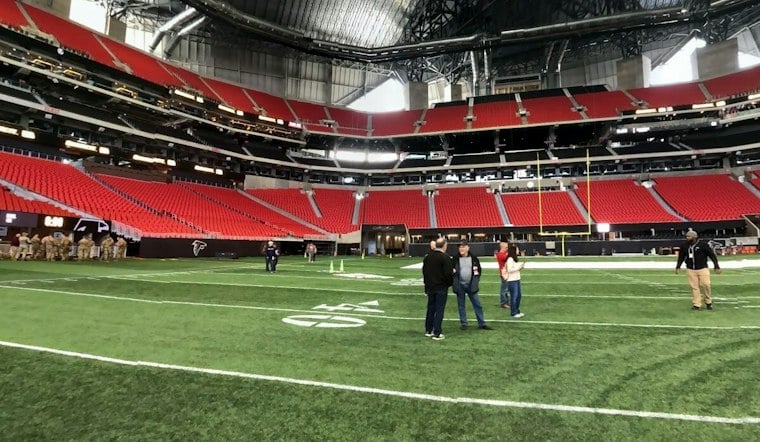
A 13-year-old boy who lost his leg in a motorcycle accident with his father last year ran onto a football field again Saturday, one of dozens of people with limb loss who came to Meadowcreek Mustangs Stadium in Norcross for the first Adaptive Sports Day hosted by the Atlanta Falcons and prosthetics manufacturer Ottobock. Participants worked through movement sessions, relays, and football drills as part of a clinic designed to get people living with limb loss moving again ahead of the Falcons' home opener against the Carolina Panthers.
The event, held one day before the Falcons hosted the Panthers, capped a partnership the two organizations announced last week naming Ottobock as the Falcons' first-ever Official Adaptive Mobility Partner, according to Atlanta News First. The announcement, made through PR Newswire, described a multi-year agreement centered on hands-on athletic programming and mobility clinics across the Atlanta region rather than a one-time promotional stunt. Ottobock specialists on-site provided custom prosthetic running blade fittings and clinical support for attendees, the station reported.
A Teen's Return to the Field
Among the participants was 13-year-old Dylan Reems, who lost his leg following a motorcycle accident with his father in 2025. Reems said he thought his football career was over after the crash, but Saturday he was back playing football and having fun with his friends again, the station reported. Organizers said confidence and belonging were the driving purpose behind the clinic.
Former Falcons wide receiver Michael Haynes helped lead football drills at the event alongside two men whose own paths to the field were shaped by trauma. Jarryd Wallace, a four-time Paralympian, also led drills; the Athens, Georgia native and University of Georgia alumnus underwent a below-the-knee amputation at age 20 due to chronic compartment syndrome before winning bronze in the 200m at Tokyo 2020 and bronze in the long jump at Paris 2024, according to University of Georgia Athletics.
From SEC Locker Room to UAB Hospital Bed
Co-drill leader Ka'Darian ‘KD’ Hill, a former Ole Miss defensive tackle and below-knee amputee, brought his own story to the field. Hill suffered his amputation in July 2023 after being pinned in a severe car crash on Interstate 65 in Alabama after being invited to try out for two NFL teams, requiring five hours of extrication and seven surgeries at UAB Hospital before he pivoted to motivational coaching, per UAB News.
Not every participant came from a football background. Navy veteran Geoff Norman, who lost his leg below the knee in a motorcycle crash, tested a lightweight carbon running blade for the first time in four years at the Norcross event, according to WSB-TV. Norman reported that the blade is taller and that a runner sinks into it.
Why Access to Running Blades Is Expanding in Georgia
The clinic arrived alongside a shift in state policy. In May 2025, Georgia passed Senate Bill 101, mandating that commercial health insurance policies cover medically necessary orthotic and prosthetic devices — including up to three devices per affected limb every three years to support physical activities — effective January 1, 2026. The O&P EDGE Magazine reported that Georgia became the 10th state to pass such legislative reforms requiring health plans to cover activity-specific prosthetics.
That coverage matters because specialized athletic running blades and recreational prostheses typically cost between $15,000 and $25,000 out of pocket without insurance, according to testimony filed with the Connecticut General Assembly. Healthcare advocates cited in that same record point out that physical inactivity costs the U.S. healthcare system $192 billion annually, framing adaptive equipment as a tool for enabling healthy living rather than a luxury purchase.
Ottobock's Decades in Paralympic Sport
Ottobock is a global prosthetics manufacturer founded in Germany in 1919, with North American headquarters in Austin, Texas. The company has supported the Paralympics since 1988, per the International Paralympic Committee.
JP Rahmann, executive director of corporate marketing for Ottobock North America, said everyone has the right to lead an active life and that amputation does not mean giving up on athletics. The Adaptive Sports Day clinic was clinically directed by Lucas Crisanti, a certified prosthetist orthotist and global running coach, who led participants through product fittings, gait evaluations, running mechanics, and football drills, according to PR Newswire's account of the partnership.
A Broader Push Toward Service-Based Sponsorships
Sports marketing analysts note that professional team partnerships like this one are increasingly shifting from static logo placement toward what Trend Hunter calls service-based sports sponsorships — deals that deliver direct clinical care and mobility technology to local communities rather than simple brand visibility. These programs let franchises expand accessibility initiatives while MedTech companies demonstrate their devices in live athletic settings.
Nearly 2 million people in the United States are living with limb loss. Organizers and team partners said they hope Adaptive Sports Day will show participants of all ages that they are not alone on their journey back to movement, a goal that played out plainly in Norcross when a 13-year-old who thought his football days were finished found himself back on the field with his friends.





