

























































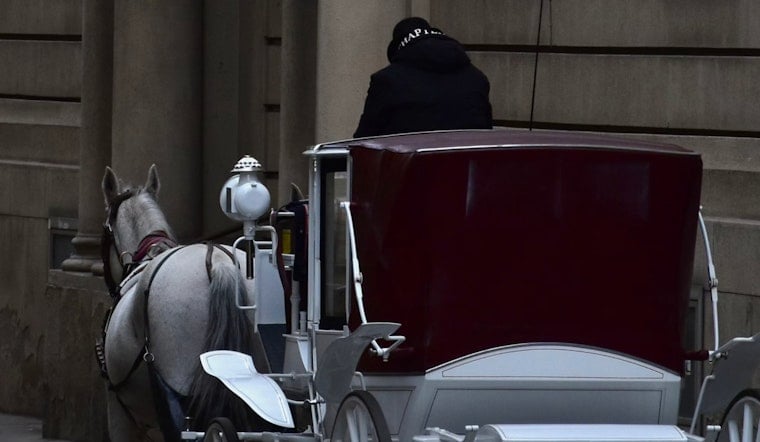
A 17-year-old Percheron named Snowman tripped and fell while pulling a carriage in Central Park on Saturday night, tumbling to the pavement after stepping up and down a curb before handlers rushed in to help him back to his feet. The horse was unhitched, examined by a veterinarian who cleared him of injuries, and led back to the stable, but the fall has reignited a fierce citywide fight over whether Central Park's horse-drawn carriages should still exist at all.
The incident happened around 10:21 pm, according to amNewYork, which reported that handlers unhitched Snowman so he could more easily get up before re-hitching him to the carriage afterward. A spokesperson for TWU Local 100, the union representing horse carriage drivers, said Snowman tripped after becoming antsy and impatient because he had not had many rides that night. The horse did not work the following Sunday or Monday, and TWU suspended rides entirely this Tuesday due to the weather.
Animal Rights Group Demands Investigation
Animal rights group NYCLASS wasted no time responding, calling for an investigation into the fall. NYCLASS director Edita Birnkrant said the latest incident exemplifies profound neglect of horses by the industry, and she demanded an immediate investigation by relevant authorities. Birnkrant also renewed her call for the City Council to pass Romanch's Law, the bill that would end the carriage-horse industry in Central Park.
TWU Local 100 pushed back firmly, saying the animals are well cared for and warning that a ban would eliminate drivers' jobs and livelihoods. The union represents horse carriage drivers and has consistently opposed a ban on the industry. Supporters of Romanch's Law counter that the carriage-horse industry poses unnecessary risks to both horses and the public, an argument that has gained real traction at City Hall in recent months.
A Bill Renamed After a Tourist's Death
Romanch's Law is named for Romanch Mahajan, an 18-year-old tourist from India who was killed after a horse-drawn carriage flipped over in Central Park on June 17, 2026. According to CBS News, the fatal accident occurred at Cherry Hill when the carriage driver stepped away to take a photo of the family, causing the unguided horse to spook and bolt, throwing Mahajan as he tried to protect his mother. Two months later, the Mahajan family announced plans to file legal claims against multiple city agencies for failing to prevent the accident, per PIX11.
The bill, formally Intro 0943 and introduced by Council Member Christopher Marte, would immediately ban new carriage horse licenses, phase out the industry entirely by June 1, 2028, prohibit sending retired horses to slaughter or other carriage businesses, and require the Department of Consumer and Worker Protection to run a job transition program for drivers, according to the Animal Legal Defense Fund. The measure was originally introduced as Ryder's Law following the 2022 collapse of an emaciated 26-year-old carriage horse named Ryder on Ninth Avenue, a case that Hoodline previously reported led to animal cruelty charges against Ryder's driver before the horse died that October.
Momentum Builds Toward a Council Vote
Just a week before Mahajan's death, a 16-year-old carriage horse named Deniz collapsed and died inside the park on June 10, 2026. A Cornell University necropsy later determined the cause was sudden cardiac arrest triggered by ingesting toxic Japanese yew plant material in the park, according to CBS News. The back-to-back tragedies helped push Romanch's Law past a critical threshold: during a nine-to-ten-hour City Council Committee on Health hearing on July 15, the bill picked up its 26th and 27th co-sponsors, giving it majority support among the Council's 51 members, as the Columbia Spectator reported.
A day before that hearing, City Council Speaker Julie Menin became the first sitting Speaker in city history to publicly endorse a bill banning horse-drawn carriages from Central Park, according to the New York City Council. The Central Park Conservancy has also thrown its weight behind the ban, reporting in July that eight serious horse-related incidents occurred inside the park over a 13-month period before officially endorsing legislation to end carriage rides for good.
The Industry's Economic Stakes
New York City's horse carriage industry is capped by law at 68 permitted carriages operating out of three West Side Manhattan stables, supporting roughly 160 active horses and an estimated 150 to 200 drivers and stable workers, according to The Guardian. Under existing city Health Code and Administrative Code rules, carriage horses are already barred from working when temperatures hit 90 degrees or drop below 18 degrees, capped at nine working hours per 24-hour period, and guaranteed five weeks of mandated pasture vacation each year — the very regulations TWU Local 100 argues are already sufficient to keep the animals safe.
The NYC Department of Health and Mental Hygiene, which regulates the carriage-horse industry, had not responded to amNewYork's request for comment on Snowman's fall. Snowman's stumble follows a string of recent scares that have kept the debate simmering, including a carriage that overturned near 7th Avenue in May, a runaway horse named Destiny that charged through Midtown traffic in January, and a runaway named Sundance that raced down the Van Wyck Expressway near JFK Airport in December. With the Council now holding majority support for Romanch's Law and the Mahajan family's legal claims looming, the industry's fate may be decided in the coming months.





