

























































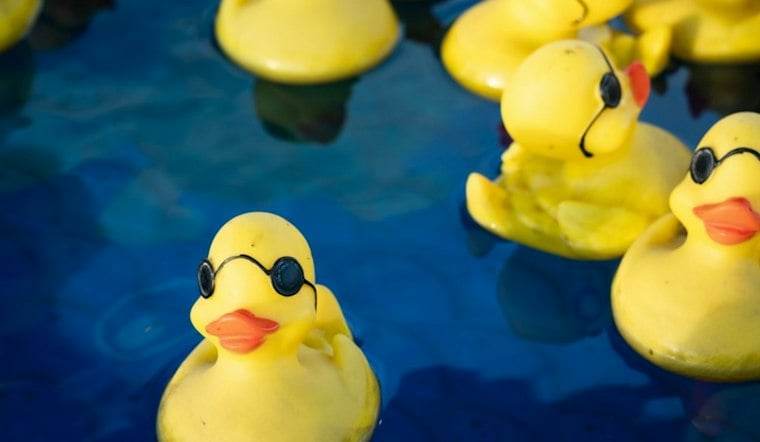
More than 20,000 rubber ducks bobbed down the Ala Wai Canal in Waikiki Saturday afternoon, launched behind the Hawaii Convention Center around 1:20 p.m. for the 37th running of the Great Hawaii Rubber Duckie Race, an annual fundraiser benefiting keiki with cerebral palsy across Oahu.
Each plastic duck cost $5 to adopt, and the race drew hundreds of spectators who came out for live music, duck-themed games, food and shaved ice along the canal, according to Hawaii News Now. The race benefits the United Cerebral Palsy Association of Hawaii, which has provided services in the islands since 1959 and describes itself as part of United Cerebral Palsy's nationwide network, according to United Cerebral Palsy Association of Hawai'i.
Funds Stay Local to Support Early Intervention
Organizers raised roughly $65,000 to $70,000 through this year's race, and all of it stays in the islands to support about 500 keiki and their families with cerebral palsy treatment costs, per the same account. The nonprofit serves families in the greater Honolulu area between Pearl Harbor and Hawaii Kai, and separately says on its own site that it provides direct services to at least 600 children through its Early Intervention Programs, which serve kids from birth to age three. Those programs include speech and language services, occupational therapy, physical therapy, special education and care coordination, according to United Cerebral Palsy Association of Hawai'i.
John Nishida, executive director of United Cerebral Palsy of Hawaii, said participation in events like the duckie race has been slowing down, pointing to rising gas prices as well as Kona lows and recent storms as factors, the station's report noted. The organization's website also notes it accepts online donations year-round for those who want to support the cause outside of race day.
One Duck Adoption, One Trip to Tokyo
The top 50 finishers won prizes, and even the duck that crossed in last place took home a prize of its own. But the biggest win of the day belonged to Wendy Takara, who won Saturday's race along with a trip to Japan. She said she was shocked by the win and hadn't thought she had a real shot at taking the top prize, per the same account. Takara said she plans to bring her husband along on the trip.
United Cerebral Palsy Association of Hawai'i's own website advertises the race's grand prize as a trip for two to Tokyo, and describes its duck races on Oahu and the Big Island as its best-known fundraising events, with every duck adopted going toward services for keiki. A 2026 event listing separately described a 37th Great Hawaii Rubber Duckie Race scheduled for Sept. 12 at the Ko'olau Center, a detail that could not be reconciled with the Ala Wai Canal race description, according to local.staradvertiser.com.
Why the Race Matters Beyond Race Day
Cerebral palsy affects a small but steady share of children nationwide — the Centers for Disease Control and Prevention's data indicate roughly 2.4 out of every 1,000 U.S. children age 8 have the condition, according to cdc.gov. For Hawaii families, the annual duck race has become one of the more visible ways the community rallies behind that need, translating a few plastic toys bobbing down a canal into therapy sessions, care coordination and support that organizers say keeps kids and their families afloat long after the ducks are pulled from the water.





