

























































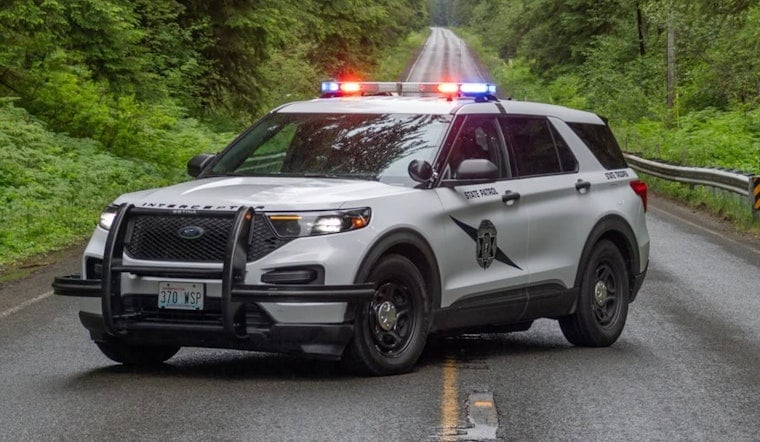
A Washington State Patrol trooper tried to pull over a driver going 96 mph in a 60 mph zone, kicking off a pursuit that wound onto Interstate 5 and into downtown Seattle before the driver abandoned the car and ran off on foot. Troopers deployed spike strips and attempted a PIT maneuver to end the chase, but neither worked, and a WSP aircraft that had been tracking the vehicle from above eventually lost sight of the driver after the car exited the freeway at Olive Way.
WSP spokesperson Rick Johnson said the pursuit began after a trooper tried to stop the speeding driver, according to KING5.com. As the vehicle sped away, troopers deployed spike strips and attempted to force it to a stop with a PIT maneuver, ramming it from behind in an effort to spin the car to a controlled stop, but the tactic did not work. A WSP Cessna followed the vehicle from the air throughout the chase, maintaining visual contact even as ground troopers worked to bring the pursuit to an end.
Troopers Pull Back as Chase Hits City Streets
Once the vehicle exited I-5 at Olive Way and entered downtown Seattle, ground troopers backed off from the pursuit, per the station's report. That pullback reflects standard Washington State Patrol tactics: agency procedure calls for disengaging ground cruisers in dense urban areas while relying on aerial surveillance to keep watch on a fleeing vehicle, reducing the risk of a high-speed crash on crowded city streets, according to the Washington State Patrol.
The WSP plane kept tracking the vehicle even after ground units disengaged, but the driver eventually left the car and fled on foot, at which point the aircraft lost sight of the driver. Troopers were not able to locate the driver following the foot escape, per the same account.
How Troopers Identified a Suspect Without an Arrest
Despite losing physical sight of the driver, troopers identified the person as the vehicle's registered owner, the outlet reports. WSP said it plans to forward charges to prosecutors, though establishing that the registered owner was actually behind the wheel during the escape is a standard that requires proof beyond a reasonable doubt for a felony charge, per the Washington State Legislature.
Prosecutors evaluating the case are likely to look at felony eluding under RCW 46.61.024, which makes it a Class C felony punishable by up to five years in prison for a driver to willfully refuse to stop for a uniformed officer's signals and drive recklessly while trying to get away, according to the Law Office of Erin Bradley McAleer. That charge can apply even though the original attempt to pull the driver over was for a traffic infraction rather than a violent crime.
Why Troopers Could Chase Over a Speeding Ticket
Troopers were legally authorized to pursue the driver over a 96 mph speed violation because of Washington's Initiative 2113, which took effect in June 2024 and lowered the threshold for police pursuits from probable cause tied to specific violent crimes back to reasonable suspicion that a driver broke any law, as reported by Police1. That change restored broader pursuit powers after a 2021 law had restricted when officers could give chase.
The restrictions that came before Initiative 2113 had consequences of their own: Washington State Patrol recorded more than 8,000 incidents of drivers refusing to stop for troopers in the years the 2021 law was in effect, according to a statistics summary cited by Skagit Valley Law. That trend has kept excessive speeding elevated along the I-5 corridor and prompted WSP to run targeted aerial emphasis patrols, known as Target Zero Aerial Patrols, to help address it.
The Eyes in the Sky Behind the Callsign Smokey
The WSP Aviation Section flies a fleet of six aircraft out of Olympia Airport, including two Cessna 206 Stationairs equipped with Forward-Looking Infrared thermal cameras and Augmented Reality Systems that let crews track vehicles day or night, per 102.7 KORD. Each mission is crewed by a commissioned pilot trooper alongside a Tactical Flight Officer who runs the camera systems and relays real-time updates to ground dispatchers, according to FLYING Magazine.
The aircraft, often flying under callsigns like Smokey, have become the primary eyes-in-the-sky for freeway enforcement across the state. Hoodline has covered a similar pattern in recent weeks, including an August incident in which a WSP aircraft kept tabs on a 103 mph driver on I-5 after ground troopers pulled back, and an August 2025 chase in which a Smokey aircraft tracked a driver near 100 mph from Federal Way across Snoqualmie Pass to Ellensburg before ground units deployed spike strips to make an arrest, according to KIRO 7.
For now, the driver in this latest chase remains unidentified to the public, and it is not yet known whether prosecutors will file the felony eluding charge WSP plans to forward. The case underscores a tension in the state's current approach to pursuits: troopers now have broader authority to chase down speeders, but that authority does not always translate into an arrest when a driver is willing to abandon the vehicle and run.





