

























































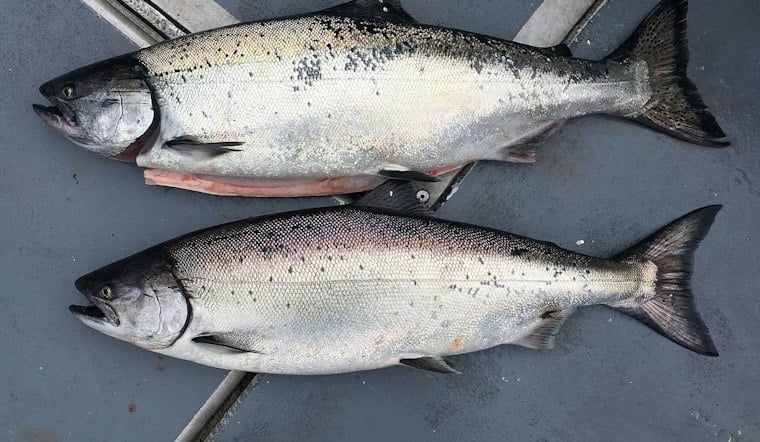
About 2,000 fish have died in Lake Washington near Sound Transit's new I-90 light rail crossing, and among the carcasses divers found were federally protected Chinook salmon. Amateur divers first spotted a pile of dead fish offshore from Seattle in August 2025, and by summer 2026 they had located nine to 12 separate piles of carcasses beneath the eastbound span near Mercer Island, some resting in water 60 to 180 feet deep.
The die-off has become the subject of an active investigation involving Sound Transit, the Washington Department of Fish and Wildlife, and the National Oceanic and Atmospheric Administration's Fisheries West Coast Region, according to The Seattle Times, whose reporters Isabella Breda and Mike Lindblom detailed the timeline. Muckleshoot fisheries scientists reviewed images from the die-off and identified at least two Chinook salmon carcasses, with tribal fisheries manager Mike Mahovlich saying that sockeye also appeared to have been killed. “One dead salmon here is bad news,” Mahovlich said, per the same reporting. Most of the dead fish were nonnative species, including smallmouth bass, sculpin and yellow perch identified by a fish and wildlife expert, along with at least one unknown salmonid the expert believed might be a small cutthroat trout.
Anode Cables Under Scrutiny
Investigators are focused on two central questions: how many fish and which species actually died, and whether underwater anode cables carrying stray electrical current are to blame. The I-90 corridor's cathodic protection system pumps continuous low-level current into the lake through dangling metal anodes designed to divert stray 1,500-volt train current and prevent corrosion of the floating bridge's concrete pontoons and underwater steel anchor cables, according to reporting compiled by Ground News. Sound Transit spokesperson Tony Raben wrote that some anode strings may have been resting on the lakebed and spaced closer together than intended, and dead-fish piles were found next to hanging anode cables that had become displaced and coiled on the lake bottom.
Sound Transit was notified of the dead fish on August 3, after Washington Department of Fish and Wildlife had already been contacted in late July. The agency issued a corrective-maintenance permit to Sound Transit on August 7, and commercial-diver inspections began August 10 to examine the anode system more closely. On August 23, crews completed an interim fix by lifting 32 underwater anode cables off the lakebed where the dead fish had been concentrated, according to reporting from Kent Reporter. Sound Transit is now inspecting those 32 relocated cables and plans to sample and test fish carcasses this week, while also examining whether a chemical reaction with lake sediment, separate from any electrical cause, might have contributed to the deaths.
A Fragile Salmon Run Already Under Pressure
The stakes extend well beyond one stretch of lakebed. Puget Sound Chinook salmon were listed as threatened under the federal Endangered Species Act back in March 1999, making any unpermitted killing or injury of the species a potential violation of federal law, per NOAA Fisheries. NOAA Fisheries West Coast Region has confirmed that salmonids were affected and said it is awaiting details on the number and species involved, adding that Sound Transit continues to assess and address the problem to prevent further impacts on fish.
Lake Washington's salmon runs were already in trouble before this die-off. Sockeye counts entering the lake through the Ballard Locks dropped to 17,571 fish by mid-August 2025, one of the lowest returns since counting began in 1972, according to data from the King County Department of Natural Resources and Parks. Lake Washington sockeye nearly went extinct in the past, and Muckleshoot and state officials have kept the run on life support by trucking fish to a hatchery. Returning salmon already face steep mortality from warm water in the Lake Washington Ship Canal, artificial passage barriers, and seal predation, and survival figures covering the past 15 years show only about 69 percent of Chinook and roughly 41 percent of sockeye that pass the Ballard Locks actually reach spawning grounds or hatcheries.
Regional Chinook abundance has shown no significant trend toward recovery since the 1999 listing, with populations still at roughly one-third of early 20th-century levels, according to the U.S. Environmental Protection Agency. Muckleshoot Indian Tribe member Jaison Elkins put it plainly: “It hurts us to know that our salmon are getting killed.” Chinook have not been harvested by the tribe for more than three decades, even though the Muckleshoot hold treaty-reserved rights under the 1974 Boldt Decision to co-manage salmon resources and harvest up to half of harvestable fish in usual and accustomed areas that include Lake Washington.
Bridge Safety and Regulatory Signoff
Passenger service on Sound Transit's 2 Line Crosslake Connection began March 28, 2026, three days after the Washington State Department of Transportation gave interim acceptance to the cathodic protection system on March 25, making it the world's first passenger light rail line to operate across a floating bridge, per reporting in the Lynnwood Times. WSDOT has not yet given final signoff to accept the cathodic protection system, and the fish issue must be resolved before that transfer happens. WSDOT Secretary Julie Meredith has confirmed the Homer M. Hadley floating bridge remains structurally safe for vehicular traffic despite the ongoing stray-current investigation.
The stakes for the bridge itself are considerable: stray current can cause long-term corrosion to steel rebar inside the bridge's concrete pontoons and to I-90's anchor cables, and the $1 billion rail project was designed to let the corridor serve both motor vehicles and trains for another 70 years. In technical planning documents dating to 2008, state bridge experts mandated cathodic protection for the light rail line, but fish protection from stray current was rated as low importance after international reviews turned up no prior harm to aquatic life, according to a summary of the documents. Sound Transit is now weighing whether attaching anode lines directly to the bridge's anchor cables, rather than letting them dangle toward the lakebed, could reduce the current needed to protect the structure while removing the hazard to fish.
What Comes Next
Snohomish County Executive Dave Somers has requested more frequent updates on solving the problem, and the divers who first raised the alarm say they intend to keep watching the water. One diver, identified in reporting as Eiler, and his son found that an anode cable was no longer touching the lakebed on a more recent visit and reported finding no more fish pile at that location, though the broader explorers' group says it will continue monitoring and photographing the sites. Washington Department of Fish and Wildlife says it is monitoring reports for impacts on species of conservation concern as Sound Transit's carcass sampling and cable inspections continue.





