

























































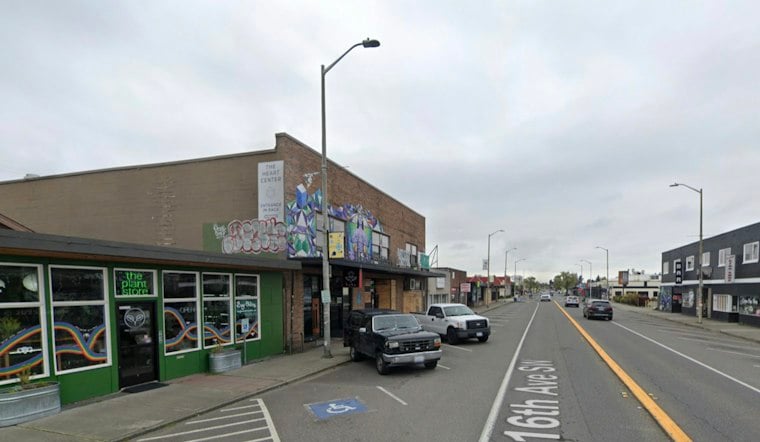
Mashiko, the sustainable sushi restaurant that has anchored West Seattle's California Avenue for 32 years, has announced its new address: 9640 16th Ave SW in White Center. The longtime restaurant will soon vacate its original home in the West Seattle Junction and set up shop just south of the Roxbury Street border, taking over a storefront currently occupied by Búho.
The move was confirmed in a West Seattle Blog report published Friday night, which noted that Mashiko will announce its final day in West Seattle next week, per the restaurant's own announcement. Before reopening in its new digs, Mashiko will close briefly for renovations, according to the same report. Búho, the PNW-Latin comfort food and agave spirits spot that has served White Center for six years, is set to close its 9640-A 16th Ave SW location on September 23, according to a Búho announcement on its Facebook page.
The relocation isn't a story of declining sales or a rent dispute — it's about the building itself. Local business reporting confirmed that Mashiko is leaving 4725 California Ave SW because the structure is slated for demolition and redevelopment, the report notes, part of a wave of West Seattle Junction storefronts facing similar displacement in 2026.
A Rebrand Rooted in Continuity
Owner Mariah Kmitta plans to rename the restaurant “Mashikotsugi” once it opens in White Center — “tsugi” meaning “next” in Japanese — while expanding the menu to include izakaya-style small plates alongside its existing sustainable seafood offerings, according to WhatNow Seattle. Kmitta chose White Center in part because she and co-owner Alix both live in the neighborhood and have deep ties there, the outlet reports; Kmitta has worked at Mashiko since 2000.
Mashiko's roots stretch back to 1994, when founder Hajime Sato opened the restaurant, and in 2009 he converted it into Seattle's first fully sustainable sushi bar, stripping the menu of endangered or unsustainably caught species like unagi and bluefin tuna, according to Seattle Magazine. That sustainability pivot initially caused sales to dip before the restaurant recovered, per the same account. Sato ran Mashiko for 25 years before transferring ownership in 2019 to three longtime employees — chefs Kmitta and Brandon Wicks, and manager Allison Hill — keeping the restaurant employee-owned as he relocated to Michigan, as reported by Seattle Met.
Founder's Legacy Now Spans Two States
Sato's own culinary path has continued well beyond Seattle. He went on to run Sozai in Clawson, Michigan, and won the 2024 James Beard Award for Best Chef: Great Lakes before recently returning to the Pacific Northwest to open Sazanami, a high-end sustainable sushi counter in Beaverton, Oregon, Hoodline previously reported.
Mashiko's arrival adds another notable name to White Center's 16th Avenue SW corridor, which has built a national dining profile in recent years. James Beard Award-winning chef Brady Ishiwata Williams, formerly of Canlis, opened his acclaimed restaurant Tomo at 9811 16th Ave SW in September 2021 — in a space that was once an adult video store — according to Seattle Met.
A Corridor Still Rebuilding
The 16th Avenue strip has weathered its own setbacks. A major fire in the summer of 2021 destroyed or damaged roughly 10 small businesses on White Center's main commercial block, triggering a multi-year, community-led rebuilding effort along the corridor, Seattle Magazine reported, with local block parties and fundraising helping support the affected owners.
White Center itself sits outside Seattle's municipal boundaries entirely. It's one of King County's few heavily urbanized unincorporated communities, situated directly south of Seattle's SW Roxbury Street boundary without its own city government or city tax structure, according to the Washington State Department of Commerce. Seattle has discussed potential annexation of the area for decades, per the same source.
The neighborhood has been drawing new food businesses in the wake of the rebuild, a trend Hoodline has tracked as new shops move into the rebuilt block. Exactly when “Mashikotsugi” will open its doors, and how West Seattle regulars will adjust to crossing the Roxbury Street border for their sushi fix, remains to be seen as the restaurant works through its fall renovations.





