

























































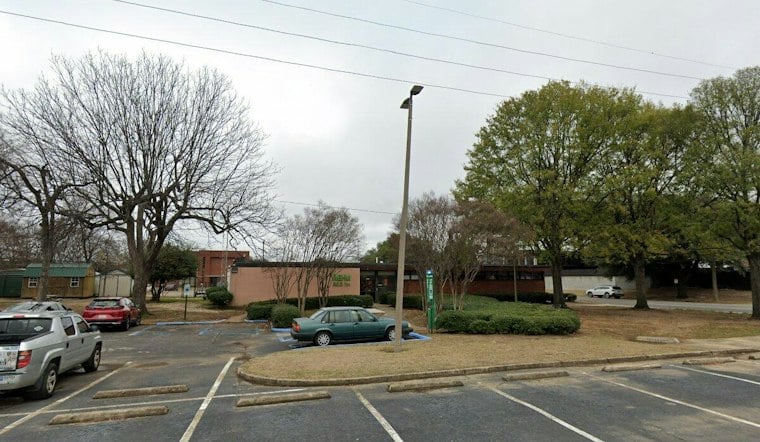
Starting Thursday, on-air staff at Birmingham’s public radio station WBHM are barred from saying “Gulf of Mexico” on air or online, under a new Alabama law that reaches directly into the station’s newsroom. The station is owned and operated by the University of Alabama at Birmingham, and because its reporters are classified as university employees, they now fall under a state mandate requiring the term “Gulf of America” in official communications.
The requirement comes from Alabama’s Gulf of America Act, also known as House Bill 2, which the Republican-controlled Alabama Legislature passed and Gov. Kay Ivey signed. As reported by Chron, the law compels Alabama state and local entities to use “Gulf of America” in official documents, maps, websites and other communications, and specifically bans the phrase “Gulf of Mexico” from WBHM content created on air or online. Under Alabama’s legislative process, the bill cleared the state Senate on April 1 and was signed on April 7, setting a compliance deadline of October 1, according to LegiScan.
WBHM anchor Richard Banks said staff are considered state employees under the law, per Chron’s reporting, and are expected to comply after Thursday or risk disciplinary action or termination. Banks also said further university guidance on the policy could come as soon as Tuesday, potentially clarifying whether the mandate extends to content sourced from NPR or the Associated Press — both of which continue to use “Gulf of Mexico” in their own coverage.
A Leadership Change Amid the Compliance Deadline
The policy shift is arriving alongside a leadership transition at the station. Will Dahlberg, WBHM’s executive director and general manager, plans to leave his position next month, and al.com has reported he may have lost his job because of the law, according to Chron’s account. Dahlberg has said the new law conflicts with WBHM’s journalistic independence, calling that independence foundational to a news organization.
In his absence, the University of Alabama at Birmingham has designated Stephen Murray, UAB’s executive director of business operations, to take over management duties and field listener concerns about the law’s rollout, according to BirminghamWatch. The law itself contains no enforcement mechanisms or penalties written into its text, per Chron, though WBHM employees still face the prospect of discipline through university personnel channels.
Notably, the mandate does not apply uniformly across Alabama’s public broadcasters. WUAL, the flagship station of Alabama Public Radio based in Tuscaloosa, along with its affiliates in Mobile, Muscle Shoals and Selma, is a separate network from WBHM. Another public station, WJAB in Huntsville, is owned by Alabama A&M University rather than UAB. The law does carve out some flexibility: state agencies are exempt from using “Gulf of America” when doing so would create a major operational or financial hardship, and Alabama public schools and universities may still use “Gulf of Mexico” as a historical term during educational activities.
First Amendment Questions Raised by Civil Liberties Group
The Alabama mandate has drawn scrutiny from civil liberties advocates who question whether the state can dictate the vocabulary of journalists employed by a public university. Aaron Terr, director of public advocacy at the Foundation for Individual Rights and Expression, said in September that compelling public broadcast journalists and university staff to use government-mandated geographic terms raises major First Amendment concerns regarding compelled speech, according to WBHM.
WBHM launched in 1976 as the first full-service public radio station in north-central Alabama and National Public Radio’s 200th national affiliate, operating under a broadcast license held by the University of Alabama System’s Board of Trustees, per the station’s own history. That licensing structure is precisely why its journalists are treated as state employees bound by the new law rather than as independent members of the press.
Part of a Broader National Push
Alabama’s law did not emerge in isolation. It follows President Donald Trump’s January 2025 Executive Order 14172, which directed federal agencies and the U.S. Board on Geographic Names to replace references to the Gulf of Mexico with “Gulf of America” in federal records and maps, according to the White House. Florida became the first state to mandate the change when Gov. Ron DeSantis signed legislation in April 2025 requiring the term across state statutes, government maps and public school materials, a move Alabama lawmakers explicitly cited during their own legislative debates.
The U.S. House also passed federal legislation in May 2025, the Gulf of America Act introduced by Rep. Marjorie Taylor Greene, by a vote of 211-206 to codify the name change across federal agencies, according to the House Committee on Natural Resources. Major mapping platforms have already adjusted: Google modified its services in February 2025 to display “Gulf of America” for U.S. users while continuing to show “Gulf of Mexico” for users in Mexico, per Google’s own blog. The Associated Press, meanwhile, announced in January 2025 that it would continue using “Gulf of Mexico” in its wire coverage to maintain clarity for global audiences — a stylebook conflict that now lands squarely on public stations like WBHM that rely on AP and NPR content.
National polling suggests the renaming push runs against broad public sentiment. A Marquette University Law School poll conducted in February 2025 found 71 percent of U.S. respondents opposed renaming the Gulf of Mexico, while 29 percent supported the change, according to figures cited on Wikipedia. Despite that opposition, legislative measures have continued to advance in Gulf Coast state capitals, leaving stations like WBHM to navigate the gap between state mandates and national newsroom standards.





