

























































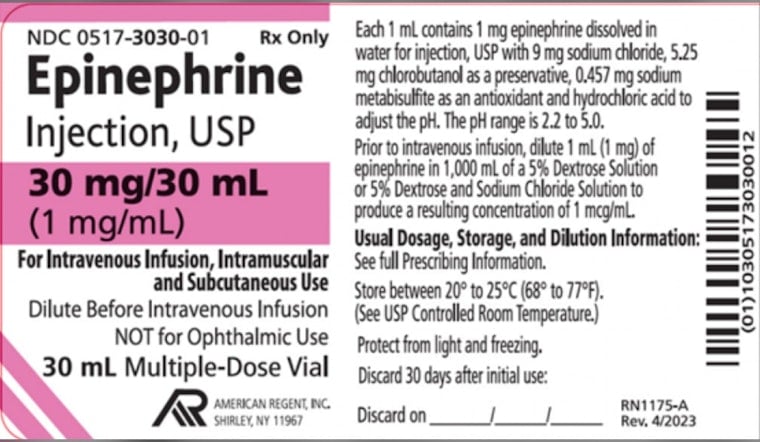
Hospitals across the country are being told to pull three lots of epinephrine injection off their shelves after American Regent discovered cracked and leaking vials that could compromise sterility. The 30 mg/30 mL multi-dose vials, the kind hospital crash carts rely on for emergency resuscitation and shock treatment, were distributed nationwide before the company flagged the defect. No adverse events tied to the recall had been reported as of September 3, 2026, according to the company.
American Regent said it received customer complaints about leaking and cracked vials, which resulted in a lack of assurance of sterility, according to WLKY. The FDA attributes the recall to the presence of particulate matter and a lack of sterility assurance in the affected product. Compromised container integrity, the agency notes, can result in loss of sterility and potential contamination that poses a serious risk for patients.
The recalled material, drawn from an FDA recall notice, includes lots 25128L1C0, 25280L1C0, and 26108L1C0. Lot 25128L1C0 was distributed from September 4 to December 18, 2025, and expires this August; lot 25280L1C0 shipped between December 16, 2025, and April 17, 2026, and expires in October; lot 26108L1C0 went out from June 15 to July 31, 2026, and does not expire until July 2027. All three carry NDC number 0517-3030-01.
Why These Vials Matter in the ER
Unlike the single-dose EpiPen autoinjectors people carry for outpatient allergic emergencies, these 30 mL multi-dose vials are meant for institutional use, drawn into syringes by medical staff for continuous IV infusion during septic shock or for repeated dosing in intensive care settings. Epinephrine injections are also used for emergency treatment of Type I allergic reactions, including anaphylaxis caused by insect stings, foods, drugs, sera, and other allergens, as well as idiopathic and exercise-induced anaphylaxis. The product is specifically indicated to raise mean arterial blood pressure in adult patients with hypotension tied to septic shock.
The particulate matter identified in American Regent's investigation included nylon, cellulosic, acrylic, polyethylene, and glass. Officials warn that particulate matter introduced through intravenous administration can cause serious adverse health consequences, including local vein irritation, inflammatory reactions, aggravation of preexisting infections, and allergic reactions. In more severe cases, it can cause blockage and clotting in blood vessels, reducing blood flow to vital organs, triggering life-threatening pulmonary embolism, and potentially leading to permanent organ damage or death.
A Pattern Emerging at American Regent
This is not an isolated slip. On July 24, less than six weeks before the epinephrine recall, American Regent issued a separate voluntary nationwide recall for a lot of Papaverine Hydrochloride Injection after visible particulate matter, identified as glass and paraformaldehyde, turned up in the smooth-muscle relaxant. Days later, on July 31, the company pulled its Adequan Canine and Adequan i.m. animal health products nationwide after routine inspections found glass microfibers floating inside injectable vials used for osteoarthritis treatment in horses and dogs. Hoodline previously reported on the arthritis shot recall.
That means American Regent has issued three separate nationwide recalls in a roughly six-week window, spanning both human and veterinary injectable product lines. The epinephrine vial line itself is relatively new to the market, having launched in October 2024 as an FDA-approved generic option for emergency resuscitation and shock management in hospitals, per a release cited by PR Newswire at the time. American Regent, headquartered in Shirley, New York, with major manufacturing and distribution operations in Ohio, operates as the U.S. injectable drug subsidiary of Tokyo-based Daiichi Sankyo Group, Japan's second-largest pharmaceutical company, which consolidated its American sterile injectable operations under the American Regent name.
Part of a Wider Industry Problem
Particulate contamination is not unique to American Regent. FDA enforcement data compiled from August 2017 through February 2024 found that foreign particulate matter was responsible for roughly 31% of all sterile injectable drug recalls nationwide, a trend Hoodline touched on in its earlier coverage of Baxter's IV bag recalls. The recall also lands amid heightened regulatory scrutiny: revised mandatory standards under United States Pharmacopeia Chapter 788, which set updated testing parameters for subvisible particulate matter in injectable drugs, took effect nationwide on August 1.
Under federal rules, the FDA classifies recalls as Class I, II, or III based on health hazard evaluations, reserving the most serious Class I designation for defects with a reasonable probability of causing serious health consequences or death. This latest action follows an earlier 2026 disruption in the epinephrine supply chain: a Class II recall in April affected more than 80,000 units of epinephrine injections over sterility assurance concerns. It remains an open question whether the FDA will pursue formal warning letters or broader facility inspections at American Regent's manufacturing sites over filling line and vial integrity controls.
What Affected Facilities Should Do
American Regent is notifying distributors and customers by letter and arranging for the return or replacement of all recalled product. Patients or providers still holding any of the recalled lots should stop using them and contact a doctor or health care provider. American Regent's product quality complaints line can be reached at 888-354-4855 or [email protected], weekdays from 9 a.m. to 5 p.m. Eastern, while its pharmacovigilance team can be reached at 800-734-9236 or [email protected]. General customer service is available at 800-645-1706, with hours from 8 a.m. to 6 p.m. Eastern Monday through Thursday and 8 a.m. to 4 p.m. on Fridays.





