

























































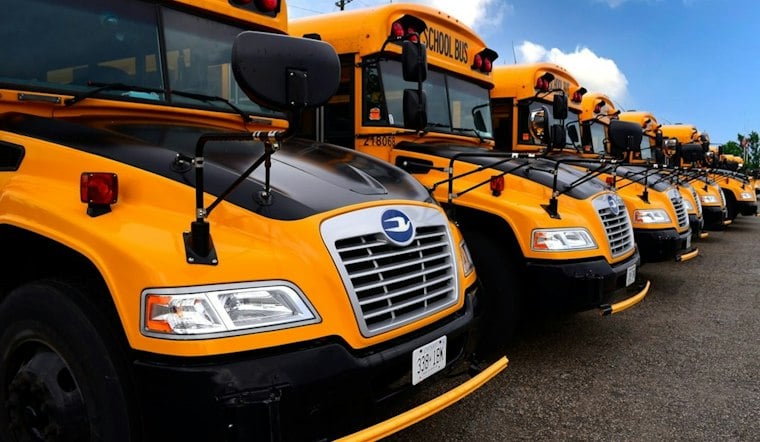
Marion L. Steele High School students are without regular district transportation this fall after Amherst Exempted Village Schools eliminated regular busing for grades 9-12 entirely, part of a sweeping transportation overhaul tied to the district's ongoing financial crisis. The changes also tightened K-8 bus eligibility, cut four driver positions, and pushed car lines at Powers Elementary past 500 vehicles on some dismissal days.
The district reduced transportation services as part of its broader financial reduction plan, according to The Morning Journal. The cuts followed a levy failure in November, and the district was required to make spending reductions after its five-year forecast triggered state requirements. Amherst Superintendent Mike Molnar said he was pleased with how transportation services have gone so far this year, according to the same report.
K-8 students now qualify for district transportation only if they live more than two miles from their assigned school, down from a previous one-mile threshold, per the district's reporting to The Morning Journal. That two-mile line actually reflects Ohio's statutory floor — under Ohio Revised Code Section 3327.01, districts must bus K-8 students living beyond two miles from school, while high school transportation is entirely optional under state law. That legal backdrop is why Amherst could eliminate Steele High School busing outright while keeping younger students at the state minimum.
Driver Shortage Compounds the Cuts
Amherst eliminated four bus driver positions as part of the reductions, but the district's remaining fleet has been further strained by turnover. Transportation official Shonteea Ford reported three bus driver resignations just three to four weeks into the new school year, the Morning Journal report notes. The district is now actively seeking qualified drivers, particularly those holding commercial driver's licenses with bus and passenger endorsements.
To cope with tighter staffing, the district reorganized how buses are assigned to its four buildings. Ford said the district changed how buses are assigned to schools, with Powers Elementary, Walter G. Nord Middle School, and Amherst Junior High School each now running buses designated only to their own building rather than shared routes. District officials say those dedicated buses have made school dismissal faster overall.
Staggered dismissal times underscore why that mattered: Steele High School lets out at 2:25 p.m., Nord Middle School dismisses car riders at 3:15 p.m., and Powers Elementary dismisses walkers and car riders between 3:25 and 3:30 p.m., according to Amherst Exempted Village Schools. With no more shared routes crisscrossing between buildings, each school's buses can focus solely on its own dismissal window.
Parents Flood the Car Line
The end of high school busing and the narrower K-8 eligibility have pushed more families into their cars. The district has seen an increase in parents using car lines, and Powers Elementary alone sometimes sees more than 500 cars during dismissal, per the Morning Journal's reporting. Even so, the school has managed to move vehicles through its pickup line in roughly 20 to 25 minutes.
Beginning October 1, the district plans to open a limited workaround for families outside the new eligibility zone. Amherst will offer space-available seats on existing bus routes to K-8 students who don't otherwise qualify, provided they use an existing bus stop rather than requesting a new one. The district has already received about 200 student requests for that space-available transportation, but officials say they will not add new routes or stops to accommodate them.
One exception applies to older students: those attending the Lorain County JVS receive an exception to the high school transportation restriction, according to the Morning Journal's account. The district cannot guarantee that any of the eliminated services will return, and officials have said restoring transportation depends squarely on the outcome of the district's levy.
A Financial Squeeze Years in the Making
The transportation cuts sit inside a much larger budget overhaul. Amherst Exempted Village Schools has a state-required financial reduction plan calling for $13.2 million in total spending cuts through fiscal years 2026 through 2029 to climb out of state fiscal precaution, according to the Chronicle Telegram. The district had faced a projected $8.5 million deficit by fiscal year 2028 before adopting that plan.
That reduction plan eliminated 48 total staff positions. Staffing accounts for roughly 85% of district operations, the paper's reporting notes, which explains why transportation absorbed such a direct hit when the district needed to trim costs quickly.
Voters have twice rejected new revenue for the district in the past year. According to the Medina Gazette, residents turned down a 1.5% income tax levy in November 2025 and a reduced 0.75% version in May 2026, prompting the school board to place a 5.97-mill fixed-rate property tax levy on the November 3 general election ballot. It would be the district's third attempt in roughly a year to secure new operating revenue.
What the November Levy Would Mean
If approved, the 5.97-mill levy would generate approximately $5.8 million annually for day-to-day operations, costing property owners $209 per year for every $100,000 in Lorain County auditor market value, per the Lorain Daily's reporting. District Treasurer Amelia Gioffredo's August 2026 forecast showed some improvement regardless — projecting $43.6 million in revenue against $44.27 million in spending for fiscal year 2027, narrowing the projected deficit to about $645,000, roughly $3.4 million smaller than the prior year's projected shortfall.
Molnar said restoring some transportation remains a goal if the levy passes, and the school board plans to consider the cost of restoring services within the next couple of board meetings, per the Morning Journal. Under discussion is whether to bring K-8 eligibility back down to the one-mile threshold and whether to reinstate high school transportation altogether.
The stakes are steep given the district's track record at the ballot box. Prior to this recent string of attempts, Amherst Exempted Village Schools had not passed a new operating tax levy in 14 years, with voters last approving new operating funds back in 2012. Whatever happens in November, the district will keep running on the leaner transportation model until voters decide otherwise.




