

























































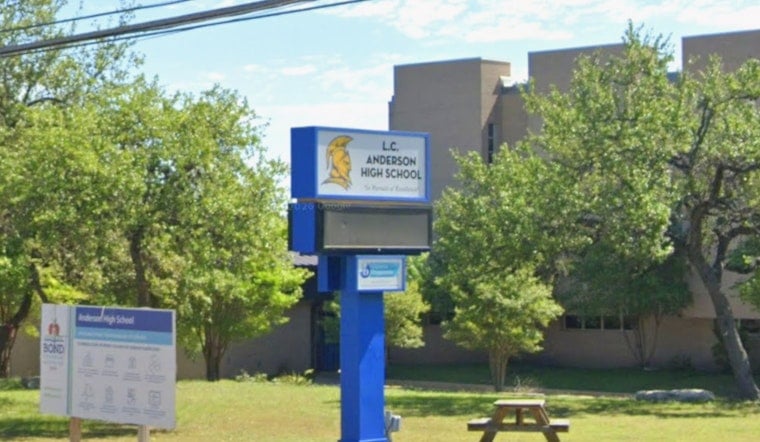
Anderson High School students and staff were sent home early Tuesday after the campus HVAC chiller could cool only 40 percent of the building, leaving classrooms sitting in the low-to-mid-80s during another round of Central Texas heat. Buses began their routes early, departing at about 12:30 p.m., roughly 15 minutes after students and staff were officially released at 12:15 p.m.
Principal Brian Lancaster told families the decision came down to the chiller's limited output, according to KVUE, which first reported the early dismissal. The station reported that Anderson's main academic building experienced the most significant air-conditioning problems on campus, with classroom temperatures settling in the low to mid-80s — well outside the 72°F to 76°F range that Texas Administrative Code guidelines call for in occupied public school spaces during summer months.
Not every student had a ride waiting at 12:15 p.m. Those who couldn't be picked up right away were allowed to wait in the air-conditioned performing arts center, and food service workers handed out to-go lunches for students who needed them, per the station's report.
A New Breaker and a 400-Ton Fix, Installed Overnight
To get ahead of Wednesday, both the Austin ISD facilities maintenance team and the campus's HVAC contractor shut off power to the building Tuesday to install a new breaker capable of supporting a 400-ton rental chiller, the outlet noted. That temporary chiller was expected to be installed overnight Tuesday and is intended to cool the entire Anderson campus and maintain comfortable spaces across the building on Wednesday while Austin ISD maintenance crews work to repair the school's permanent HVAC chiller. School officials said they would provide families an update later Tuesday about what campus operations would look like Wednesday.
Anderson's chiller trouble arrived just five days after a similar breakdown forced McCallum High School, another Austin ISD campus, to publicly beg for donated portable fans when its own AC system failed during the same late-August triple-digit heat, as Hoodline reported. The back-to-back failures came as Travis County sat under National Weather Service advisories, with afternoon temperatures reaching 102°F and heat indices climbing to 110°F.
A Campus Already Mid-Renovation
The irony is that Anderson is already in the middle of a major upgrade meant to fix exactly this problem. Austin ISD broke ground in May 2025 on a $47.41 million Phase 1 modernization project at the school, funded by the district's 2022 bond, that includes HVAC, electrical, and plumbing overhauls — but the work at the 1970s-era campus, which serves roughly 2,400 students on Mesa Drive, isn't scheduled to wrap until spring 2027, according to Community Impact's reporting on the project.
That timeline gap is not unique to Anderson. Austin ISD voters approved a historic $2.44 billion bond package in November 2022, the largest school bond in Central Texas history, setting aside more than $400 million specifically for HVAC, plumbing, electrical, and roofing repairs across the district's aging campuses. But multi-year construction timelines mean many schools are stuck relying on stopgap fixes in the meantime.
Why Austin ISD Can't Just Write a Faster Check
Part of the delay traces back to how Texas funds school repairs. Districts lean heavily on voter-approved bonds for major HVAC overhauls because bond proceeds are shielded from the state's school finance recapture system, sometimes called Robin Hood, while general operating funds get heavily recaptured — meaning Austin ISD surrenders significant local property tax revenue to the state each year and can't easily redirect maintenance dollars into swift infrastructure fixes.
In the meantime, leaning on rental units carries its own cost: temporary chillers like the one headed to Anderson can run the district roughly $10,000 a month per unit while permanent systems await repair, according to Community Impact's reporting on the district's HVAC replacement plans. A 2021 Austin ISD Facility Condition Assessment had already rated Anderson's facility condition a 76, or Satisfactory, and its educational suitability a 61, or Average, years before this week's breakdown — a sign facilities planners knew about lingering system deficiencies well ahead of the current heat wave.
Anderson, which opened at its Mesa Drive location in 1973 and now enrolls more than 2,200 students, runs the oldest International Baccalaureate program in Central Texas. It's the latest Austin ISD campus to run into construction-related headaches this school year; Hoodline reported two weeks ago that a botched, bond-funded roof job flooded Travis Heights Elementary, forcing 469 students to start the school year at another campus altogether.



