

























































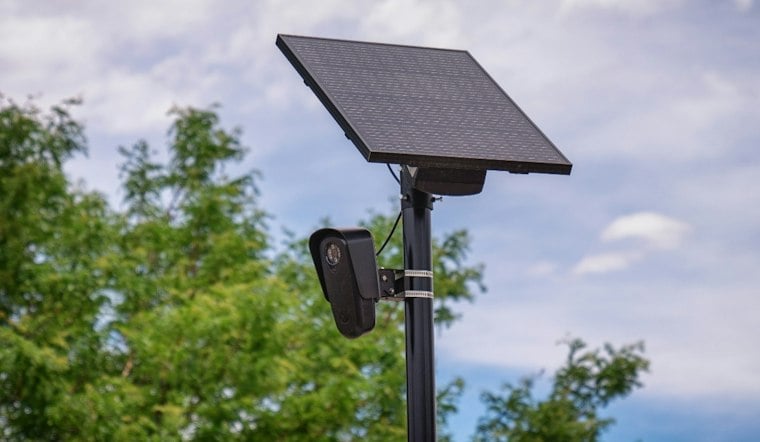
Anne Arundel County currently operates 88 fixed automated license plate reader locations across the county, part of a surveillance network that has quietly expanded since it first went online in 2012. The cameras capture a vehicle's plate number, a photograph, and the time, date and location of every scan, and county officials say the data is generally deleted within 30 days unless it becomes evidence in an active investigation.
The county says it picks camera locations based on crime statistics, common routes vehicles use to enter or leave an area, and traffic volume, according to Anne Arundel County. Officials describe the tool as useful for investigating crimes and locating wanted or missing people, and say access to the footage is restricted to trained personnel and subject to audits. The county also says its use of the technology is governed by Maryland Public Safety Article 3-509. As WBAL News Radio reported, Maryland law enforcement agencies had access to more than 1,100 license plate readers statewide in 2025, a mix of stationary and mobile units spread across the state's roads.
A Statewide Network Beyond One County
The plate readers are just one piece of Anne Arundel County's broader surveillance push. The county's Real-Time Information Center, which opened in early 2025, pairs license plate readers with CCTV, other security cameras, real-time situational awareness platforms and data analytics, according to the county. Officials have said the center will not use facial recognition on shared video feeds and will not routinely monitor community camera footage that's voluntarily shared with police.
Seven Maryland law enforcement agencies had contracts with Flock Safety, the company behind much of the state's camera network, operating more than 250 cameras between them as of 2025, per WBAL's reporting. Those agencies included the Anne Arundel County Police Department, along with departments in Boonsboro, Crofton, Elkton, Hyattsville and Pocomoke, plus the Washington County Sheriff's Office. Flock Safety, which has contracts with more than 5,000 law enforcement agencies nationwide according to NPR, told WBAL it does not publicly share specifics about individual agency contracts, camera counts or deployment locations.
Crofton Pulled the Plug on Its Flock Cameras
Not every Maryland town is sticking with the technology. Crofton Police Department installed five Flock cameras in October 2025 under a $19,000-a-year contract, but ended the trial this past August, per WBAL's reporting. Crofton Police Chief Jason Jett said the cameras helped with four investigations since installation but that he could not justify the cost without a better return, even though the department had logged more than 2.8 million license plate scans during the trial.
Crofton's retreat mirrors a broader national pattern. At least 30 localities have deactivated their Flock cameras or canceled their contracts since the beginning of 2025, according to NPR. Flagstaff, Arizona removed its data from Flock's national and statewide lookup networks, limited data sharing to two local agencies, and cut its retention window from 30 days to 14, while its city council voted to end its 36-camera contract entirely after residents raised concerns about AI-driven mass surveillance. Santa Cruz, California also voted to end its Flock contract, per the same NPR report.
Arizona Cities Cite Misuse and Privacy Fears
Several Arizona communities have gone further, according to KTAR News. Tempe turned off its Flock system and canceled its contract in late August after officials decided the risk of misuse outweighed the benefits, while Cave Creek terminated its contract immediately the same day, citing privacy concerns and the theft of a Flock camera. Chandler blocked police access to its Flock system and declined to renew its contract after an audit turned up possible employee misuse, and Sedona's city council voted unanimously last September to cancel its contract and remove its cameras. In one case KTAR reported, an Apache Junction police officer resigned after an internal investigation found he had used Flock readers to track down his wife during a personal dispute.
Brian Deehring, an associate professor of cybersecurity at Anne Arundel Community College, told WBAL that Flock's systems essentially provide automated license-plate photography that can be mounted on traffic lights, light posts and poles. He said legitimate law enforcement uses can coexist with the potential for overreach, a tension that has driven the debate in jurisdictions from Anne Arundel County to metro Phoenix, where KTAR reports some government and law enforcement organizations are reconsidering the technology amid ongoing misuse investigations.
The Case Flock Makes for Itself
Flock Safety says its own 2025 Impact Census found its technology supported more than 1 million criminal investigations and public safety incidents that year, and the company has estimated its cameras assisted with roughly 1 in 5 cases cleared by law enforcement in jurisdictions where it operates. The company is also rolling out changes it frames as privacy safeguards, including a recommended seven-day default data retention period and a feature called Evidence Mode that preserves specific footage for active cases, according to Flock Safety. The company says customers, not Flock, own the captured data and control who can access or share it, and notes more than 1,500 agencies nationwide have published transparency portals detailing their policies and search activity. Flock also plans to require all law enforcement customers to adopt an audit feature that flags unusual search activity for administrator review by the end of the year.
Critics see it differently. The ACLU describes Flock's cameras as constantly recording and tracking the movement of everything that passes through their field of view, with the resulting data uploaded into a nationwide database that any agency with a Flock contract can search. Neighboring Montgomery County illustrates how quickly that data can pile up: its plate readers captured nearly 110 million reads in 2025, up from about 93.2 million in 2024, according to WJLA. Modern systems, the station notes, can also identify vehicle characteristics beyond the plate itself — make, model, color, decals, damage, bumper stickers, roof racks and even temporary tags — creating what some agencies call a vehicle's digital fingerprint.
For Anne Arundel County residents, the debate boils down to a familiar tradeoff: a tool county officials say helps solve crimes and find missing people, weighed against a growing list of towns, from Crofton down the road to cities across Arizona, deciding the tradeoff isn't worth it. Whether the county's 88 cameras stay put or face the kind of scrutiny playing out elsewhere may depend on how that debate unfolds in the months ahead.





