

























































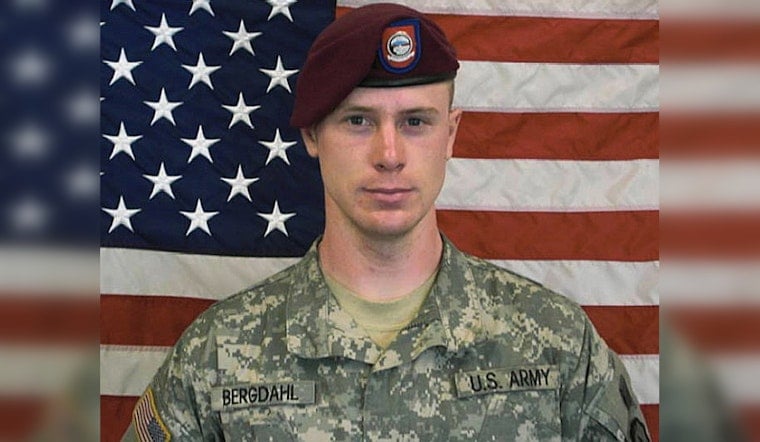
A federal appeals court has reinstated Bowe Bergdahl's 2017 court-martial conviction for desertion and misbehavior before the enemy, ruling that a lower court judge never had the legal authority to throw it out in the first place. The U.S. Court of Appeals for the District of Columbia Circuit ordered the dismissal of Bergdahl's claims in district court, undoing a 2023 decision that had vacated his conviction and sentence.
The panel, made up of Circuit Judges Robert Wilkins, Sri Srinivasan and Gregory Katsas, found that Senior District Judge Reggie Walton lacked jurisdiction to vacate Bergdahl's court-martial conviction and sentence back in 2023. Writing for the panel, Wilkins said Bergdahl's claim conflicts with the longstanding limitation that direct appellate review of court-martial judgments belongs exclusively to military appellate tribunals and the Court of Appeals for the Armed Forces, according to Courthouse News. Wilkins was nominated to the bench by Barack Obama, while Katsas was nominated by Donald Trump.
As reported by WKMG, whose report on the ruling was written by Associated Press correspondent Michael Kunzelman, Bergdahl sued in district court in 2021 arguing that his punishment violated his Fifth Amendment due-process rights. Bergdahl was a 23-year-old soldier from Hailey, Idaho, when he left his post near Afghanistan's Paktika Province without permission in June 2009 to hike to headquarters and complain about poor leadership. Taliban-affiliated Haqqani network forces captured him shortly afterward, and U.S. service members were wounded during the search that followed.
Nearly Five Years in Captivity
Bergdahl was held captive for nearly five years, during which, per the seed report, the Haqqani network tortured him repeatedly. According to background reporting from The Guardian, he was beaten with copper wires and rifle butts and kept isolated in a small iron cage for four years after escape attempts. He was released in 2014 through a prisoner swap negotiated by the Obama administration that freed five senior Taliban leaders held at Guantanamo Bay, subject to a 12-month travel monitoring agreement in Qatar, according to PBS News.
Donald Trump publicly criticized the prisoner swap, and during the 2016 presidential campaign he called Bergdahl a “dirty rotten traitor” who deserved execution, while Senate Armed Services Committee Chairman John McCain threatened in 2015 to hold committee hearings if Bergdahl went unpunished, according to The Washington Post. That political commentary became the foundation of years of appeals arguing unlawful command influence tainted the case. In August 2020, the Court of Appeals for the Armed Forces rejected Bergdahl's military appeal in a 3-2 decision, ruling that the comments from Trump and McCain did not place an intolerable strain on the military justice system, as reported by Military.com.
The Judge's Undisclosed Job Application
Bergdahl pleaded guilty in 2017 to desertion and misbehavior before the enemy, and prosecutors sought 14 years in prison. Instead, military judge Col. Jeffrey Nance sentenced him to a dishonorable discharge, a reduction in rank from sergeant to private, and forfeiture of $1,000 per month in pay for 10 months, sparing him prison time entirely.
Judge Walton's 2023 decision to vacate that conviction centered on Nance creating a potential conflict of interest by failing to disclose his application for an immigration judge position with the Department of Justice. Per Task & Purpose, Nance submitted that application on October 16, 2017 — the exact day Bergdahl entered his guilty plea — and told defense attorneys the following day that he was a “terminal colonel” moving only into “retirement pastures,” a characterization Bergdahl's legal team said amounted to concealing his career ambitions from the executive branch that was also prosecuting the case. Eugene Fidell, one of Bergdahl's lawyers, was among those who raised the issue in court.
A Narrow Path Forward
The D.C. Circuit's ruling this week did not weigh in on whether Nance actually had a conflict of interest. Instead, the panel held that federal district courts simply do not possess statutory jurisdiction to review military court-martial decisions on collateral review, since Congress reserved that authority for the military appellate system. Following the Military Justice Act amendments of 1983, the U.S. Supreme Court became the sole Article III court with statutory authority to directly review Court of Appeals for the Armed Forces decisions via writ of certiorari, according to the same Courthouse News report.
That leaves Bergdahl's original conviction and dishonorable discharge reinstated, with his remaining legal options narrowed to direct appeals within the military appellate hierarchy or a long-shot petition to the Supreme Court. The case has remained politically charged for years — in August 2023, after Walton's temporary order vacating the conviction, five U.S. congressmen submitted a formal petition to the Department of Defense demanding Bergdahl be retried on desertion charges, according to a separate Task & Purpose report. Bergdahl's legal saga, which began with his abduction near Paktika Province in 2009, now stretches into its seventeenth year with no final resolution in sight.




