

























































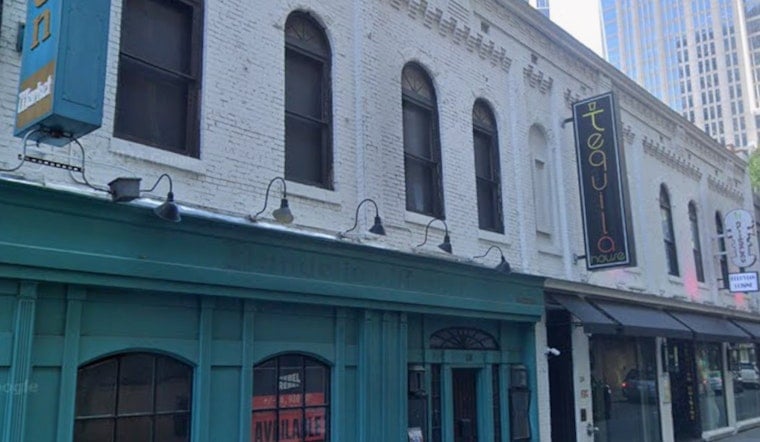
A South Carolina Army veteran says a night out celebrating a friend's engagement at an Uptown Charlotte nightclub ended with him unconscious on the pavement, his face fractured and his teeth broken, after security guards allegedly beat and kicked him outside the venue. Ronald Hurtado, of Sumter County, has filed a lawsuit against Tequila House and its owners claiming bouncers used excessive force during the March 15 incident, leaving him with injuries that required emergency surgery and a metal plate that remains in his face today.
According to the Charlotte Observer, Hurtado and his wife Itzell were at Tequila House when Itzell became sick and went to the women's restroom. Tequila House bouncers reprimanded Hurtado for waiting nearby and told him to leave, the lawsuit claims. As he was leaving, the bouncers assaulted him, and a security guard struck him in the back of the head as he descended the stairs before other guards allegedly threw him down the stairs and dragged him outside.
The lawsuit alleges that guards then kicked Hurtado in the face and continued punching and kicking him even after he lost consciousness, with a third guard reportedly continuing the assault outside the club. Security guards also taunted Itzell Hurtado after the alleged beating, according to the suit. Hurtado told the Observer he was concerned for his wife throughout the ordeal.
Facial Fractures and a Long Road to Recovery
Hurtado was taken by ambulance to Novant Health Presbyterian's emergency department, where he discovered he had two fractured teeth along with multiple facial fractures, per the lawsuit detailed by the Observer. He needed facial reconstructive surgery just over a week after the assault and now has a metal plate in his face. He told the paper he still experiences nosebleeds and headaches when flying.
The physical toll extended into Hurtado's daily life. He took several weeks off work and ultimately took a semester away from school to recover, the lawsuit states. The Observer reports that the Hurtados have experienced ongoing emotional distress from the alleged assault and its aftermath, and that Ronald Hurtado is considering pursuing criminal charges in addition to the civil suit.
Hurtado's attorney, Anthony Burts II, said the lawsuit seeks accountability for the club and its security operators. The suit alleges that Tequila House's owners failed to properly train and control their guards and that the guards used excessive and unreasonable force against Hurtado. Court records show Tequila House and its affiliates have not responded to the latest lawsuit.
A Regulatory Gap in Bouncer Training
Whether that training failure claim holds up in court may hinge on a quirk of North Carolina law. Under Chapter 74C, the state's Private Protective Services Act, contract security guards hired through third-party agencies must complete at least 16 hours of state-approved training and pass FBI background checks, according to the North Carolina Department of Public Safety. But in-house security personnel hired directly by a venue owner are exempt from that registration and training mandate, according to the North Carolina General Assembly's Chapter 74C-11. It remains unclear whether the bouncers involved in Hurtado's alleged beating were direct employees of Tequila House or contracted through a separate security firm, a distinction that could shape any negligent-training argument.
Under North Carolina common law, property owners and hospitality businesses can be held civilly liable for intentional torts or excessive force committed by security guards acting within the scope of their employment, or for negligent hiring, training and supervision, according to legal standards outlined by FindLaw. Proving that theory typically requires showing the venue breached its duty of care to patrons.
A Pattern of Complaints and Penalties
Tequila House operates under an ABC permit at 116-B West Fifth Street in Charlotte through its parent company, Fifth Street Management, LLC, which owns the club. State records show the venue has faced repeated regulatory trouble. In September 2022, the North Carolina Alcoholic Beverage Control Commission penalized Fifth Street Management with a 46-day permit suspension — avoided by paying a $4,600 compromise penalty — for failing to superintend the premises, serving minors and allowing an intoxicated person to keep drinking.
A year later, the ABC Commission issued another offer in compromise, this time a 17-day suspension or $1,700 fine, again for failing to superintend the premises along with liquor tax stamp violations following Charlotte-Mecklenburg Police Department inspections. Online patron reviews aggregated by Wanderlog have separately documented recurring complaints alleging aggressive behavior and unprovoked physical altercations by security personnel at the club, predating this year's lawsuit.
Hurtado's case is not Tequila House's only brush with federal court this year. In February 2026, twelve professional models filed a federal lawsuit against Fifth Street Management alleging trademark infringement and unauthorized commercial use of their likenesses in advertisements; the parties submitted a joint motion for consent judgment in July 2026. In March 2024, ASCAP filed a separate federal copyright infringement suit against the club over allegations it knowingly played copyrighted songs without a license, part of the performing-rights organization's nationwide enforcement campaign against noncompliant venues. Together with Hurtado's lawsuit, that amounts to three lawsuits against the club and its owner in two years.
Part of a Broader Pattern of Nightlife Violence
The allegations land amid heightened scrutiny of security at Charlotte nightlife venues. Hoodline has reported on a November 2025 double homicide at a local venue that killed 29-year-old security guard D'andre Weaver, and a July 2025 fatal shooting inside an Uptown Charlotte nightclub. In August, Hoodline reported that a third suspect charged with murder in one of those cases had turned 18, and separately covered a shooting that injured three people at Queen's Cabaret.
Citywide, overall violence has trended downward. The Charlotte-Mecklenburg Police Department's July 2026 midyear public safety briefing reported an 8% reduction in violent crime and a 4% drop in aggravated assaults during the first half of 2026 compared with the same period a year earlier. But the string of high-profile incidents at nightclubs and lounges, including the allegations now facing Tequila House, has kept security practices at Charlotte nightlife venues under a persistent local spotlight.





