

























































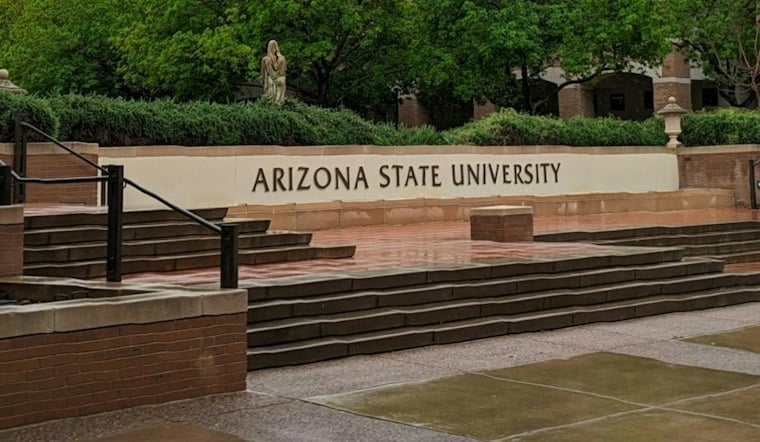
Arizona State University's Anthropocene, a devised theatre work about consumption, climate change and human progress, is headed to the UNESCO MOST Climate Summit in Paris. The production will be performed for people from 35 different nationalities, according to KJZZ. The project has developed over decades.
The project began after Bowditch encountered a New York installation illustrating the resources used to produce a coffee and a bagel, she told KJZZ. Bowditch is the production's project director and helps guide its creative vision. She is a full professor of theatre at Arizona State University and a director and author whose work includes devised, site-specific and physical theatre, according to her ASU faculty profile.
Karen Jean Martinson joined as dramaturg and now shares responsibility for the production's vision with Bowditch, according to KJZZ. The title refers to the proposed geological epoch in which human activity shapes the planet; the term remains contested. Bowditch first explored it in an ASU class before it became central to the work.
Tracing Consumption From the Silk Road to Fast Fashion
The production uses a three-story set alongside sound and projected images, rather than relying on psychological realism, according to KJZZ. Those elements help shape the scenes as the work moves between them.
KJZZ describes the play's historical arc as running from Silk Road trade to the rise of fast fashion. Its 12 actors each perform five or six roles, while costume changes mark the shifts in time—including a fast-fashion section made from Target bags.
The production's final movement uses boxes, plastic and Amazon packaging to stage an environmental breakdown, including a plastic ocean and plastic rain. The actors' collapse is followed by a moment of rebirth and reemergence, according to KJZZ.
A Personal Practice Behind the Production
The show's focus on consumption also informs an offstage practice: performers make individual sustainability commitments during the run and are paired with sustainability buddies to help keep them, according to KJZZ.
Bowditch has also described personal steps including installing solar panels at home, driving a hybrid car and composting, KJZZ reports. The production's scene in which actors have intimate conversations with Siri grew out of a workshop with Moisés Kaufman. Bowditch was a 2018 Harvard fellow, and the scene brings technology and consumption into the play's climate-focused inquiry.
Audience members have urged the production to travel beyond Arizona, with some feedback calling for a national tour, KJZZ reported. The Paris presentation will bring the work to an international audience at a UNESCO climate summit.
From ASU Stage to a Global Audience
ASU materials list the production's premiere as part of the November 2023 ASU Theatre season and say it was developed with sustainability scientists from the university's Global Futures Laboratory, according to Bowditch's faculty profile. Her work includes devised and site-specific theatre.
Climate records and theatre sustainability
The National Weather Service Phoenix lists the city's highest recorded temperature as 122°F on June 26, 1990, and another extreme of 121°F on July 28, 1995. Those individual records provide local context but do not, on their own, establish how extreme-heat conditions have changed over time.
The Broadway League reported that about 84% of scenery from shows that closed during the 2008/2009 season was recycled or reused rather than sent to landfill. Its anniversary release also said more than 97% of Broadway theatres' marquee and outside lighting had been changed to LEDs or CFLs at that time. These are dated Broadway examples, not current rates for the theatre sector as a whole, according to The Broadway League.





