

























































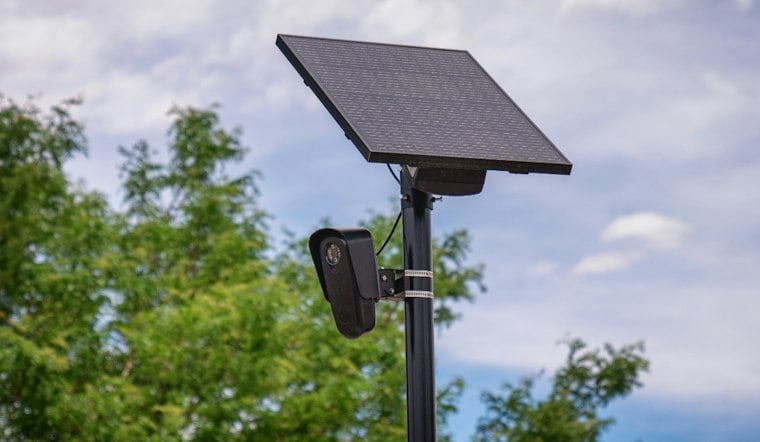
Aurora's use of Flock license-plate readers at high schools has created two separate questions: whether the installations were properly authorized and what happens to the vehicle data collected around students. Aurora police installed cameras outside nine high schools in 2025. Five remain on Aurora Public Schools campuses, while a separate set at four Cherry Creek Schools campuses was removed in May after district officials determined there had never been a formal agreement authorizing them.
The cameras, which use artificial intelligence to read vehicle license plates, were installed in school parking lots and generate data that is then checked against records of stolen vehicles or vehicles connected to other crimes, according to The Denver Post. On the Aurora Public Schools side, the police department has cameras at Aurora Central, Gateway, Hinkley, Rangeview and Vista PEAK Preparatory high schools. Aurora Public Schools entered into a formal agreement with the police department allowing the cameras on its campuses, and that agreement requires them to stay in place for at least two years while being installed at no cost to the district.
A Tangled Deal at Cherry Creek
Cherry Creek Schools tells a different story. Police installed cameras at four of its high schools — Overland, Grandview, Cherokee Trail and Smoky Hill — in 2025 after then-Superintendent Christopher Smith gave the department only verbal approval, the newspaper's report notes. Unlike Aurora Public Schools, Cherry Creek paid nothing for the cameras but had also given the police department $185,000 in 2024 to help fund eight school resource officers.
Cherry Creek's Board of Education directed the removal of the cameras from those four campuses this past May, after the district determined there was no official agreement with the Aurora Police Department covering them. Jen Perry, who became interim superintendent after Smith's resignation in January, asked that the cameras be taken off district property. Smith declined to comment on the dispute when contacted. Notably, attorney Tony Leffert disputed Cherry Creek's characterization that Perry did not know about the cameras beforehand, an account that conflicts with the district's version of events.
What the available policies say about the data
Aurora Police Department's automated-license-plate-reader directive says plate-scan information is retained for one year, while scans deemed evidence in a criminal investigation may be transferred to the department's Digital Media Management System for longer retention. The directive says department members may access ALPR data only for law-enforcement investigative purposes and generally restricts release outside law-enforcement agencies. The provisions cited here do not establish a separate school-campus retention schedule or describe additional safeguards specific to minors.
Colorado lawmakers also considered, but did not enact, SB26-071. The Colorado General Assembly's bill page says the proposal would have required new rules for the collection, storage, sharing and destruction of law-enforcement surveillance data beginning July 1, 2027. The bill's listed status is lost, so it does not currently create those requirements for the cameras at Aurora schools.
Police Point to an Arrest, Advocates Point to Risk
Aurora police have defended the program as a public-safety measure intended to protect students, faculty and staff. The department says the systems have aided investigations, including one involving a 14-year-old suspect in a shooting at Sand Creek Park last month. That case is the department's main public example of the technology's value.
Student advocates and civil-rights attorneys say the school setting raises privacy questions beyond those involved in ordinary policing because most high school students are minors. Jojo Padilla said the cameras eliminate the ability of children and their parents to consent to being monitored. Civil-rights attorney Andy McNulty described the use of Flock technology around children as a massive invasion of privacy and questioned whether the software captures teenagers' faces and clothing, although Flock says its devices do not use facial recognition. Attorney Elie Zwiebel said placing the cameras on school campuses creates additional concerns because schools commonly use security-camera footage in student-discipline proceedings.
Not Every District Signed On
Not every metro-area district has embraced the technology. Denver Public Schools and Jeffco Public Schools both told The Denver Post they have no Flock cameras on any of their campuses. Douglas County School District tried a pilot program allowing the cameras on campus but removed them after about six months, in March 2023. Aurora Public Schools and Cherry Creek Schools are two of Colorado's five largest K-12 districts, making their divergent approaches to the same police department's offer especially notable.
A Wider Backlash Against Flock
The school dispute is part of a broader backlash against Flock's license-plate network in Colorado and nationally. Earlier in 2026, Denver leaders decided to end the city's contract after months of public criticism. Colorado municipalities including Salida, Longmont, Fort Collins, Durango and Steamboat Springs have canceled or declined to renew Flock contracts, while some residents in Colorado's high country have cut down cameras installed by local police departments.
The scale of the data involved is significant. According to Denver's own Flock transparency dashboard, more than 2 million vehicles were photographed in a single month spanning mid-June to mid-July 2025, generating 175,916 matches to a law-enforcement hotlist, as reported by Colorado Politics. More than 100 automated license plate readers now photograph and record details of every passing vehicle at nearly 70 intersections across the Denver metro area, the outlet reports. During Denver's earlier 12-month Flock pilot, police reported 289 arrests and 170 recovered vehicles.
Privacy advocates argue that this footprint amounts to a mass-surveillance network that police and government officials can misuse. That fear isn't hypothetical: at least 50 law enforcement officers nationwide have been charged or accused of misusing Flock's devices, according to a Washington Post investigation cited by The Denver Post, and in one case a Texas officer reportedly used Flock cameras to track a woman who had crossed state lines and was suspected of having an abortion. Hackers also recently copied data from a Flock camera, and the files they obtained showed that the company's software detects people themselves — not just cars and license plates.
Company Under Pressure
Flock Safety itself is feeling the strain of the pushback. The company announced a voluntary employee separation program as it continues to lose customers amid growing frustration across the country, according to Wired. One advocacy group identified 93 city and county governments that cut ties with Flock in August alone, and Wired reports that roughly three times as many local governments have dropped Flock in 2026 than did so over the previous five years combined.
Colorado's own privacy framework offers residents some baseline protections over personal data, though it isn't clear how directly those rules touch school surveillance cameras. The Colorado Privacy Act grants state consumers rights to access, delete and correct their personal data, according to the Colorado Attorney General's office. The underlying legislation, Senate Bill 21-190, created those personal data privacy rights and applies to entities conducting business or offering commercial products covered by the act, per state legislative records.





