

























































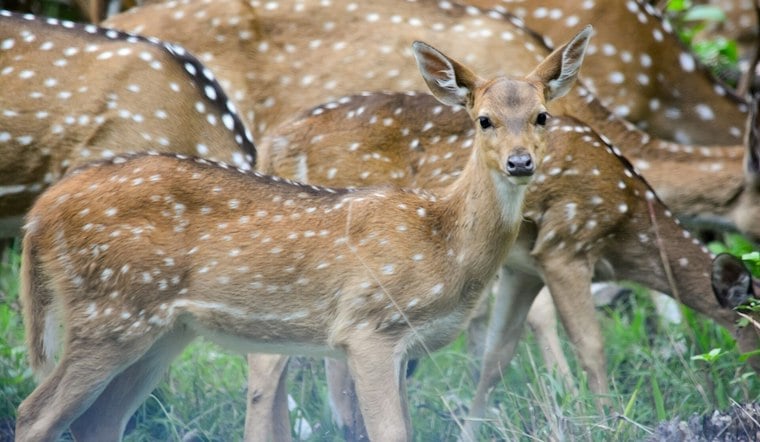
A new study has quantified a problem Hawaiʻi ranchers have reported for years: wild ungulates are reducing the forage available on working cattle ranches. Across Maui and Hawaiʻi Island, researchers found measurable losses associated with axis deer, goats, pigs and mouflon sheep, with axis deer linked to the largest reductions in grass and hay.
The research, led by the University of Hawaiʻi at Mānoa's College of Tropical Agriculture and Human Resilience, is described as the first study to measure grazing on Hawaiʻi's rangelands, according to Big Island Now. Published in the journal Rangeland Ecology & Management and funded by the U.S. Department of Agriculture, the study documented forage losses at two-thirds of the 35 sites researchers surveyed.
Researchers used motion-triggered trail cameras to compare vegetation growth at sites where ungulates were present with growth at ungulate-free sites. Sites dominated by axis deer produced nearly 25% less forage on average, while feral goats had similar impacts. On Maui, axis deer were detected at 95% of surveyed sites; the study also describes an estimated population of roughly 47,000 deer spread across about a third of the island and reaching elevations of approximately 7,000 feet.
Ranchers Say the Data Finally Matches What They've Lived Through
Mark Thorne, a researcher on the project, said the findings were consistent with reports from ranching families. “Axis deer came out as the biggest driver of declining rangeland condition, which matches what ranchers have been telling us for years,” Thorne said. Rancher Greg Friel similarly said, “It's good to finally see numbers behind something ranching families here have been living with for a long time.”
The pressure has forced real changes to how ranches operate. Maui island cattle ranchers have shrunk their herds in some years because deer left insufficient grass behind, and Upcountry Maui's Haleakala Ranch cut its cattle herd size by 50% in recent years due to the combined pressures of persistent drought and pasture depletion caused by invasive axis deer, according to the Maui News.
A Population That Keeps Outrunning the Culling
State officials have leaned on emergency measures to try to slow the damage. Hawaii Governor Josh Green issued his 22nd emergency proclamation regarding Maui County's axis deer overpopulation and drought in late July 2025, maintaining continuous emergency measures since March 23, 2022 that suspended some laws and enabled contracts, fencing, and control measures, per the Environment News Service. Under a $6.1 million state deer management program funded for 2024–2025, the Hawaii Division of Forestry and Wildlife reimburses participating private landowners $25 to $50 per submitted axis deer tail to encourage culling on private acreage, the outlet's report notes.
Those incentives coincided with approximately 17,000 axis deer killed across Maui County in 2024, more than double the county's historical annual harvest average of about 7,000, according to Civil Beat. Even that level of removal has not eliminated the broader population pressure. Axis deer populations can expand at annual rates of 20% to 30% in Hawaiʻi's predator-free environment, so a large cull may slow growth without reversing it.
Overgrazed Land Becomes More Fire-Prone
The damage compounds beyond lost forage. Several of the Maui sites surveyed in the study were located within areas burned by the August 2023 wildfires, and researchers found that overgrazed rangelands recover more slowly after fire and remain vulnerable to fire-prone weeds such as fireweed. Fireweed was found at nearly 70% of the sites studied. The plant contains hepatotoxic pyrrolizidine alkaloids that cause permanent, cumulative liver damage and potential death in cattle when alternative forage is depleted, according to Utah State University Extension.
Species-specific habits also complicate land management, since wild pigs and mouflon sheep frequented higher-elevation areas where forage production is generally faster. Wild axis deer, mouflon sheep, goats and pigs all eat vegetation meant for cattle.
A Century-Old Problem With No Easy Fix
Non-native ungulates were largely introduced to Hawaiʻi between the 1700s and 1960s. Axis deer specifically arrived in the islands in 1868 as a diplomatic gift of eight animals from Hong Kong to King Kamehameha V, and the species was later established on Maui in 1959 with an initial release of just nine animals, according to Go Hawaii Outfitters. Lacking natural predators, that small founding population has since multiplied into the tens of thousands roaming Maui today.
Hawaiʻi Island offers a contrasting example. After four axis deer were illegally transported from Maui in December 2009 and the first animal was detected in 2011, a multi-agency task force eradicated the incipient population in less than two years using thermal imaging radar, helicopter flights and ground surveys, according to the Big Island Invasive Species Committee. BIISC reports no further confirmed sightings, helping explain why Hawaiʻi Island does not have an established axis deer herd comparable to Maui's. The group also notes that wild axis deer commingling with domestic cattle on Molokai were suspected of serving as a reservoir for bovine tuberculosis, possibly contributing to a major outbreak in the 1980s that led to the loss of more than 9,000 cows on that island — underscoring the disease risk unmanaged wild ungulates pose to ranch herds.
What the population figures show
Population totals remain estimates rather than a fixed census. A 2025 estimate put Maui County's axis deer population at at least 60,000, while a late-2023 estimate put it at 34,000. Emergency management measures have continued since 2022, alongside Maui County's 2024 harvest of about 17,000 deer. Hawaiʻi Island's experience was different because authorities detected and removed an incipient population before it became established.





