

























































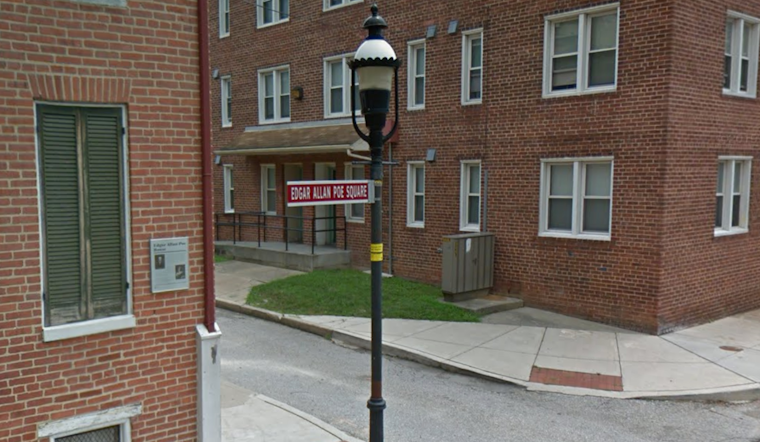
The Edgar Allan Poe House on Amity Street has outlasted nearly two centuries, a 1938 demolition threat, and a decade-long closure — but now, with wrecking crews clearing land on three sides of the museum, its caretakers say they need tens of thousands of dollars just to keep it standing safely through construction. The nonprofit that runs the site, Poe Baltimore, has launched an emergency fundraising campaign seeking $50,000 to cover unexpected preservation costs tied to the ongoing demolition of the surrounding Poe Homes public housing complex.
According to WMAR-2 News, the 1830s half-rowhouse where Poe once lived is surrounded on three sides by the redevelopment site, and demolition work is expected to take place directly across the street. The station reports that conditions at the site have deteriorated following a string of incidents, including vandalism, trespassing, debris accumulation, and renewed water intrusion. Poe Baltimore has already paid for additional security, professional oversight, and cleanup and maintenance to keep the museum protected, per the outlet, and organizers say those costs are consuming resources meant to operate and preserve the museum itself.
Demolition Sequence Reaches the Museum's Doorstep
Per the Housing Authority of Baltimore City, as reported August 28 by the same station, buildings surrounding the museum are next in the demolition sequence. Redevelopment progress so far has included clearing debris around the Poe House and boarding up buildings slated to remain standing, the station's report notes. Poe Baltimore says it will remain open during demolition, even as it works to manage the fallout from active construction next door.
The 288-unit Poe Homes complex being torn down was built between 1939 and 1940 as Baltimore's first public housing project, and was designated exclusively for Black residents during the era of municipal segregation, according to background compiled by The Metropole. Demolition on the site officially began in May 2026 as part of a city plan to eventually build 521 mixed-income housing units in row homes, walk-ups, and elevator buildings, according to the Baltimore Business Journal. The federal funding driving that transformation traces back to a $1.3 million Choice Neighborhoods Planning Grant the U.S. Department of Housing and Urban Development awarded the Housing Authority of Baltimore City in September 2018, part of a program that selected six cities nationwide that year.
A Site That Once Nearly Erased the Museum Itself
There is a strange symmetry to the current threat: the Poe House was originally slated for demolition in 1938 to clear land for the very same Poe Homes project now being torn down, according to Explore Baltimore Heritage. It was spared after preservation efforts by the Edgar Allan Poe Society of Baltimore, later opening as a museum in 1949. The house, where Poe lived from 1833 to 1835 with his aunt, grandmother, and cousins and wrote early Gothic tales including “MS. Found in a Bottle” and “Berenice,” was designated a National Historic Landmark in 1972 and became Maryland's first United for Libraries Literary Landmark in January 2020.
The museum has weathered more recent instability, too. It closed to the public in October 2012 after losing its municipal subsidy from the city, then reopened in October 2013 under Poe Baltimore, the independent nonprofit that has run it since, according to background on Wikipedia. Today the museum occupies just 620 square feet — only half of the original 1833 brick duplex — which helps explain why Poe Baltimore has supported the redevelopment of Poe Homes and worked toward expanding the museum as part of the transformed site, per SouthBMore.com.
Long-Term Growth Plans Collide With Short-Term Costs
That expansion effort has already attracted serious institutional support. Poe Baltimore announced nearly $700,000 in capital grants in August 2025, including $579,000 from the Maryland Department of Energy and $150,000 from Wells Fargo, to fund a multi-phase, 17,000-square-foot expansion featuring an auditorium, exhibit space, and literary gardens, SouthBMore.com reported. Architect Davin Hong presented expansion concepts to Baltimore's Urban Design and Architecture Advisory Panel in March 2025, proposing a design inspired by Poe's poetry for land carved out of the Poe Homes site, according to Community Architect Baltimore. Land assembly for the project has involved private deals as well: in August 2023, developer La Cité Development agreed to sell a 16,553-square-foot parcel on West Saratoga Street to the Housing Authority of Baltimore City for $1.1 million to help piece together the site.
None of that long-range progress solves the museum's immediate problem. The 9th Annual International Edgar Allan Poe Festival, scheduled to run October 2 through October 4, will help raise funds for the house's future, according to WMAR-2 News, but organizers say the $50,000 emergency campaign is needed now to cover costs tied specifically to safeguarding the historic property throughout the demolition process. For a house that has already survived a wrecking ball once, the current construction next door is, once again, a test of whether Baltimore will keep the Amity Street landmark standing while it builds something new around it.





