

























































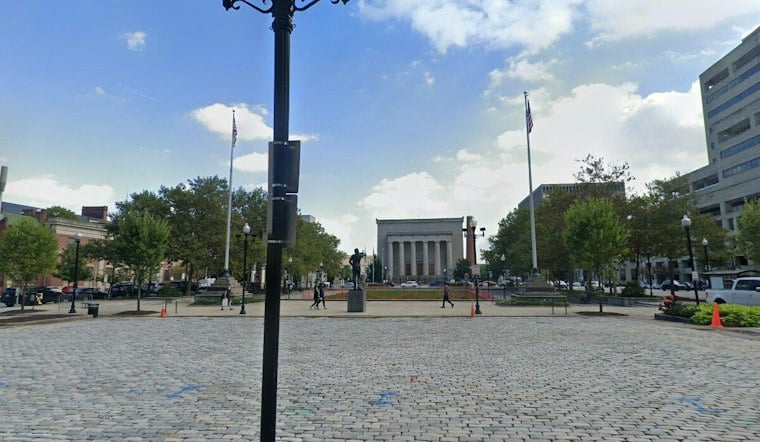
About three dozen Baltimore high school students gathered outside City Hall to confront elected leaders over a problem they live with every school day: buses that show up late, bus stops littered with trash and broken glass, and a transit system they say state officials keep promising to fix without ever funding it. Students arrived on a yellow school bus from Baltimore Polytechnic Institute, Baltimore School for the Arts, Forest Park High School and Baltimore City College, then spent the rally calling on Gov. Wes Moore to commit real money to the system thousands of them depend on just to get to class.
The frustration stems from a basic structural fact about Baltimore City Public Schools: it is the only school district in Maryland without yellow bus service after fifth grade, according to The Baltimore Banner. Because the district uses a universal school-choice system, students often attend schools far from home and are issued free MTA transit passes rather than neighborhood yellow buses once they reach middle and high school. District transportation policy limits yellow bus service to elementary students living more than a mile from school, while middle and high schoolers beyond 1.5 miles are expected to rely entirely on public transit unless they have specialized IEP or language accommodations, according to Baltimore City Public Schools.
Students Describe Predawn Commutes and Neglected Stops
At the rally, students said the daily reality of that system is exhausting. Jeremiah Carter said he begins his day at 5 a.m. because the buses can't be trusted to run on time, while other students described commutes starting as early as 5:30 a.m. Justice LeGrand said unreliable buses cost students time they need for sleep, studying, family and other opportunities, and students described bus stops left in rain, heat, snow, trash and broken glass, with shelters that are completely broken or nonexistent, all per the Banner's report.
Izma Sheikh told the crowd that every number in the transportation budget represents a real student standing at a real bus stop, per the same report, missing class or wondering whether they'll make it home safely. Students held handmade signs at the rally, including one that read, “Tired of waiting. We need more buses now.” Mayor Brandon Scott joined the students rallying in front of City Hall, according to the outlet's account.
A Budget Fight Over How Much Baltimore Transit Actually Loses
The rally landed just weeks after the Moore administration published a draft transportation capital budget earlier in September, and the numbers have become their own point of dispute. Bikemore and the Central Maryland Transportation Alliance analyzed the draft and reported a $362 million cut to Baltimore transit in next year's state budget, while Maryland Department of Transportation officials, speaking at a transit commission meeting, estimated the cut at $249 million — leaving Baltimore-area transit facing roughly a quarter-billion dollars in reductions amid another year of stagnant plans, per the Banner.
Separately, an analysis from Bikemore of MDOT's draft FY2027–2032 Consolidated Transportation Program found $95 million allocated strictly for planning and engineering on the Red Line light rail project, with zero construction dollars funded through 2032 and no state funding set aside for the BMORE Bus Plan. The same analysis found the draft program allocates $605.3 million across three highway-widening projects — 6.4 times the total state capital funding committed to the Red Line over the same six years — and includes a 44% cut to the Maryland Transit Administration's minor capital program, which pays for routine maintenance, safety upgrades and state-of-good-repair work on buses and rail.
Transit officials told students at the City Hall hearing that Baltimore would receive more money, even as they acknowledged there is currently no funding for construction of a new east-west light rail line or for improvements to Baltimore's bus system, according to the Banner. Officials also acknowledged that a significant share of Baltimore-area transit funding will instead go to projects near Washington, D.C.
What's Changed for Students, and What Hasn't
State transit officials have made some recent moves to ease the burden on student riders. Beginning with the 2026–2027 school year, eligible Baltimore City Public Schools students aged 13 and older get free transit access through digital passes on the MTA CharmPass app, while children 12 and under ride MTA buses and trains free automatically, according to the Maryland Transit Administration. That followed a July 2025 change in which MTA permanently removed time restrictions on student passes — previously valid only between 5 a.m. and 8 p.m. on school days — so students can now ride Local Bus, Light Rail and Metro Subway free at any hour, per Baltimore Fishbowl. In January, MDOT MTA also rolled out the MARC Student Saver program, offering a 50% fare cut on MARC commuter rail tickets for enrolled high school and college students.
None of those changes address the frequency and reliability problems students described at the rally. An estimated 25,000 Baltimore City Public Schools students commute by public transit daily, with average trip times of about 40 minutes — more than double the average yellow bus commute for students in neighboring Baltimore County, per a community discussion thread citing local reporting. Baltimore City Public Schools reported a chronic absenteeism rate near 50% in late 2025, down from a pandemic peak of 58%, with district officials and policy researchers pointing to transit breakdowns, long wait times and missed connections as major academic barriers, according to WBAL-TV.
The fight over the state's draft budget isn't over. MDOT's full FY2027–2032 Consolidated Transportation Program totals $21.93 billion in six-year capital spending, and the final proposal is due to go to the General Assembly in January. The draft's funding priorities have already brought three dozen students to City Hall with handmade signs instead of textbooks.


