

























































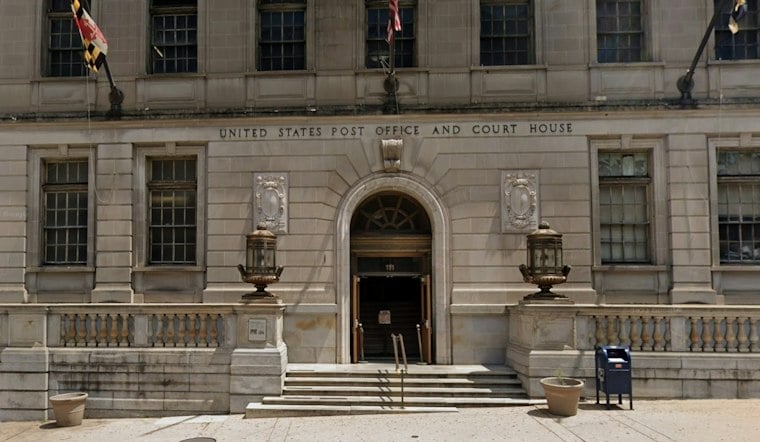
Matthew Harper Jr., 30, is on trial in Baltimore City Circuit Court in connection with the Oct. 7, 2024, killing of Damien Parker, 26. Proceedings entered their third day before Judge Cynthia H. Jones, with testimony scheduled to conclude Sept. 17, according to Baltimore Witness.
The prosecution’s case, as described in charging documents reviewed by Baltimore Witness, includes an alleged connection between Harper and a black Infiniti seen by police two days after the shooting. The documents allege that a pursuit ended in a crash, that Harper ran from the vehicle and discarded a loaded .40-caliber Taurus G2c handgun, and that investigators later linked the weapon to the shooting through DNA and ballistic evidence. Those are allegations, not findings of guilt.
What the witnesses described
The vehicle evidence became a central point of the testimony. A Baltimore police detective described surveillance video and the investigation of the Infiniti, which police located and searched after obtaining a warrant. Investigators found ballistic damage on the vehicle and recovered a password-protected cellphone they could not access, Baltimore Witness reported.
The defense focused on what the investigation did not establish, questioning the detective about the vehicle description, firearms and shell casings, and why investigators did not conduct gunshot-residue testing on the Infiniti or Harper. A forensic scientist testified that three cartridges were recovered at the scene and that portions of the firearm evidence were inconclusive. Defense attorney Jason Ott also questioned her about a firearms report issued in January 2025 and later uploaded to the police department’s database, according to Baltimore Witness.
What forensic evidence can show
Maryland appellate courts have treated challenges to firearms-identification testimony as dependent on the specific record and timing of an objection. In a separate Baltimore City case arising from a November 2019 murder, the Supreme Court of Maryland said the law governing admission of unqualified firearms-identification testimony was not sufficiently clear for plain-error review, underscoring that the ruling did not establish a blanket answer for every criminal trial, according to the Supreme Court of Maryland.
For gunshot-residue evidence, a NIST-hosted OSAC proposed practice distinguishes collecting and preserving organic gunshot residue from analyzing and interpreting it; the practice itself does not cover those latter steps. The Maryland State Police Forensic Sciences Division says its laboratory is accredited by the ANSI National Accreditation Board, licensed by the Maryland Department of Health’s Office of Health Care Quality and operated in conformity with ISO/IEC 17025 requirements, according to the NIST-hosted OSAC proposed standard and the Maryland State Police Forensic Sciences Division.
Harper faces charges including first-degree murder, firearm use in a felony violent crime, carrying a handgun on his person and possessing a handgun in a vehicle in Baltimore City Circuit Court. The trial had been postponed from July 22, 2026, after his lead defense attorney was unavailable because of another trial, according to Baltimore Witness.





