

























































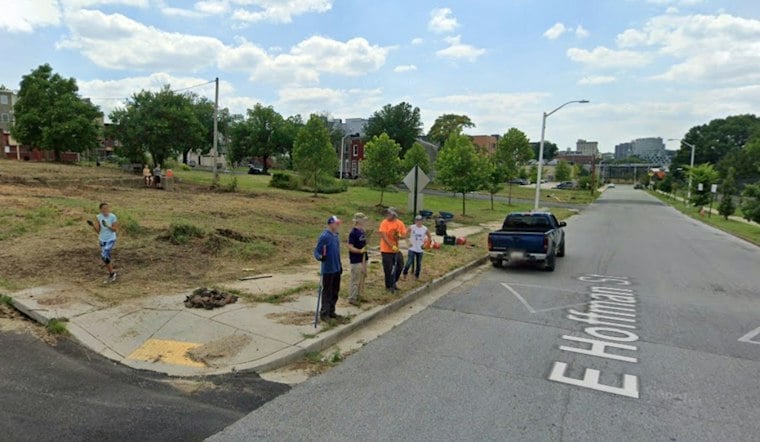
Bags of collards, squash, green peppers, red peppers and hot peppers go out every Thursday from a Baltimore nonprofit that has spent more than a decade turning trash-strewn vacant lots into working farms. The 6th Branch, founded by military veterans in 2010, has now converted more than 23 acres of once-abandoned land into green spaces and urban farms across the city, and none of what it grows is for sale.
According to WBAL-TV, the organization oversees three urban farms that distribute thousands of pounds of free produce every year, harvesting weekly to share with roughly 100 families who live in what the station describes as a food desert. Grace Champion, the 6th Branch's community farming director, oversees the three sites and told the station the work is about more than groceries. “The farms connect people to green spaces and food,” Champion said, per WBAL-TV.
Those three sites — Oliver Community Farm, Johnston Square Farm & Garden, and Broadway East Tree & Berry Farm — form the backbone of the nonprofit's growing operation, according to a profile from ejji.org. The 6th Branch holds a 99-year lease at Oliver Community Farm, the profile notes, giving the group a long-term foothold in land that was once vacant. None of the harvest is sold at these locations; it's all free, and there's no limit on how much produce people are allowed to take home, per the same account.
Growing Kale, Collards and Eggplant on Former Rubble
The farms grow kale, collards, Swiss chard, root vegetables, tomatoes and eggplant, WBAL-TV reports. That harvest has scaled up fast: the group's own website states it doubled its annual food production poundage in both 2022 and 2023 through improved efficiency and holistic management practices. The ejji.org profile puts numbers behind that growth, reporting the nonprofit produced just under 3,000 pounds of produce in 2021, climbing to 6,500 pounds by 2023.
Johnston Square Farm, one of the three main sites, was established in 2019 on three adjacent lots, two of which were previously covered in rubble from demolished row houses, according to a report from the National Wildlife Federation. The site now devotes about 6,000 square feet to pollinator gardens, part of a broader push across the city: since 2023, four partners have established 10 pollinator gardens at six Baltimore sites through the federation's Pollinators and Produce project. Beyond food, the 6th Branch offers programs in food access, canopy development and workforce development, and sells compost and honey, WBAL-TV reports.
'We Don't Enter a Space Unless Invited'
The nonprofit's approach to expansion is deliberate. Curtis Ritz, executive director of the 6th Branch, said the organization does not enter a space unless invited and asked, according to WBAL-TV. The group typically spends about the first year of any project simply listening to what a community needs before breaking ground, the station reports.
Terrell Williams, a Marine Corps veteran and board member of the 6th Branch, described the stakes of that work bluntly. “It is hard to give people hope when trash is all around them,” Williams told WBAL-TV. Johnston Square itself illustrates the shift he's talking about — an area where blocks of homes were once demolished has been transformed into a vibrant space where residents now access fresh produce grown on-site, per the station's report.
From Dumping Ground to Neighborhood Park
Williams pointed to Henrietta Lacks Educational Park as proof the transformation is sticking. He said families now use the park in ways he had not previously seen there, per WBAL-TV. The 6th Branch supported the community-led campaign — alongside BUILD (Baltimoreans United in Leadership Development) — to restore the Johnston Square park, according to a case study from the Neighborhood Design Center.
Before the renovation, the park was overgrown with weeds, littered with trash and broken asphalt, the case study states. Today, green infrastructure built into the redesign captures 230,000 gallons of stormwater annually, according to the same source. The 6th Branch separately describes stewarding 22.5 acres of community-controlled green space across Baltimore on its own website.
The nonprofit's model fits into a wider city strategy. Baltimore's 2019 Sustainability Plan identifies urban agriculture as a way to improve access to land and fresh, culturally appropriate food for historically excluded communities, according to Baltimore's Office of Sustainability. The city had already begun exploring flower farming back in 2014, as part of the Growing Green Initiative, as one way to return vacant lots to productive use, per the same office. For the 6th Branch, that citywide push translates into a simple weekly ritual of farm stands and full bags.





